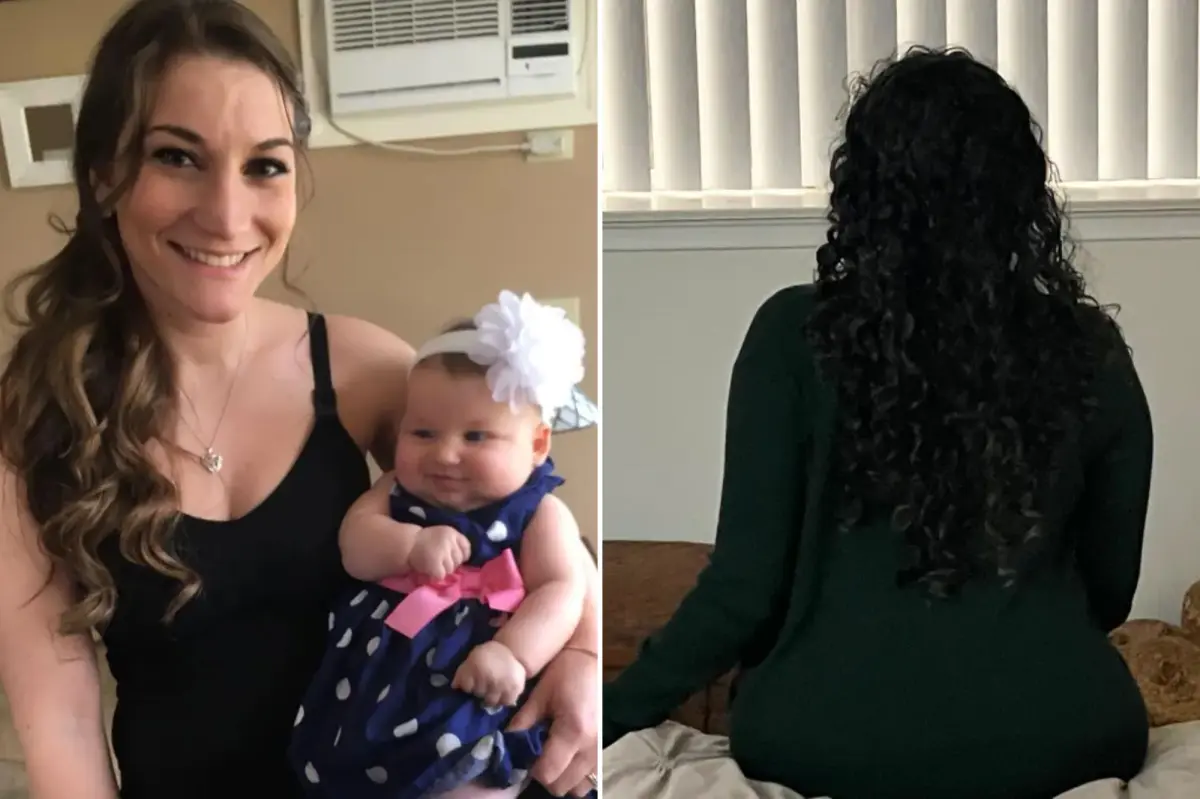

Aaisha Alvi was in a doctor’s office when she says she first heard the chilling order.
“Stab Lina! Stab Lina! Stab Lina!”
In that same moment, she said, a terrifying image flashed through her mind: a long carving knife being driven repeatedly into the chest of her 4-year-old daughter, Lina.
“I didn’t want to do what the voice was telling me, but at the same time, I felt like it was going to make me do it,” Alvi told The Post.
The voice, which no one else could hear, had begun two months earlier, she said, in the aftermath of a miscarriage.
“At that point, I started screaming to the doctor, ‘Just give me something to make this all stop,’” Alvi recalled.
“I don’t want to be locked up,” she pleaded, she said, while anxiously reciting scripture about the sacredness of life. “I’m feeling forced to do bad things to people and to myself.”
Pressed to explain what she meant by “bad things,” Alvi said she could not bring herself to describe them. “I didn’t articulate exactly what they were because it just felt like they were so profoundly evil that I couldn’t,” she remembered. “I just said they were evil things.”
Alvi said the doctor didn’t ask any follow-up questions, deciding she didn’t require hospitalization — and that admitting her would be a very difficult process anyway. Instead, the doctor prescribed medication for panic attacks.
“I did take the medications, but they continued to worsen,” she recalled.
Then, as had happened after four previous appointments with other doctors, she was sent home.
Nearly two decades later, that afternoon still haunts Alvi — not only because it was one of the darkest moments of her life, but because it represented a failure she believes should never have happened.
As the murder trial of Massachusetts mother Lindsay Clancy begins, postpartum psychosis — a rare, severe psychiatric emergency — has thrust a little-understood illness into the national spotlight.
Clancy, 36, has pleaded not guilty to killing her three young children in January 2023 before attempting suicide, leaving herself paralyzed.
Her attorneys are expected to argue that she was suffering from postpartum psychosis, while prosecutors contend the killings were deliberate.
The case has also prompted renewed questions about how postpartum psychosis presents, whether it can be recognized before tragedy occurs and why it is so often misunderstood and stigmatized. Alvi, an author, uses a pen name in her work and does not show her face for this reason.
How could psychosis drive a mom to violence?
For Alvi, that question is painfully familiar.
“I know it can be incredibly hard to believe an illness can make you think and do things you don’t want to do,” she said. “I would never have believed that myself if I had not experienced it.”
She had no reason to think she was at risk, with no history of mental illness before becoming pregnant with her daughter in 2002.
Her pregnancy had been relatively smooth, and she and her husband, Adam, had eagerly prepared a nursery and bought all the popular baby books.
“I experienced visual hallucinations of like corpses, decapitated heads — very, very terrifying things. [I believed] I was in a third dimension, where I would be able to see the devil.”
Aaisha Alvi
But within a week of giving birth, anxiety settled over her with startling intensity. Depression followed. At first, the changes seemed almost explainable — the exhaustion of caring for a newborn, the emotional upheaval of childbirth, the overwhelming responsibility of keeping an infant alive.
Then reality itself began to shift.
She became convinced that members of her family wanted to harm her daughter. And, she recalled, “I started to believe that my baby was not really a baby, but that she was an adult pretending to be a baby.
“The worst symptom for me during that episode of postpartum psychosis was that I believed that my husband wanted to molest our daughter,” Alvi said. “They were delusions, but I didn’t know it at the time. I believed them so sincerely.”
Her husband remembers watching the transformation with growing alarm. Ordinarily, Alvi was deeply connected to her family — but she suddenly withdrew from them. At one point, she suggested they give their newborn daughter up for adoption.
“That’s how I knew something was not right with her,” Adam said.
The delusions eventually drove Alvi to attack him while he was driving them on the highway. “I was just so disgusted by the thought of what I believed he was planning to do to our daughter,” she said. “That’s how strong the beliefs that I had were.”
Despite the dramatic change in her behavior, doctors twice dismissed her symptoms. But four months later, the psychosis disappeared almost as suddenly as it had begun: “I just woke up one day and returned to my previous baseline.”
She had survived an episode of postpartum psychosis without ever learning its name.
When hallucinations take control
For the next four years, Alvi remained terrified of becoming pregnant again. But as time softened the memories, she and Adam decided to try for the second child they had always wanted.
Instead, the pregnancy ended in miscarriage. Grief arrived, then the worryingly familiar anxiety, depression and loss of reality.
She sought medical help immediately, multiple times, explaining to each provider that something was terribly wrong. Again and again, she was told she was grieving.
But, she recalled, “My symptoms kept worsening.”
Within weeks, the illness had progressed beyond anything she experienced after her daughter’s birth.
“I clearly expressed that I felt like I was hearing a voice,” said Alvi. “I told them I felt like I was being forced against my wishes to do evil things to others.”
The voice, which she described as sounding like a “very aggressive, angry man,” drowned her own thoughts, issuing horrifying commands.
“I experienced visual hallucinations of like corpses, decapitated heads — very, very terrifying things,” remembered Alvi. “I had gotten to the point of believing I was in a third dimension, where I would be able to see the devil.”
What terrified her most was the growing realization that she could no longer trust herself to know what was real.
“I began hearing command hallucinations, which were ordering me to stab my daughter to death,” she said. “I did not want to in any way harm my daughter. That’s why I was actually at the doctor, because I was looking for help.”
Her husband’s frustration grew with every appointment. He watched his wife stop eating. She barely slept. She lost interest in the daughter she had once doted on.
Only a few days into Alvi’s second bout of postpartum psychosis, her mother insisted she move into her home so she wouldn’t be left alone while Adam worked. He readily agreed.
“I could so clearly see something was wrong with her,” he remembered.
Why postpartum psychosis so often gets missed — even by doctors
Stories like Alvi’s illustrate why postpartum psychosis remains one of the most challenging psychiatric emergencies to recognize, Dr. Uruj Haider, a perinatal psychiatrist and medical director of MCPAP for Moms, told The Post.
Similar to postpartum depression, postpartum psychosis symptoms can wax and wane. “The women may be coherent and appear even normal one minute, but a couple of minutes to hours later, they may be very confused, and in rare cases, floridly psychotic,” explained Haider.
However, postpartum psychosis is the only postpartum condition marked by extremely rapid clinical deterioration, meaning it can onset suddenly within days of giving birth, causing hallucinations, delusions and bizarre behavior, similar to Alvi’s experiences.
Hallucinations are also not always present at the outset, and early warning signs — including severe insomnia, confusion, irritability, disorganized thinking and unusually rapid speech — can easily be mistaken for exhaustion or anxiety.
“There is a spectrum of psychotic symptoms, and the signs and symptoms can be very subtle, so I refer to these as pink flags” said Haider. “Examples of pink flag signs may be irritability, disorganization, disorientation or confusion and rapid speech.”
Although postpartum psychosis affects an estimated 1 to 2 women per 1,000 births, roughly half of cases have no previous psychiatric history, making it difficult for families and even clinicians to anticipate. The highest-risk period is generally within the first several weeks after childbirth, when profound sleep disruption and hormonal changes coincide.
For Alvi, the breakthrough came only after she found a perinatal psychiatrist familiar with postpartum psychosis.
Unlike the brief appointments Alvi had grown accustomed to, the evaluation lasted about 90 minutes.
And for the first time, someone recognized the illness Alvi had spent years trying to describe. She was diagnosed with postpartum psychosis and prescribed “the tiniest possible dose” of an antipsychotic medication.
Getting help
The change was almost immediate.
“I repeatedly called my psychiatrist over the course of a week, and she increased the dosage of antipsychotic medication from one pill to 10 pills a day,” recalled Alvi. “It was at that point that my psychosis broke.”
The hallucinations receded. The delusions loosened their grip. Within a few months, she was well enough to stop taking the medication.
“The fact that I could get better so fast is just so damning,” said Alvi. “If my doctor had not spent the time that she spent with me, I would not be alive today, and my daughter would not be alive today.”
Nearly 20 years later, she has never experienced another episode of psychosis outside the postpartum period. That recovery, she believes, is one of the most important parts of her story.
Public attention often focuses on the most tragic outcomes associated with postpartum psychosis. Far less attention is paid to the fact that the illness is treatable when recognized and caught early, particularly with specialized psychiatric care.
“The goal of treatment is to achieve full symptom control while minimizing adverse effects through careful monitoring and medication adjustments,” said Haider. “This includes using the lowest effective dose that maintains stability, regularly assessing symptoms and side effects and tailoring treatment to each patient’s clinical history, risk factors and reproductive goals.”
“That’s the most sad part about Lindsey Clancy’s story and my situation. We were not hiding our symptoms. We did all the right things.”
Aaisha Alvi
But because postpartum psychosis is uncommon, many frontline clinicians may encounter very few cases during their careers.
“If there’s any concern from the patient, the partner or family members, get that mom connected to a psychiatric clinician as soon as possible,” she advised. “If they are actually actively psychotic or manic, then get them to the ER and make sure the baby is being taken care of and with family.”
Lindsay Clancy’s story
Today, Alvi spends much of her time trying to ensure other women and families recognize what she could not.
She speaks publicly about postpartum psychosis, volunteers with maternal mental health organizations and wrote the memoir “A Mom Like That: A Memoir of Postpartum Psychosis,” hoping to give language to an illness that feels unspeakable for many women.
She published under a pen name because postpartum psychosis remains so misunderstood and stigmatized that many women who have experienced fear being judged or criminalized.
As the Clancy trial unfolds, Alvi hopes public attention extends beyond the courtroom. Whatever the legal outcome, she wants families, physicians and policymakers to come away with a better understanding of postpartum psychosis — and a greater sense of urgency.
“That’s the most sad part about Lindsey Clancy’s story and my situation,” said Alvi. “We were not hiding our symptoms. We did all the right things. We sought out care multiple times from the systems meant to help and protect us.”
She hopes one day those conversations begin much sooner, not just after a tragedy. And that the healthcare system is prepared to listen.
Because Alvi knows, perhaps better than most, how much can depend on being heard the first time.
“I don’t want what happened to me to happen to anyone else.”
If you or someone you know is or may be struggling with postpartum mental health issues, contact a medical professional and visit postpartum.net