
Share this @internewscast.com
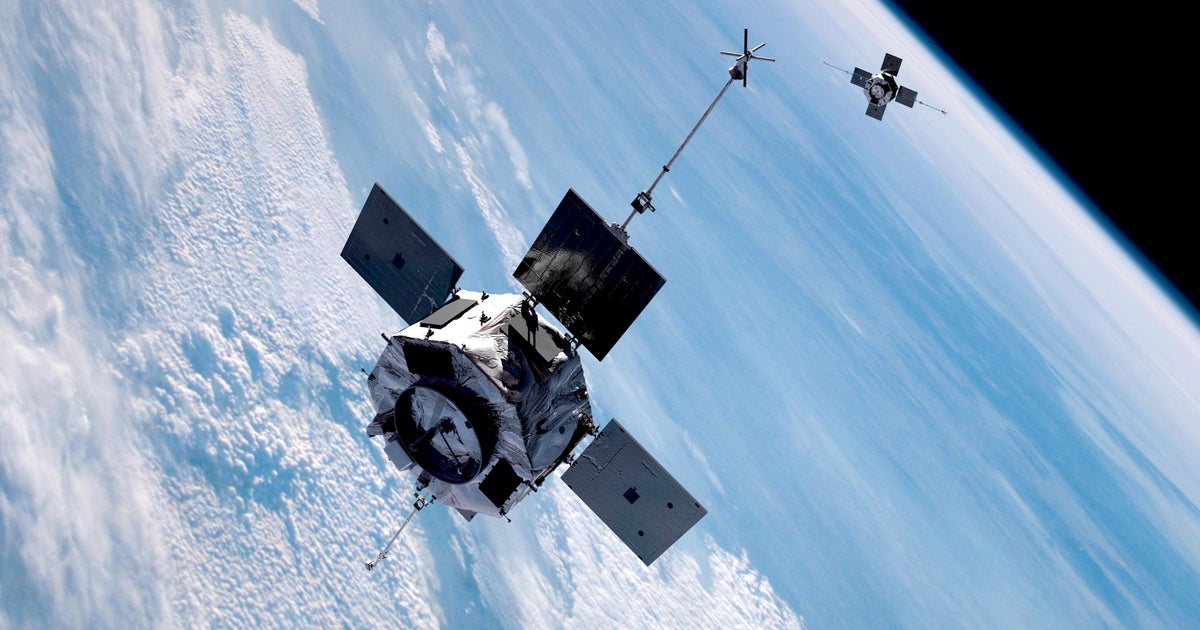
A NASA spacecraft weighing approximately 1,300 pounds is on course to make its return to Earth’s atmosphere, marking nearly 14 years since its mission commenced.
The U.S. Space Force has recently indicated that the Van Allen Probe A, which was launched back in August 2012, is projected to re-enter Earth’s atmosphere around 12:03 a.m. Eastern Time on Wednesday.
Earlier estimates from NASA, based on information from the U.S. Space Force, had suggested the probe might re-enter around 7:45 p.m. ET on Tuesday. However, there was an acknowledged uncertainty margin of about 24 hours.
As the probe descends, NASA anticipates that the majority of it will disintegrate upon re-entry. Nonetheless, certain components might endure the journey. The agency has assessed the likelihood of anyone on Earth being affected by the debris as 1 in 4,200, emphasizing that the risk is minimal.
The probe, along with its counterpart, Van Allen Probe B, was deployed to investigate Earth’s constant radiation belts and study the dynamics of particle gain and loss within them. These regions, identified as the Van Allen belts, are composed of charged particles confined by Earth’s magnetic field, offering protection against cosmic radiation, solar storms, and solar wind.
Originally intended to last two years, the mission impressively extended to nearly seven years, as reported by NASA. Typically, missions to these belts are brief to reduce exposure to the hazardous radiation present.
The Van Allen probes were the first that were meant to spend a significant amount of time in the region, NASA said, and broke all records for spacecraft to function there.
HUM Images/Universal Images Group 
The probes made a number of discoveries during their seven years in operation, NASA said. They collected the first data showing the existence of a third radiation belt that can form during times of intense solar activity, and their observations have been the subject of hundreds of publications, according to NASA.
The mission ended in 2019, when the probes ran out of fuel and could no longer orient themselves toward the sun. An analysis by mission specialists found the probes would likely re-enter Earth’s atmosphere in 2034, but the current active solar cycle has triggered intense space weather events and increased atmospheric drag on the spacecraft, pulling them in faster than expected.
Probe B is not expected to re-enter Earth’s atmosphere until the 2030s.