
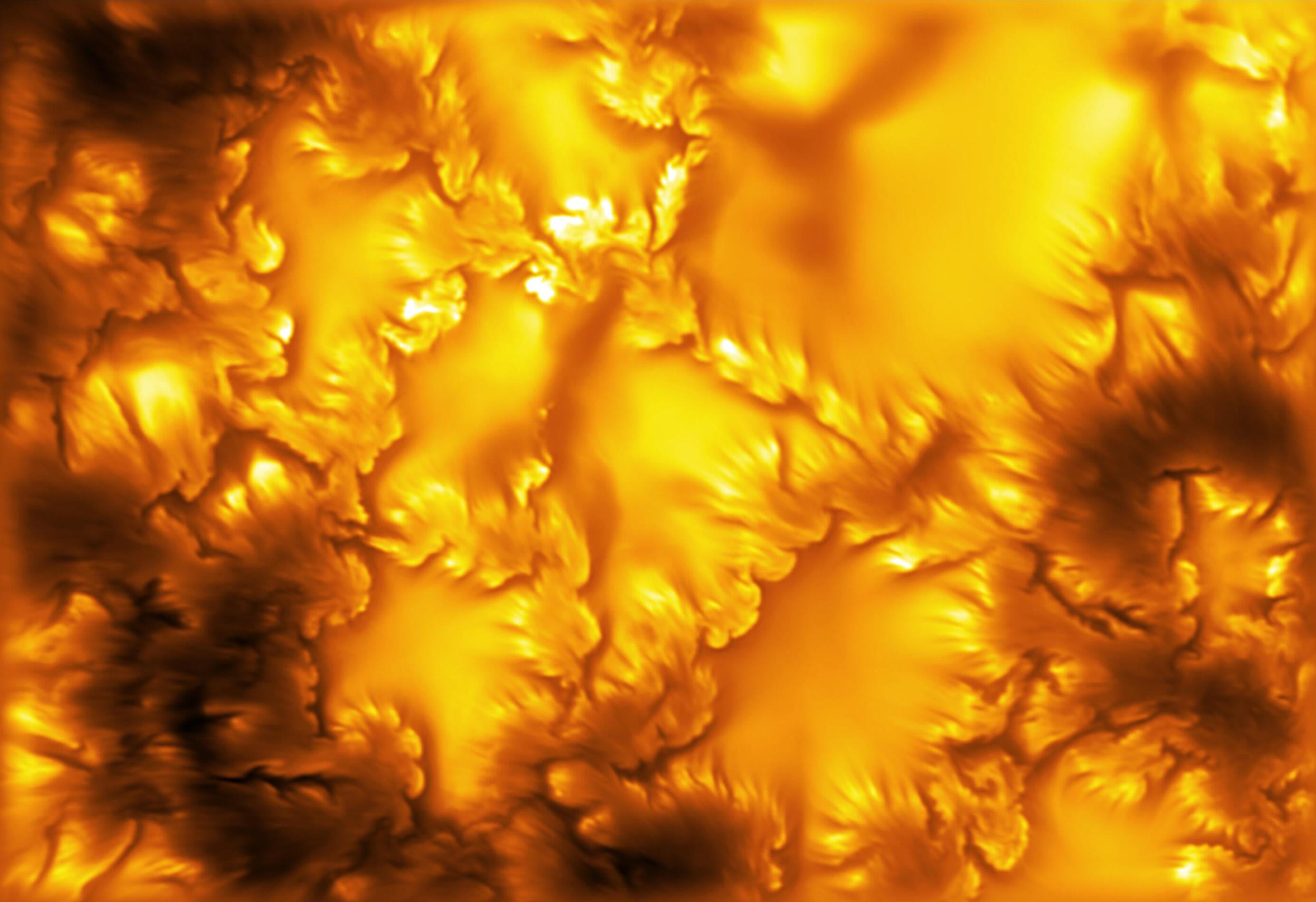
Scientists have released the sharpest images ever taken of the sun’s surface, exposing an eerie, constantly shifting face of our nearest star in unprecedented detail.
Staring at the sun without proper eye protection can cause serious damage. Researchers, however, were able to examine its blistering surface safely using the National Science Foundation’s Daniel K. Inouye Solar Telescope on Maui, Hawaii.
The images were not originally intended to make a major solar discovery. Scientists captured them while calibrating the telescope and pushing its capabilities. But once they reviewed the data, they found they had recorded the sun’s bright outer layer at a higher resolution than anyone had achieved before.
Even more striking were the unusual, feather-like patterns seen rippling across the solar surface.
The images “reveal a solar landscape unlike any that had been seen before, uncovering small-scale and dynamic swirls everywhere at the edges of magnetic areas,” the NSF’s National Solar Observatory said in a news release.
National Science Foundation National Solar Observatory via AP
“That reminds me of famous paintings, like the swirling skies in Van Gogh’s Starry Night,” said Ruizhu Chen, a solar physicist at Stanford University who was not involved in the research.
What researchers were seeing were ripples of instability created as streams of magnetized plasma slid past one another at different speeds. The effect is much like the waves that form when wind sweeps across water. Scientists know the process as Kelvin-Helmholtz instability, or KHI, a fundamental phenomenon that helps explain the motion of fluids.
KHI has been observed on Earth and on planets including Jupiter and Saturn. But according to study co-author Friedrich Wöger of the National Solar Observatory, “it has not been observed ever at that level on the solar surface.”
Dr. David Boboltz, deputy director at the National Solar Observatory, said the discovery, “backed up by analysis of numerical simulations, is a major step forward in our understanding of the dynamics and evolution of solar and stellar plasma, and will serve as a basis for future discoveries.”
The findings were published Wednesday in the journal Nature.
Scientists are curious about the sun’s inner workings to better track massive bursts of energy called coronal mass ejections that can hurl toward Earth. When they hit, they can trigger solar storms, potentially scrambling GPS communications and producing colorful auroras.
“To understand the dynamic space weather that affects Earth, we have to see the small-scale processes driving it,” said Dr. Jacqueline Keane, NSF program director for the National Solar Observatory. “For decades, seeing these vortices at such tiny scales remained elusive. By pairing a massive four-meter mirror with state-of-the-art optics and instruments, the NSF Inouye Solar Telescope delivers the resolving power needed to reveal these ultrafine details for the first time, enabling discoveries that were once beyond our reach.”