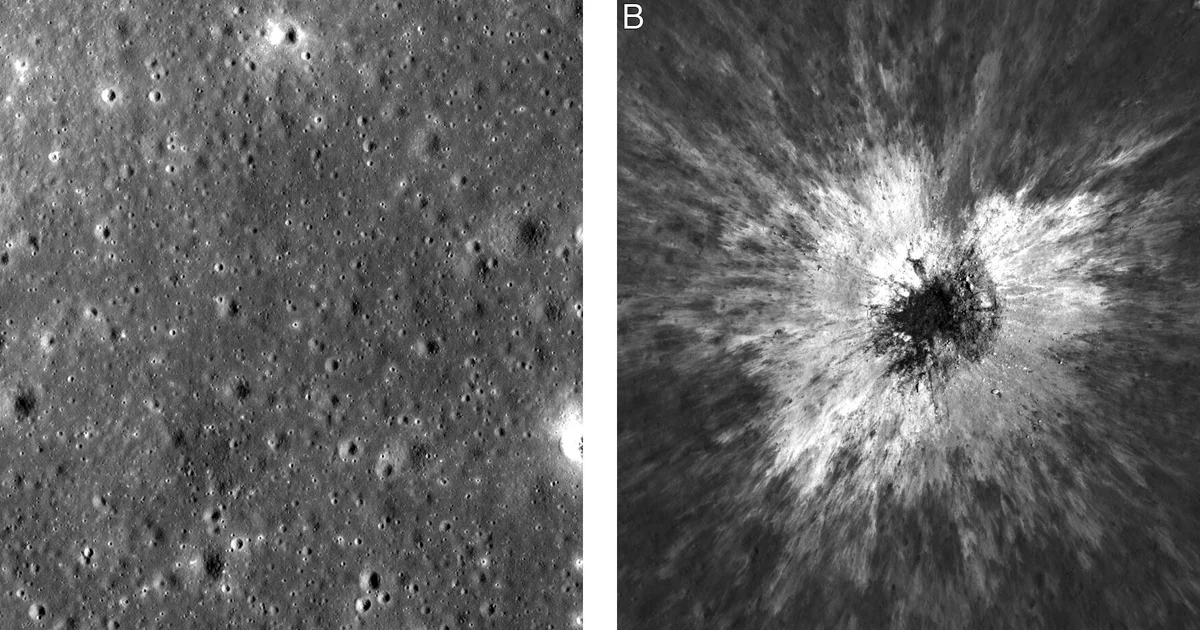

Scientists have identified a newly formed lunar crater larger than Rome’s Colosseum, created by a powerful impact that went unnoticed for nearly a year.
The steep-walled crater is about 728 feet wide—roughly the length of two football fields—and reaches depths of up to 141 feet, or the height of three yellow school buses stacked vertically, NASA said. It is the largest known impact crater formed anywhere in the solar system in recent times.
Researchers estimate that an impact of this magnitude occurs only about once every 132 years. That makes the discovery especially valuable as NASA prepares for future astronaut missions and the construction of a lunar base.
“This event constitutes a statistically rare, effectively once-in-a-lifetime observation,” scientists wrote in one of two studies published Wednesday in the journal Science Advances.
NASA/Goddard Space Flight Center/Intuitive Machines via AP
NASA’s Lunar Reconnaissance Orbiter detected the crater on the moon’s near side sometime between April 11 and May 22, 2024. It formed when a fragment from an asteroid or comet—estimated to be the size of a three- to six-story building—slammed into the lunar surface. Telescopes on Earth and in space did not detect the impact as it happened.
The LRO’s initial wide-angle images remained buried in a massive backlog of data until August 2025. The spacecraft captured higher-resolution images the following fall, and researchers confirmed the crater’s discovery early this year.
Named for the late Thomas McGetchin, a former director of Houston’s Lunar and Planetary Institute, the crater is three times wider than the previous record-holder discovered by the LRO a decade ago. The moon, marked by impacts dating back billions of years, is home to some of the solar system’s largest craters, including one spanning more than 1,500 miles.
The new impact disturbed the lunar surface across an area extending more than 66 miles. Dust and rock were thrown outward at a steeper angle than scientists expected, said Mark Robinson, chief scientist for the LRO’s cameras at Intuitive Machines and lead author of one of the studies.
Another study found a cold region about 4 miles wide surrounding the crater, a sign that the moon’s uppermost soil had been loosened. David Paige, a study co-author at the University of California, Los Angeles, compared the process to gardening.
“We’re now thinking of impacts as a way to garden the regolith — churning the sediments and putting stuff above that’s usually below the surface,” Paige said in a statement.
NASA’s Lunar Reconnaissance Orbiter has been circling the moon since 2009, providing detailed views of the surface as the agency works toward returning astronauts. The orbiter’s many crater discoveries indicate that ejected material overturns the moon’s top inch of soil roughly every 80,000 years—more quickly than previously believed, according to Robinson.
That finding also challenges the idea that the dusty footprints left by Apollo astronauts will remain forever. They will “definitely be long gone in that time frame,” Robinson said in an email.
Researchers now plan to assess the risk that debris from future impacts could hit NASA’s proposed lunar base, Robinson said. “That information will help engineers harden structures so one won’t have to worry about damage, or maybe worry less.”


