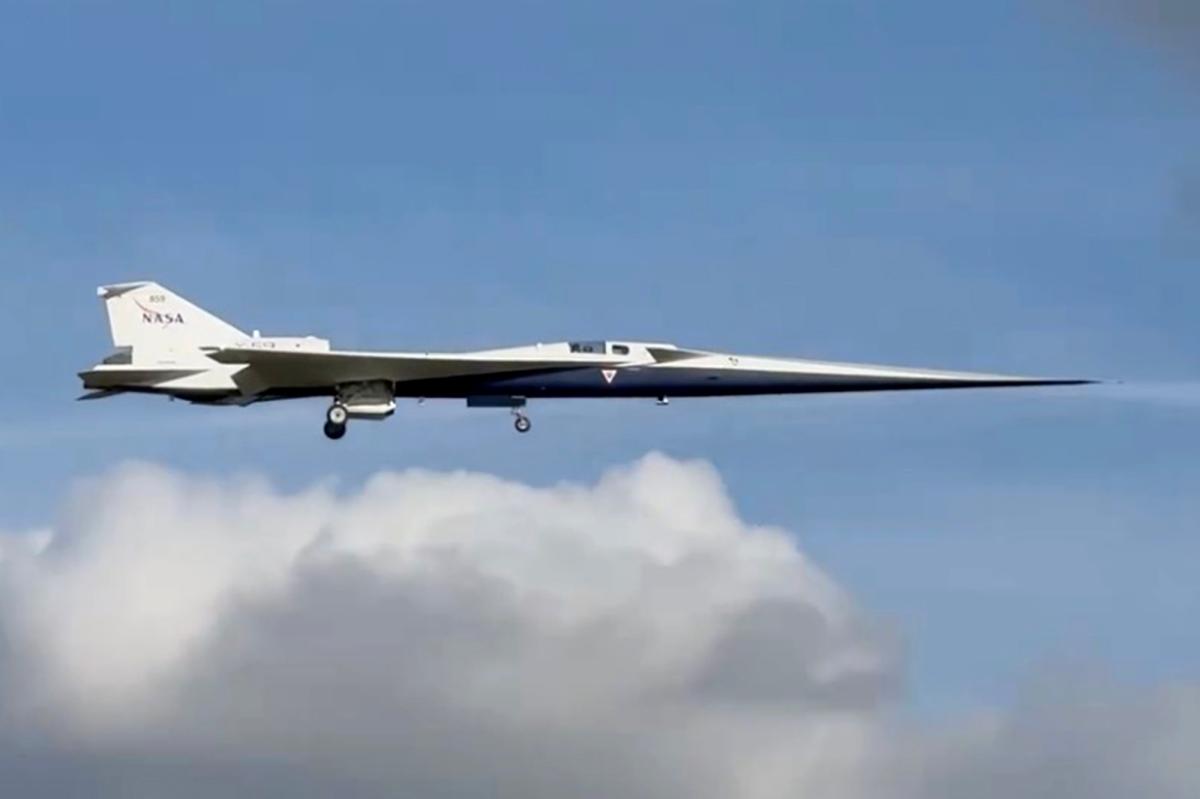

NASA’s experimental X-59 QueSST marked its first year in the air with a flight to Kennedy Space Center, logging 41 flights and reaching a speed that could eventually slash long-haul travel times in half.
The needle-nosed aircraft, often nicknamed the “Son of Concorde,” is built for speed. NASA says the X-59 is designed to reach 925 mph—Mach 1.4—while cruising at 55,000 feet, more than twice the altitude and nearly twice the speed of a conventional passenger jet.
But speed is not the aircraft’s most groundbreaking feature.
QueSST stands for “Quiet SuperSonic Technology” — and its design turns the deafening “sonic boom” created by supersonic flight into much more manageable “glide thump.”
If the design can be scaled up into a passenger plane, it could allow supersonic flight to return to the continental US and other populated areas.
The jet would be capable of completing a trip from New York City to London in just 3.5 hours. New York to Los Angeles — usually 5 to 6 hours — would be cut to just 2.5 hours.
The US has not had commercial supersonic flights available since the Concorde, which was scrapped in 2003 due to high costs, limited seating, and a lack of interest from the public following a fatal crash in 2000.
The X-59 was recorded leaving its California base last week, and it was spotted landing at Fort Worth, Texas, on Oct. 28.
Viral video quickly spread of the X-59, with its unique shape, flying over the Lone Star State, with NASA chief Jared Isaacman confirming on X that the jet was en route to the Kennedy Space Center in Florida.
The footage, taken by Victoria Fontana, shows the supersonic plane flying over Fort Worth accompanied by one of NASA’s F-15s.

The sighting came exactly one year after the X-59 first took to the skies at Lockheed Martin’s Skunk Works facility, in Palmdale.
The high-tech X-59 flies as the centerpiece of the space agency’s QueSST (Quiet SuperSonic Technology) mission to produce a quieter sonic boom, with the jet designed in such a way that it softens the blow when it breaks the sound barrier.
The cost of the X-59 program is estimated to be $630 million.