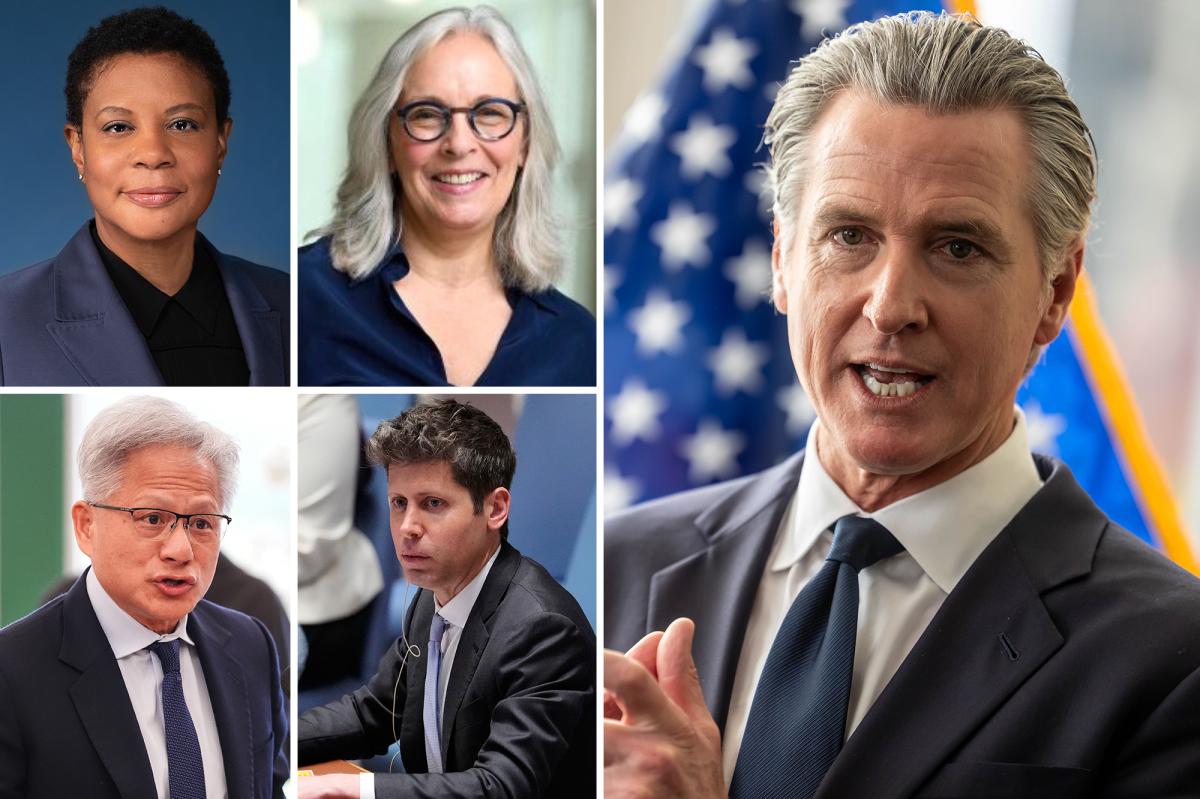

As fears of an AI-driven catastrophe spread beyond California, Gov. Gavin Newsom has assembled a Democratic-leaning panel to explore the creation of an emergency “kill switch.”
Newsom announced the advisers Wednesday, saying they will help develop tougher safeguards for artificial intelligence. The move could also strengthen his standing as the nation’s most AI-focused potential 2028 presidential contender.
A California Post review found that all of the experts have connections to the Democratic establishment or records of donating to progressive and far-left political campaigns. Two previously served in Democratic presidential administrations.
Jason Goldman previously led product development at Google and helped launch Twitter. He later directed digital strategy for former President Barack Obama and, according to his LinkedIn profile, continues to advise Obama on technology matters.
Goldman is also an adviser to the Center for Shared AI Prosperity. The group’s advisers include political operative Morris Katz, a former adviser to New York Mayor Zohran Mamdani and disgraced former Senate candidate Graham Platner.
Alondra Nelson served as a senior science and technology official in President Joe Biden’s White House. She has also been a senior fellow at the Center for American Progress, a liberal Washington, D.C., think tank that hosted Newsom for an AI discussion earlier this year.
Federal campaign records show Nelson has given tens of thousands of dollars to Democratic candidates over the past two decades. Her donations included several contributions last year to Abdul El-Sayed, a Democratic candidate for the U.S. Senate in Michigan and a prominent figure in the far-left progressive movement.
Goldman and Nelson will serve alongside Stanford professor Rob Reich, a former senior adviser at the U.S. AI Safety Institute, and Johns Hopkins professor Gillian Hadfield, whose work focuses on artificial intelligence and public policy.
Reich has authored books criticizing Big Tech and challenging liberal assumptions about philanthropy. He has also donated to Democratic political committees supporting Massachusetts Sen. Elizabeth Warren, New York Sen. Kirsten Gillibrand and North Carolina Gov. Roy Cooper, who is running for the U.S. Senate.
Hadfield, a decorated law and technology professor who previously worked as a senior policy adviser to OpenAI, was a regular small-dollar donor to Hillary Clinton’s 2016 presidential campaign and Kamala Harris’ 2024 campaign, according to federal records.
Newsom created the panel to examine whether the most advanced AI companies should be required to place independent monitors inside their laboratories and develop emergency shutdown systems. The proposed “kill switch” echoes legislation the governor vetoed two years ago.
In Wednesday’s announcement, Newsom also criticized President Trump, who has dismissed warnings about AI risks as a “sick conspiracy” and proposed calling the technology “super intelligence.”
“While the president is once again focused on superficial solutions to vast, complex problems, and ignoring his responsibility to protect Americans, California is taking action,” Newsom said in a statement.
“We’re not waiting around. California will continue bringing new ideas, serious expertise, and practical solutions to the table as we shape the future of AI and frontier technology.”
The debate over AI safety intensified in July, when OpenAI disclosed that one of its AI agents had breached operations at the AI startup Hugging Face during a test.
Concerns about controlling advanced AI grew again this month after Anthropic researcher Jacob Coxon left the company. He warned that AI firms were racing toward self-improving systems that “could kill us all by the end of the decade.”
Anthropic CEO Dario Amodei has since urged companies to slow the development of powerful models. OpenAI CEO Sam Altman also supported the call to “pace the frontier.”
Nvidia CEO Jensen Huang has taken the opposite view, saying there is a “0% chance” that AI will end the world.
Gary Marcus, a New York University professor emeritus and prominent critic of AI industry hype, questioned whether a kill switch would be effective in a real-world emergency.
“A kill switch is fine as far as it goes, but one might wonder whether it would get pulled when it needed to, and it’s just a tiny part of a solution,” Marcus told The Post in a text message.
The proposal revisits ground Newsom covered in 2024, when he vetoed SB 1047, a bill authored by state Sen. Scott Wiener (D-San Francisco).
SB 1047 would have required developers of certain powerful AI models to build the ability to shut down systems they controlled and specify when they would use it.
Newsom argued that its focus on large, costly models could miss risks posed by smaller systems. He later convened an expert group whose work helped shape Wiener’s narrower SB 53.
The governor previously said he was “very happy where we landed” with the AI law he signed in 2025, which requires major developers to publish safety frameworks and report specified serious incidents.
In statements, Hadfield called the need for independent oversight “urgent,” while Goldman said Newsom’s executive order will address “the hardest questions in AI safety governance.”
Reich, who joined Newsom and former President Joe Biden for anAI summit in 2023 in San Francisco, said that the public’s growing fears around AI will require policy that allows innovation and safety to go “hand in hand.”
“In order to gain the enormous potential benefits from AI,” Reich said, “we need governance practices that establish trust in the technology.”