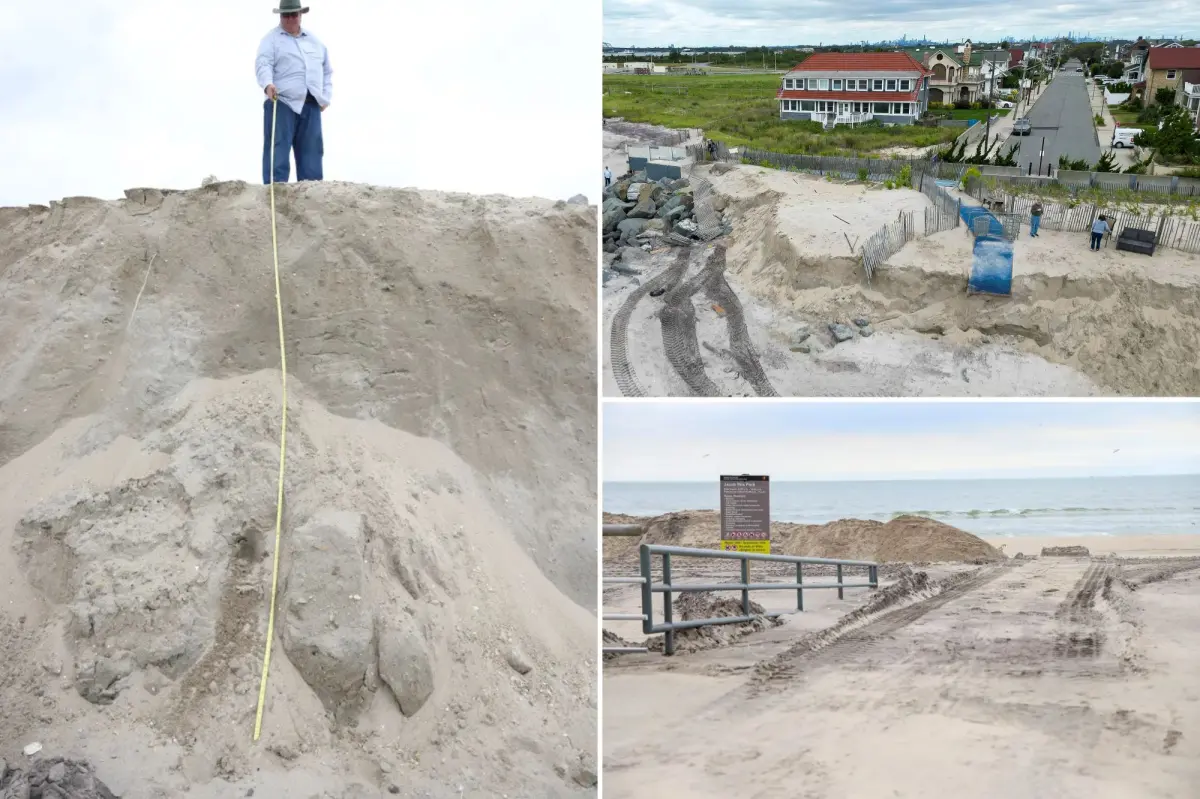

This weekend’s deadly nor’easter stripped away massive sections of the Rockaway shoreline, leaving parts of Queens’ coast resembling the rugged cliffs of Ireland.
At Jacob Riis Park, the storm tore through the city beach, creating hazardous drop-offs and winding trails of dark sand that revealed how violently the tides surged—at times reaching the level of nearby streets.
“The beach is pretty much gone,” a Parks Department employee told The Post Tuesday, speaking on condition of anonymity as crews started bringing in replacement sand to repair the damage.
“All the sand here was taken away and ended up down there by Breezy Point. So they’re all really happy in Breezy Point — they just got a lot of sand delivered,” he said.
The worker gestured toward a line of wooden jetties along the water, explaining that the structures had been buried beneath the beach until the powerful waves swept away the sand covering them.
A single stone jetty at the federal park helped prevent one section of the shoreline from being washed away entirely, the employee said.
Waves surged over the jetty at Beach 149th Street and pushed inland, carving a towering sand escarpment from a dune pile. The Post measured the cliff at about 14 feet high.
Sand residue on the railings near the local bathhouse suggested that the storm surge climbed as high as 26 inches while waves pounded the boardwalk.
John Thuilot, 18, of Belle Harbor, said he experienced the storm’s force firsthand after joining a group of thrill-seeking surfers in the water Saturday.
“I was standing on a sandbar a ways out, and I felt the entire sandbar get pulled out from under my feet and just disappear,” Thuilot said.
By Tuesday, Riis Park had taken on the appearance of a major construction site, a stark contrast to the calm beach that had attracted thousands of visitors only weeks earlier.
“It definitely looks different! You used to be able to walk through there by the jetty,” said Hazzard Ho, 32, who was stunned to discover that he could no longer cross the beach with his Labrador mix, Chef.
“Now it just stops where that cliff is,” Ho said.
The extent of the erosion differed from one part of the shoreline to another. One resident said nearly 30 feet of beach had vanished about four miles east of Riis Park.
“If it wasn’t for the new stone jetty, [the storm] would have taken most of the beach,” said Steve Closs, a retired FDNY lieutenant who lives near Beach 80th Street.
“The beach is almost totally gone,” said Closs, a former Bravest, as he questioned how long it might take to restore the battered shoreline.
Riis Park is managed by the National Park Service, while the beaches beside nearby residential communities fall under the city and the US Army Corps of Engineers. That divided oversight has frustrated residents for years as they campaign to remove the aging wooden jetties they say are ineffective and dangerous.
City Councilwoman Joann Ariola described the severe coastal erosion as a “tremendous cause for concern.”
“We can’t put this off and have work impact the summer season, nor can we leave residents unnecessarily vulnerable throughout the rest of storm season,” said the Republican, urging the city’s Emergency Management department and the US Army Corps of Engineers to inspect the area without delay.
“Work needs to be done now, with clear timelines in place so that residents can be safe for any storms that follow this one, and Summer 2027 isn’t impacted next year,” she said.
It’s not yet clear just how much sand was lost or how much it will cost to replenish the shores.
A 2013 project allocated a jaw-dropping $26.4 million to restore roughly 3.5 million cubic yards of sand lost during Sandy.
The Corps of Engineers told The Post it is currently assessing the situation to “put together a plan.
“It’s important to note that this project did suffer sand loss, but that also means it performed as intended by mitigating impacts from coastal flooding to the communities, reducing damage to infrastructure and property,” a rep said.