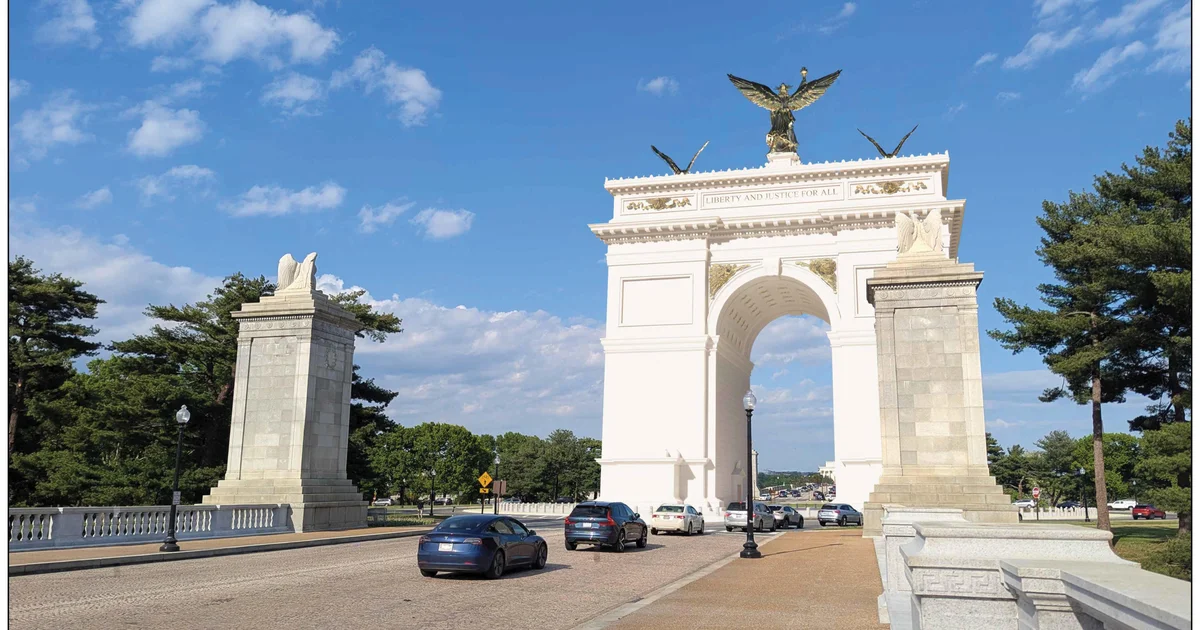
President Trump’s proposed 250-foot Triumphal Arch would need design changes before it could receive final approval, the National Capital Planning Commission said Thursday, even as the panel voted to give the project preliminary approval.
The planned Memorial Circle monument includes a 166-foot mezzanine, a 24-foot observation deck and a 60-foot statue of Lady Liberty at the top. According to the commission, that design would conflict with the 1910 Heights of Buildings Act, a law intended to protect Washington, D.C.’s skyline by limiting structures to 130 feet. In a June memo, the Department of the Interior argued that the law “does not apply to federal buildings.”
The NCPC pushed back on that interpretation, saying it “has historically held that the Height of Buildings Act is binding on federal buildings, and NCPC has consistently applied that position.”
As a potential solution, the commission recommended reducing the mezzanine to 130 feet and the observation level to 20 feet. The 40 feet removed from those elements could instead be incorporated into the statue, making Lady Liberty 100 feet tall while keeping the full height of the arch at 250 feet.
If built as currently envisioned, the arch would tower over the 99-foot Lincoln Memorial located across the bridge. It would also stand about 30 feet higher than Mexico City’s Plaza de la República, which is currently considered the tallest arch in the world.
The proposal has drawn strong public opposition, much of it evident during more than an hour of testimony at the commission meeting. Speakers raised concerns ranging from the review process to the monument’s cultural message, with several arguing that blocking views of Arlington National Cemetery would be deeply inappropriate.
“My concern is not with commemoration itself, but with this specific proposal, its location, its scale, and its impact on a historic memorial landscape,” said Cynthia Morrison, a Gold Star mother. “The open space between the Lincoln Memorial and Arlington National Cemetery is not just empty land. It is deliberately designed and historically significant memorial vista.”
Michael Lemmon, a Vietnam veteran and a plaintiff in the lawsuit challenging the arch, called for “a careful review by concerned stakeholders,” including local residents, veterans, historians and lawmakers. He also warned that the monument could interfere with ceremonies, burials and visits at Arlington National Cemetery.
“As a combat veteran, I feel a duty to protect the memory and honor the sacrifice of my comrades and all those buried there,” Lemmon said, “This vainglorious monumental arch does neither.”
A majority of the commission voted in favor of approving preliminary site plans for the arch.
While the commission, chaired by Trump White House aide Will Scharf, did not pose any substantive challenges to the arch, it did leave a few stipulations.
Critics of the arch have also expressed concerns about the flight path to nearby Ronald Reagan National Airport.
Any recommendations by the Federal Aviation Administration must be incorporated, and the FAA still needs to conduct a full aeronautical study before construction.
The NCPC is asking for revisions to plans for pedestrian accessibility and lighting, as well. The commission is concerned the 32 proposed traffic poles will create clutter and about the brightness from eight 14-to-20-foot tall stanchions.
There is no date set for final review of the site and building plans. According to National Park Service documents filed to the federal registrar last month, federal officials are seeking an aggressive work schedule that would require 20 hours a day of construction over two years.
While many of D.C.’s monuments are constructed in natural stone such as marble and limestone, the arch is set to be built from concrete and finished with granite.