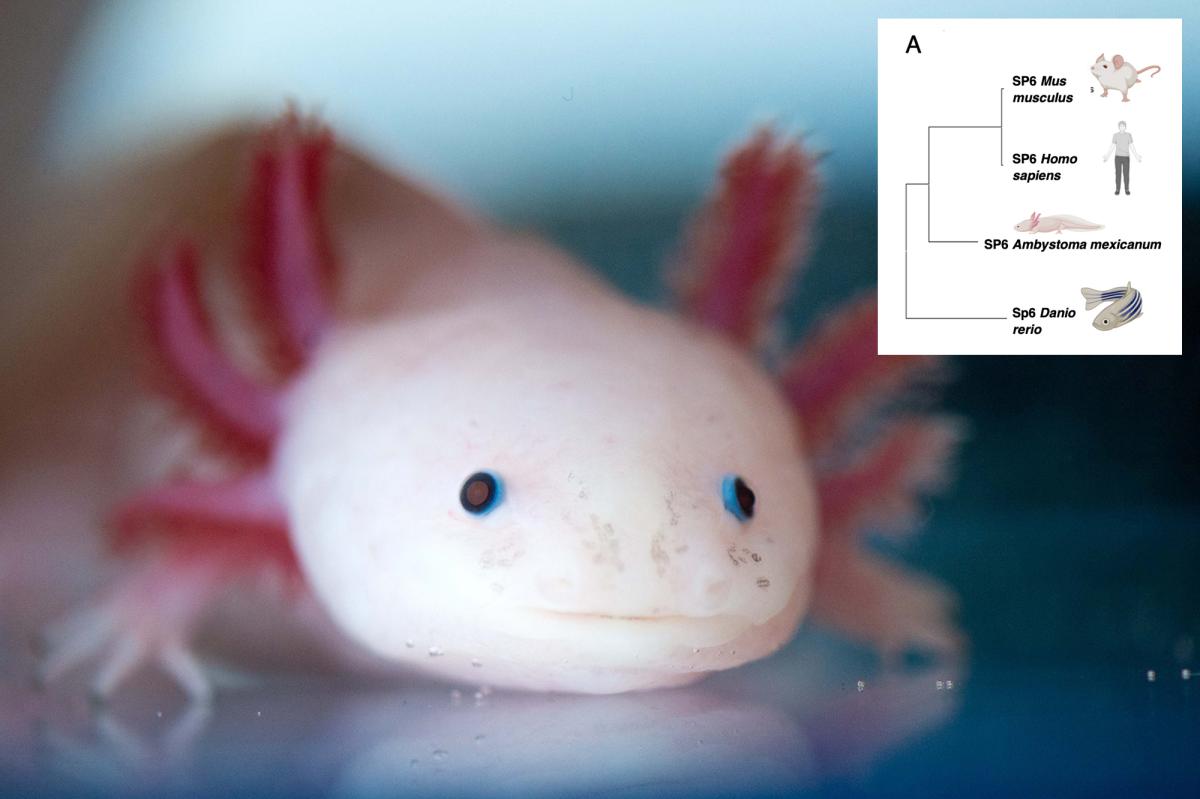


While it might seem like something out of a sci-fi novel, scientists have potentially made a groundbreaking advance towards a future where amputees could regenerate their own limbs.
In a study involving axolotl salamanders, zebrafish, and mice, researchers have identified a powerful group of genes that appear to be key players in the process of regeneration.
This discovery, detailed in the Proceedings of the National Academy of Sciences, could pave the way for developing therapies aimed at regenerating human tissue, bones, and even entire limbs.
“This pivotal research united three laboratories to examine regeneration across different species,” explained Josh Currie, a biologist at Wake Forest University whose work focuses on the Mexican axolotl salamander, as reported by Science Daily. “It revealed that there are overarching genetic programs driving regeneration in vastly different organisms like salamanders, zebrafish, and mice.”
The collaborative study also featured David A. Brown, a plastic surgeon at Duke University who investigates digit regeneration in mice, and Kenneth D. Poss from the University of Wisconsin-Madison, who specializes in fin regeneration research in zebrafish.
Axolotls, a unique species of salamander, are renowned for their remarkable ability to regenerate not only limbs but also tails, spinal cord tissue, and sections of organs such as the heart, brain, lungs, and liver.
Zebrafish can repeatedly regrow damaged tail fins. Their bodies are also capable of repairing the heart, brain, spinal cord, kidneys, retinas and pancreas.
Mice were included because, like humans, they’re mammals. Mice can regenerate the tips of their digits, and humans can sometimes regrow fingertips if the nailbed remains intact after injury, allowing skin, flesh and bone to regenerate.
The stars of the study were two genes called Specificity Protein 6 or SP6 and SP8. Scientists discovered that when these genes switched on, animals were able to trigger extraordinary healing abilities.
But when researchers used the gene-editing tool CRISPR to remove SP8 from axolotls, the animals suddenly lost the ability to properly regrow limb bones.
The same thing happened in the mice. Then, using new DNA-altering technology, they partially restored bone regrowth in mice that had lost their regenerative powers.
The exciting conclusion was that the same technology may apply the same genetic changes in humans.
Around the world, more than 1.5 million amputations occur every year, according to limb loss statistics, mostly due to diabetes complications. Around 65 million people worldwide live with limb amputations.
Human beings cannot regrow arms or legs, but the findings suggest our bodies may still contain ancient regeneration programs from 350 million years ago, waiting to be reactivated.
“The gene-therapy approach in this study is a new avenue that can complement and potentially augment what will surely be a multi-disciplinary solution to one day regenerate human limbs,” said Currie.