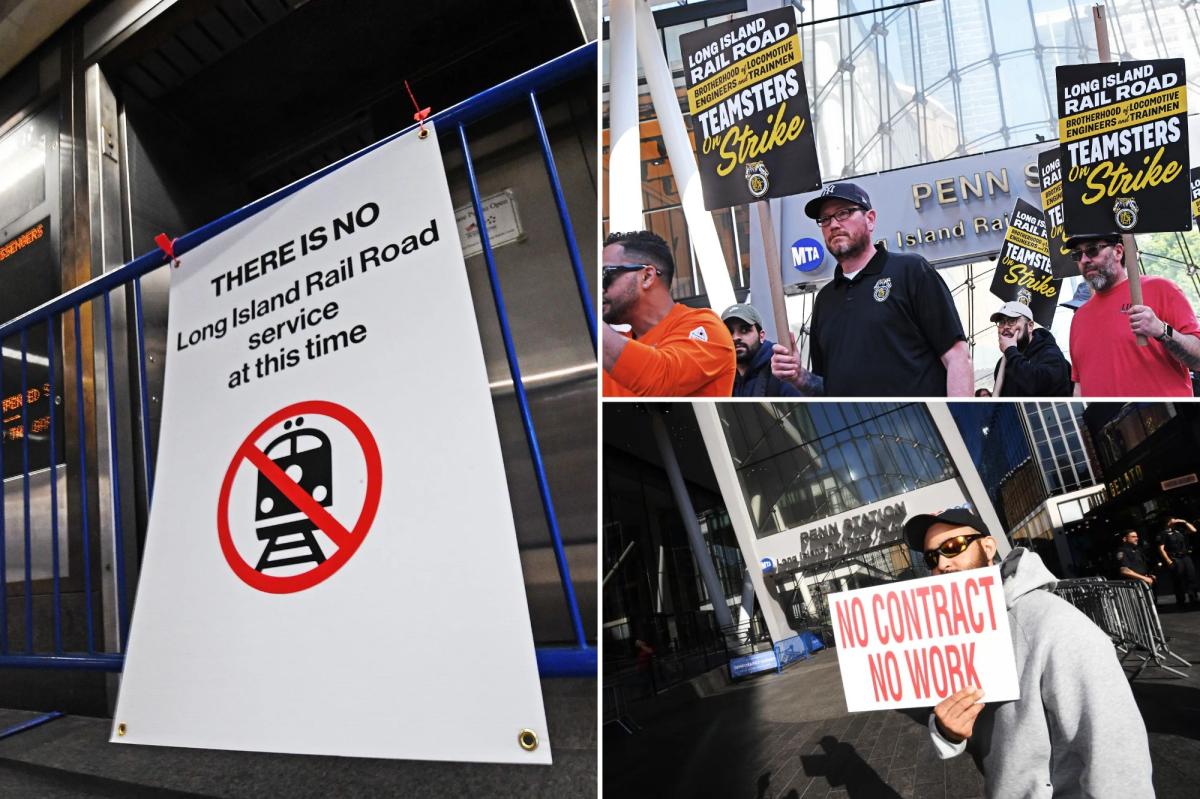


Almost a dozen Long Island Rail Road (LIRR) employees are earning more than $200,000 annually just from overtime, a staggering amount that rivals the entire salary of Governor Kathy Hochul.
Recent payroll data from the transit authority exposes that numerous unionized workers are benefiting significantly from taxpayer dollars, even as their strike continues to disrupt the daily routines of the metropolitan area’s working population.
In fact, over 325 LIRR workers are making upwards of $100,000 each year solely from overtime, in addition to their already substantial salaries. Of these, 11 employees are securing at least double that amount in overtime pay alone.
Overtime expenses make up a significant 22% of the LIRR’s payroll, according to Ken Girardin, a fellow at the Manhattan Institute think tank.
“Governor Kathy Hochul needs to take a stand and clarify why the LIRR should not give in,” Girardin stated in a Sunday interview with The New York Post, referring to the Metropolitan Transportation Authority’s (MTA) ongoing contract negotiations with five LIRR unions representing thousands of workers.
“She could start by addressing how inefficient union contracts have allowed 11 LIRR employees to earn over $200,000 each in overtime last year,” Girardin added.
“The LIRR workers are already the best compensated transit workers in the United States,” he said.
Among the commuter railroads’ top OT kings are:
- ”Gang’’ or supervising foreman Leonardo Espinosa, who earned an eye-popping $244,954 in OT last year on top of his $129,483 salary, bringing his total earnings to $396,749.
By comparison, Hochul makes $250,000 annually as governor of the state of New York, a post that also makes her the de facto boss of the LIRR.
Espinosa, meanwhile, was fingered last year as one of three dozen LIRR workers who allegedly used a fake ID scheme to avoid work while still getting paid, according to a probe conducted by MTA Inspector General Daniel Cort.
- Gang foreman Steve Delacrausaz, who raked in $233,195 in overtime, to net a total salary of $388,151 when combining his base pay of $133,924.
- Foreman Brian Turner, who netted $229,426 in OT on top of a base salary of $131,176, earning a total of $378,926.
- Gang foreman Larry Young, racking up $227,999 in OT added to a base salary of $ 130,428 for a total of $378,869.
- Utility worker Salvatore Lazzarino, with $222,185 in OT plus his $100,306 base salary for a total of $326,480.
- Gang foreman Jose Rodriguez, who took in $207,847 in OT in addition to his $130,415.56 salary, handing him a total of $349,198.01,
- Yardmaster Peter Zoufaly, who earned $206,954.32 in OT plus his base salary of $128,529.24 for a total of $336,010.
- Gang Foreman Dwayne Freemantle, who grabbed $204,606 in OT on top of a base salary of $130,033 for a total of $349,278.
- Surfacing foreman Dallas Bazemore, who raked in $202,890 in OT plus his regular pay of $131,163 for a total of $337,280.11.
- Track foreman Lee Levine, who accumulated $200,619.12 in OT on top of his $127,567.46 salary for a total of $329,335.
In 2021, The Post wrote a series of stories about OT fraud at the LIRR, which resulted in federal indictments and “OT King” Thomas Caputo getting sentenced to eight months in prison after copping to fraud theft that netted him thousands of dollars.
The Empire Center for Public Policy, for years, has highlighted massive OT at the MTA’s agencies, which also include NYC Transit subways and buses, Metro-North and Bridges and Tunnels.
“The LIRR fraud problem has taken many forms over the years,’’ Girardin said.
“The system is so distorted that it’s hard to tell what is legal waste and illegal waste.’’
The union is reportedly demanding a retroactive increase totaling 9.5% for the past three years and a 5% boost this year.
But management is said to only be agreeing to a 3% raise this year on top of a one-time lump-sum payment that would raise the total to 4.5%.
MTA spokesman Aaron Donovan said in a statement to The Post on Sunday, “We’re outraged by these [OT] numbers.
“That’s why we are fighting hard to put work rules changes on the table, but so far the unions have adamantly refused to consider any changes.’’
Gov. Hochul’s office declined to comment on the OT issue Sunday — well into the second straight day of the shutdown for the crucial LIRR commuter service.
Kyle Strober, executive director of the Association for a Better Long Island, cautioned that “the key here is not to make a deal just to please the unions and get the trains running if it’s not sustainable.
Any pact has to be “sustainable in the long run,” the advocate said.
Strober said there are three pressure points that can impact the regional economy if the LIRR labor deal gets too expense: fare hikes, an increase in the payroll tax or a higher congestion toll.
“It will make the region less affordable and drive more people out of New York,” he said.
An MTA source noted that the LIRR is the most heavily subsidized operation at the agency
It gets more of its operating budget from subsidies and taxes than the city subway, buses or Metro-North, the source said.
That’s at least partly because the current work rules — which don’t exist anywhere besides the LIRR — require the MTA to spend this much on overtime, the source said.
Republican gubernatorial candidate Bruce Blakeman has called for suspending the $9 congestion pricing toll for motorists crossing into core Manhattan during the strike.
Hochul retorted that there is “actually no legal mechanism to do that.’’