
Share this @internewscast.com
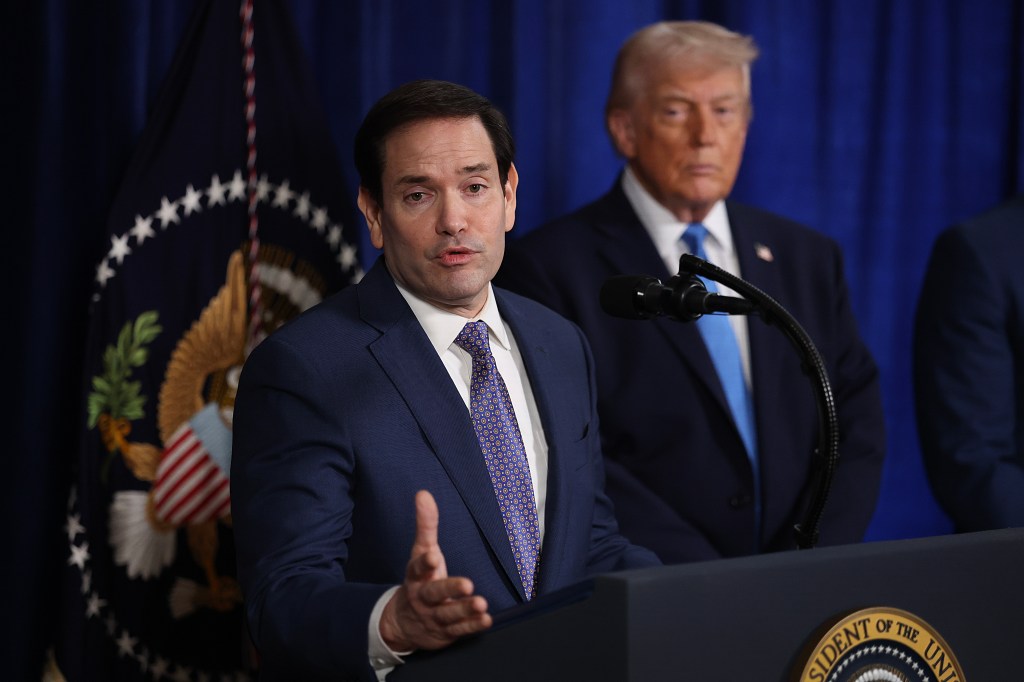
In a strategic maneuver to exert influence over Venezuela, the United States has initiated an oil “quarantine” alongside a comprehensive pressure campaign, with the possibility of deploying ground troops if deemed necessary by President Trump. This was revealed by Secretary of State Marco Rubio during an appearance on CBS’ “Face the Nation” on Sunday.
Rubio elaborated on the situation, describing the oil quarantine as a means to wield significant leverage over Venezuela’s future developments. He highlighted that the current military posture is among the most substantial naval deployments witnessed in recent history within the Western Hemisphere. This move underscores the U.S.’s commitment to influencing the region’s political landscape.
Despite these strategic moves, Rubio emphasized that President Trump is keeping all options on the table, including the potential deployment of American troops should Venezuela’s new leadership fail to align with U.S. expectations. This statement underscores the administration’s readiness to escalate measures if diplomatic efforts do not yield desired outcomes.
The political dynamics in Venezuela shifted dramatically when U.S. forces captured Nicolas Maduro on Saturday, leading to Vice President Delcy Rodriguez assuming temporary leadership. However, Secretary of Homeland Security Kristi Noem expressed skepticism regarding Rodriguez’s ability to maintain her position in the eyes of the U.S. government.

In a statement on “Fox News Sunday,” Noem asserted, “You can lead or you can get out of the way,” indicating the U.S.’s insistence on finding a cooperative leader who aligns with American interests. This candid remark highlights the U.S.’s firm stance on seeking leadership in Venezuela that supports its strategic objectives.
Additionally, Rubio pointed out the U.S.’s intent to involve international oil companies in reshaping Venezuela’s oil industry, which is a critical component of the nation’s struggling economy. This initiative aims to revitalize the sector, potentially stabilizing the country’s economic conditions while aligning with U.S. interests.
Venezuelan oil fields have become less productive since Maduro took over the nation following Hugo Chavez’s death in 2013, and Rubio pitched U.S. intervention as a way to improve production.
“They need investment from private companies who are only going to invest under certain guarantees and conditions,” he said on “Face the Nation.” “We want the oil industry in that country not to go to the benefit of pirates and adversaries of the United States.”
Venezuelan oil exports have been officially sanctioned since 2017. Most of the country’s oil exports from the state-owned company, PDVSA, are sold on the black market in China.
In mid-December, Trump instituted an oil “blockade” surrounding Venezuela, stopping all sanctioned ships from entering or exiting the country through a massive U.S. Navy deployment. Rubio said Sunday that blockade, which he referred to as an “oil quarantine,” would allow the U.S. to dictate terms with whatever Venezuelan leadership emerges.

“My number one objective is America,” Rubio said on ABC’s “This Week.” “We care about Venezuela. We want it to do well moving forward. But our number one objective here is America.”
Many observers have criticized the U.S. operation in Venezuela, which local leaders said killed 40 people, as a violation of international law. The plot involved several military aircraft and bombs dropped on the capital city of Caracas.
On Sunday, Rubio described as a law enforcement operation to arrest Maduro, who was indicted for narcoterrorism under U.S. law. He was jailed in Brooklyn upon his arrival in the U.S. Saturday night.
Several other members of Maduro’s regime, who face similar American criminal charges, remain in Venezuela, ostensibly in positions of power.
“We have learned through the years when America tries to do regime change and nation-building in this way, the American people pay the price in both blood and in dollars,” Sen. Chuck Schumer (D-N.Y.) said on “This Week.”