
Share this @internewscast.com

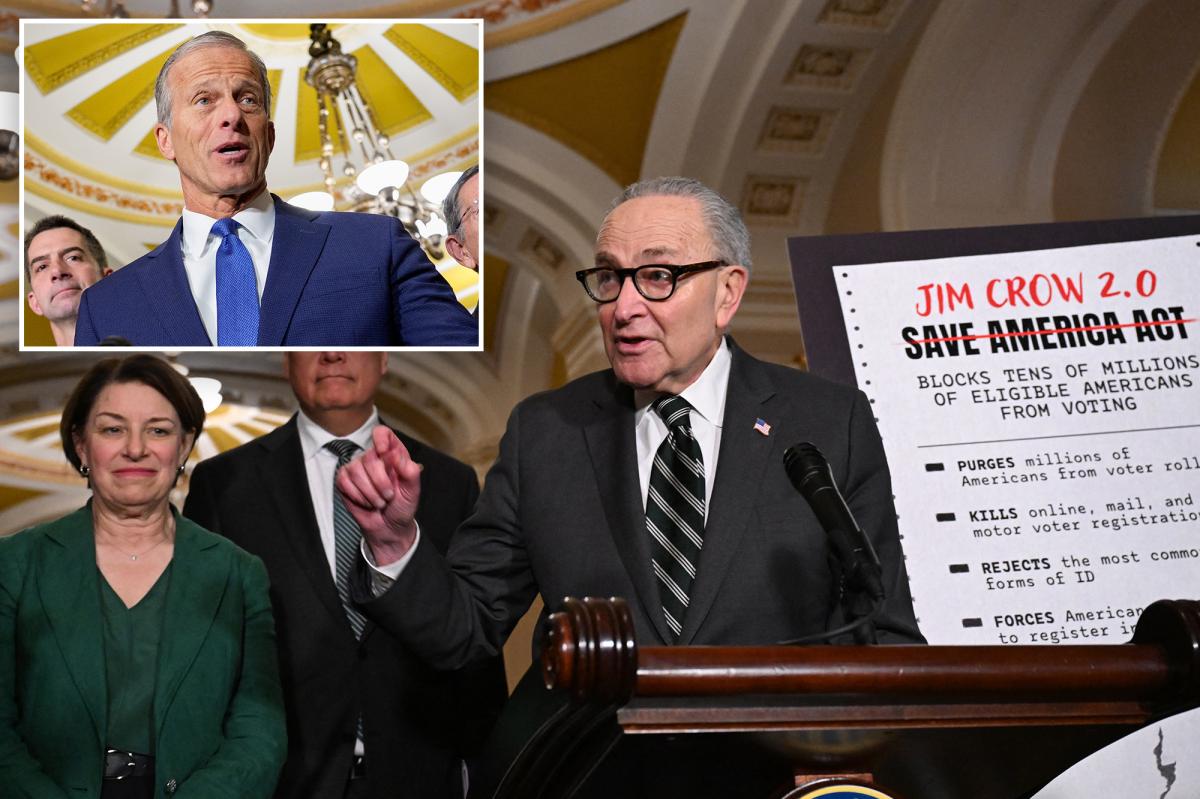
WASHINGTON — Senate Republicans advanced President Trump’s key legislation aimed at tightening voter eligibility for federal elections, despite some internal opposition and a unified Democratic front against it.
The Senate narrowly approved a motion to proceed with the Safeguarding American Voter Eligibility (SAVE) America Act in a 51-48 vote on Tuesday afternoon. All Democrats, along with Republican Senator Lisa Murkowski of Alaska, opposed the motion to debate the bill. The proposed legislation mandates photo identification for voting and proof of citizenship for voter registration.
Although Senate Majority Leader John Thune of South Dakota successfully initiated debate on the bill, its future remains uncertain. The measure lacks the 60 votes necessary for final passage, casting doubt on how long discussions might continue.
The bill includes measures to compel states to remove noncitizens from their voting rolls. Democrats argue that these provisions could inadvertently disenfranchise some citizens who are legally registered to vote.
Republicans, however, contend that instances of noncitizens voting have been documented, emphasizing that several elections in recent years were decided by narrow margins.
Senator John Fetterman of Pennsylvania, typically known for his willingness to diverge from Democratic consensus, promptly voted against the Republican-backed bill.
Senate Minority Leader Chuck Schumer (D-NY) said in a floor speech ahead of the vote, “If MAGA Republicans want to bog down the Senate over a debate on voter suppression, Democrats are ready. We’re ready to be here all day, all night, as long as it takes to ensure the powers of voter suppression did not win the day.”
But even with a “no” vote from Murkowski, affirmative votes from Sens. Mitch McConnell (R-Ky.) and 50 other Republicans were enough to clear the way for the upper chamber to begin debate on amendments.
All 47 Democrats voted against the legislation.
Sen. Thom Tillis (R-NC), who has publicly opposed the bill, did not vote.
“We don’t know that we don’t have 60 votes yet,” Thune said at a press conference. “I think it’s an important debate to have. How it ends remains to be seen.”
The House already passed the provisions last month in a 218-213 vote by tucking them into a previously-approved Senate bill that hadn’t included all the voting rule changes.
Trump called on congressional Republicans last week to shelve all other legislative priorities until they could send the bill to his desk, pushing back key votes on the government’s foreign spying powers and funding for the beleaguered Department of Homeland Security.
The president has also accused Democrats of opposing the voter ID law because they “want to cheat” — and could threaten the Republican majority in Congress in the 2026 midterm elections.
“They’re doing everything possible because they know if we get this, they probably won’t win an election for 50 years,” Trump told House Republicans during their annual retreat at his Doral, Fla., golf resort. “Maybe longer.”
He later pledged to “not sign other Bills until this is passed.”
A Harvard-Harris survey in February found that 85% of voters support only American citizens being able to cast ballots in elections — and 71% of the voters also back the SAVE America Act.
By party affiliation, 91% of Republicans, 69% of independents and 50% of Democrats favor the bill.