
Share this @internewscast.com

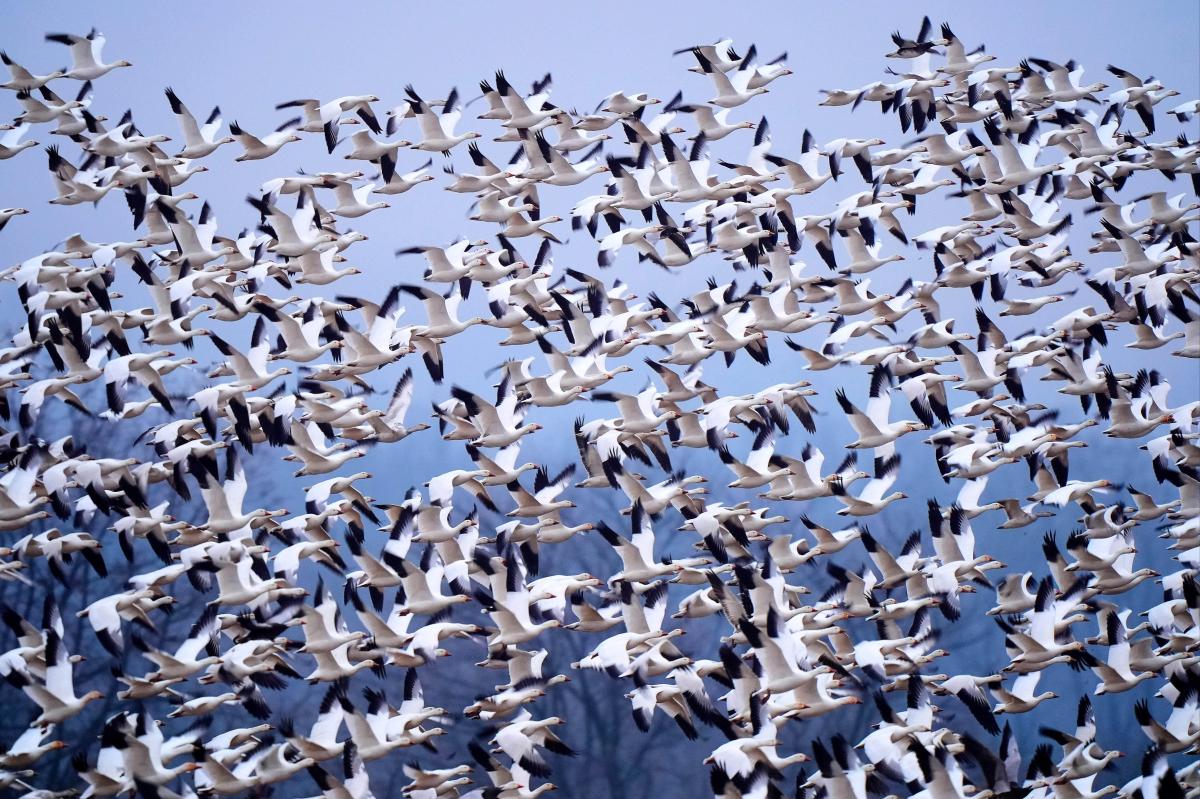
In the early morning shadows of Kleinfeltersville, Pa., several keen birdwatchers assembled, eagerly awaiting the moment when thousands of snow geese, pausing from their honking and preening, would suddenly soar into the skies from a local reservoir.
This captivating spectacle, occurring roughly an hour post-sunrise, was as fleeting as it was breathtaking.
The geese circled a few times before departing to nearby agricultural fields, in search of leftover grains and nourishment to fuel their grand annual spring migration towards New York state and Quebec.
Originally constructed five decades ago to lure waterfowl, this Pennsylvania reservoir has since seen its avian population flourish.
According to Payton Miller, an environmental education specialist with the Pennsylvania Game Commission, this phenomenon resembles a boisterous whirlwind of birds ascending from the surface.
“Whenever I witness a magnificent morning flight like this, I’m reminded of the sheer beauty of seeing such a vast number of these splendid creatures,” Miller expressed. “It never ceases to amaze me.”
Among those taking it all in was Adrian Binns, a safari guide from Paoli, Pennsylvania, who went to the Middle Creek Wildlife Management Area for “the whole enjoyment of seeing something you don’t see every day.”
Snow geese have been arriving in growing numbers at the 6,300-acre (25 square kilometers) Middle Creek property since the late 1990s.
At this time of year, they have just spent months along the Atlantic coast, from New Jersey south to the Carolinas, with many of them overwintering on the Delmarva Peninsula that forms the Chesapeake Bay.
They don’t stay long at Middle Creek — it’s just a way station on their journey to summer breeding grounds in the Canadian Arctic and western Greenland.
But for a few short weeks, they are the main attraction at Middle Creek, which draws about 150,000 visitors annually — including about a thousand hunters.
The Pennsylvania Game Commission, which owns Middle Creek, says about 100,000 snow geese were roosting there on the busiest day last year, on par with recent peak activity but below the single-day record of about 200,000 on Feb. 21, 2018.
Snow geese are doing well, but their large numbers have come with a cost.
According to a 2017 study published by Springer Nature, greater snow geese grew in population from about 3,000 in the early 20th century to some 700,000 by the 1990s.
By some estimates, there are about a million of the birds now — along with maybe 10 million of lesser snow geese, which are smaller — that also breed in the Arctic.
The number of migrating tundra swans at Middle Creek, while far lower, has also increased over time, from a dozen or so in the mid-1970s to 5,000 or more in recent years. Middle Creek birders have also identified more than 280 bird species on the site, among them bald eagles, northern harriers, ospreys and owls.
As snow geese numbers have boomed in recent decades, wildlife officials in the U.S. and Canada have navigated a balancing act involving hunting regulations, concerns about crop damage, shifts in snow geese migration, and changes to overwintering patterns.
Environmental damage from overgrazing in the Arctic has led experts to conclude that the birds are overabundant.
David M. Bird, a McGill University wildlife biology professor, described the population as “probably one of the biggest conservation problems facing wildlife biologists in North America today.”
Snow geese feed by pulling up plants by the roots, which damages habitats for themselves, various birds, and other kinds of wildlife.
The Pennsylvania Game Commission reported recently that avian influenza viruses, present in the state since 2022, continue to circulate among the state’s wild birds.
The game agency asked for the public’s help in reporting sick or dead wild birds and reported that about 2,000 wild bird carcasses — mostly snow geese — had to be removed from a quarry a few miles north of Bethlehem in December and January.
Bird said that for nature lovers, snow geese can be a delight, but for farmers, they’re a pest.
For hunters, they’re food, but for animal rights advocates, they’re a species that needs protection, he said.
“But if you are a paid professional wildlife manager at a municipal, state, or federal level whose challenging job is to try to please all of the aforementioned parties, then you will undoubtedly experience many sleepless nights in the fall when the geese arrive,” Bird said.