
Share this @internewscast.com
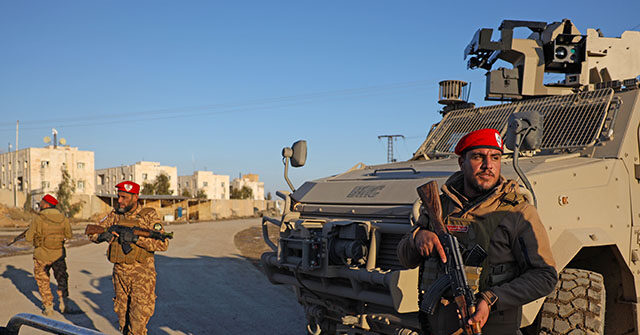
On Thursday, a top official at al-Aqtan prison in Raqqa, Syria, urged European and American leaders to assume responsibility for the facility. With tensions escalating between Syrian government forces and the Kurdish-led Syrian Democratic Forces (SDF), there is an increasing risk that Islamic State militants could escape.
Syrian authorities are also advocating that Western nations take charge of foreign-born ISIS fighters, who have been held in these Syrian detention centers for several years.
In a video message released on Thursday, Chiya Kobane, head of security at al-Aqtan, declared that the SDF is no longer capable of managing the prison and called for international intervention to safeguard its ISIS detainees.
“We have maintained security at al-Aqtan prison up till now, but resources are depleted. There are shortages in water, electricity, fuel, and food,” Kobane stated.
He appealed for an “international entity” to “assume control of the prison so that we can reach secure zones under global protection.” Kobane emphasized that the SDF has persisted in its efforts due to its “humanitarian responsibility” to secure the facility.
Since December, the Kurdish-led SDF has been engaged in conflict with the Syrian army, as interim president Ahmed al-Sharaa’s central government attempts to reassert authority over the autonomous Kurdish region. Both factions frequently accuse each other of inciting violence and breaking cease-fire agreements.
The SDF, a vital U.S. and European ally against the Islamic State, has long maintained prison camps where ISIS terrorists and their family members are held. Many of these prisoners are foreign fighters who traveled from other countries to join ISIS in Syria during its heydey. Their home governments have been reluctant to take them back, in part because they believe returning ISIS recruits, their wives, and their children could become security risks.
The SDF began falling back from the prison camps this week, under intense assault from Syrian government forces. A prison break involving hundreds of ISIS jihadis occurred at the al-Shaddadi prison camp on Monday.
Damascus has accused the SDF of releasing some of its prisoners to create a security crisis to put pressure on the government, while the SDF has accused jihadi fighters working for the Syrian army of releasing ISIS prisoners on purpose.
U.S. Central Command (CENTCOM) said on Thursday it has begun moving thousands of ISIS prisoners from northeastern Syria to Iraq, a surprise move that ameliorated some of the security risks from the SDF-Damascus clash. The first 150 relocated prisoners reportedly arrived at a “secure location” in Iraq on Thursday, with up to 7,000 more on standby to be transferred from Syria.
The Supreme Judicial Council of Iraq said it would “begin taking the proper legal measures against the defendants who are handed over and placed in the relevant correctional institutions.”
“Legal procedures will be applied to them without exception, in a manner that safeguards the rights of the victims and upholds the principle of the rule of law in Iraq,” the council said.
An Arab security source told The National on Thursday that CENTCOM does not fully trust the SDF nor the Syrian army to secure the ISIS prisoners.
“The SDF appears to have released ISIS prisoners from one jail in al-Shaddadi to create chaos. At the same time, Washington was worried about the presence of ISIS sympathisers among government forces and their tribal allies,” the source said.
The Arab source added that President Sharaa “knows how to handle ISIS prisoners,” but the force that he deployed to blitz the Kurdish-controlled region of Syria includes jihadi elements who are not so trustworthy.
“In any case, this was not Al Shara’s war with ISIS and many of the prisoners are not Syrian. Washington was bound to move some ISIS detainees outside Syria, regardless of who controls power there,” the source said.
“There are certainly rogue members of the Syrian Arab Army who are extremists,” confirmed Myles Caggins, a former spokesman for the coalition against the Islamic State.
Iraqi officials did not sound happy to have the enormous burden of the ISIS prisoners dropped on their laps so suddenly, but they appreciated the need to keep those dangerous detainees under lock and key.
“We have no other option but to bring them here under our direct supervision, rather than leave them in a fluid situation that could pose a threat to our national security,” an Iraqi security official told The National.