Share this @internewscast.com
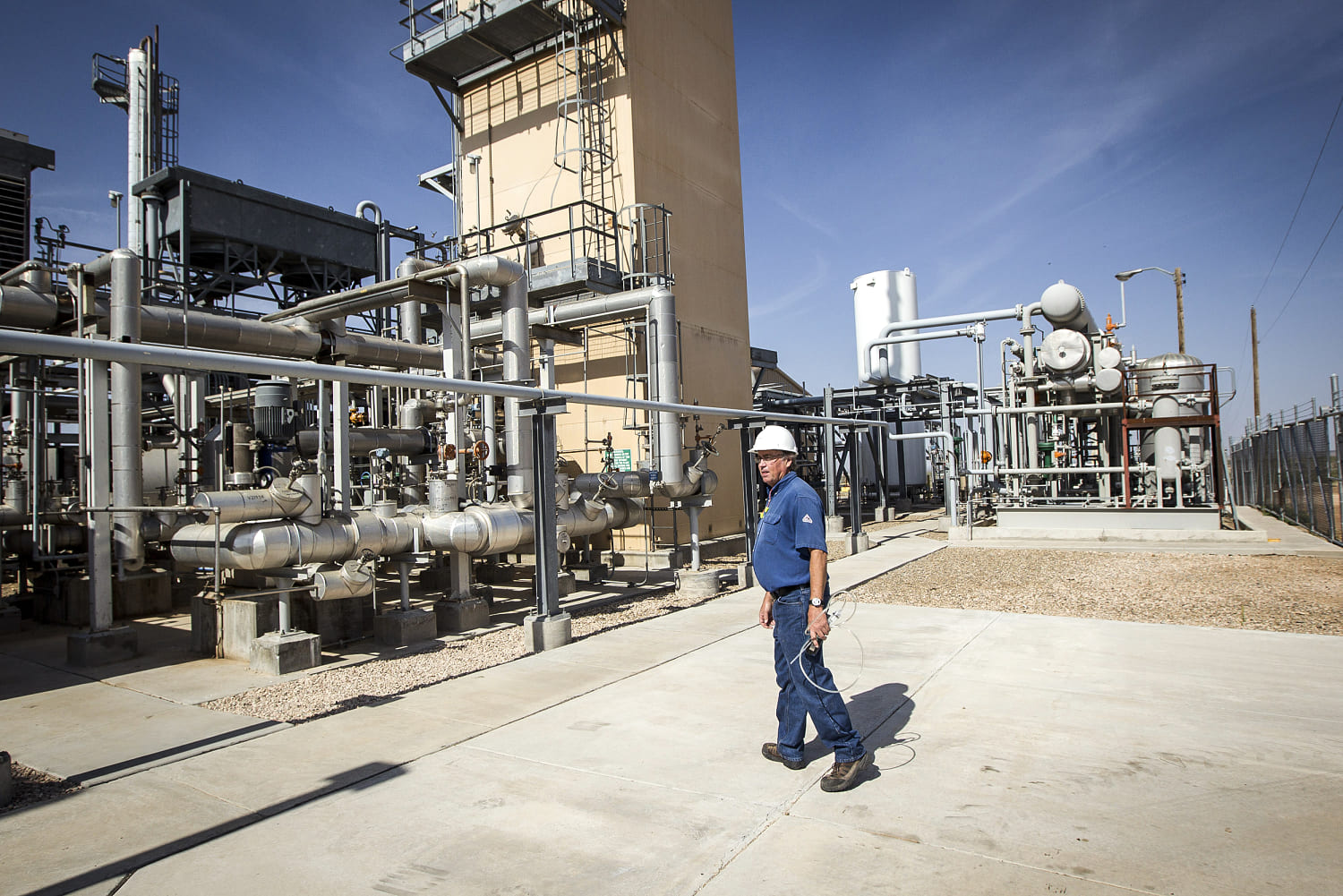
On Thursday, the U.S. government sold the Federal Helium Reserve, a massive underground stockpile based in Amarillo, Texas, that supplies up to 30% of the country’s helium.
Once the deal is finalized, the buyer — which will likely be the highest bidder, the industrial gas company Messer — will claim some 425 miles of pipelines spanning Texas, Kansas and Oklahoma, plus about 1 billion cubic feet of the only element on Earth cold enough to make an MRI machine work.
Regulatory and logistical issues with the facility threaten a temporary shutdown as it passes from public to private ownership, and hospital supply chain experts worry the sale could have serious consequences for health care down the road — especially when it comes to MRIs.
To be sure, a Federal Helium Reserve shutdown wouldn’t mean that MRIs would suddenly power down across the country, said Soumi Saha, senior vice president of government affairs at Premier Inc., which contracts with helium suppliers on behalf of 4,400 hospitals in the U.S. “But we are stressing about this shortage. From a health care perspective, MRI machines are the No. 1 concern.”
American patients undergo an estimated 40 million MRI scans each year to help diagnose cancer, brain and spinal cord injuries, strokes and heart conditions. The superconductive magnet-powered imaging machines give doctors clear, high-resolution images of areas inside the body they can’t see on X-rays and CT scans. But without liquid helium, the Earth’s coldest element, MRI machines can’t keep their magnets cool enough to generate these images.
The sale of the government’s stockpile of the nonrenewable element could exacerbate an existing supply shortage, Saha said.
A number of factors could trigger a shutdown of the facility that could last as long as three years, said Rich Gottwald, CEO of the Compressed Gas Association, a trade group that represents companies, including Messer, that buy up helium and sell it to hospitals, semiconductor manufacturers, NASA and other customers.
The facility spans three states, each with its own laws. The federal government didn’t need to reconcile state-specific rules, but a private buyer would, he said. Another issue is that helium must be enriched before it can be used, and a separate system is needed to do that. That enrichment system isn’t part of the federal reserve, but is privately owned by four private companies, including Messer; unlike the pipelines and helium itself, it wasn’t for sale.
“A new owner will need to create some sort of lease to use the enrichment unit, or build their own unit to enrich the helium,” Gottwald said. “There’s a whole host of issues that need to be resolved and the concern is, until they’re resolved, the system will need to shut down.”
In a letter in October urging the White House to delay the sale, the CGA and four other trade associations laid out what they see as the most critical issues at the facility. Two of the trade associations behind the letter, AdvaMed and the Medical Imaging and Technology Alliance, represent MRI manufacturers.
“Timely, critical patient care would suffer if helium supplies constricted further,” Scott Whitaker, AdvaMed’s CEO, wrote in an email to NBC News. “AdvaMed urges the White House to delay the sale and privatization of the Federal Helium Reserve until outstanding issues identified by the Compressed Gas Association are resolved.”
The sale has been in the works for more than a decade. Congress first mandated it through the Helium Stewardship Act of 2013. It was initially supposed to occur in 2021, but a series of delays — in part due to the same logistical and regulatory issues threatening shutdowns today — postponed the auction to Thursday.
In an emailed statement, a spokesperson from the U.S. Interior Department said the sale would not constrict helium supply.
“Sale of the reserve to a private party, as Congressionally mandated by law, is not expected to meaningfully change the availability of helium,” the spokesperson wrote.
Other sources of helium
There’s a finite amount of helium on Earth. The largest reserves are in massive underground pockets in parts of Algeria, Qatar, Russia and the U.S.
While the Texas stockpile is the largest source of helium in the U.S., it’s not the only one. There are a number of smaller, privately owned facilities — some of which are in Colorado and Wyoming — according to Gottwald.
Sourcing helium inside the U.S. or from Canada is the easiest and cheapest option. Transit time is an important factor: If the shipment takes longer than 35 to 48 days, the liquid helium will evaporate.
The two other biggest helium reserves are in Qatar and Russia.
“Shutting down the U.S. helium reserve would force a situation where we would have to increase our reliance on foreign sources, like Qatar and Russia,” Saha said. “Given the ongoing geopolitical concerns and tensions in those regions and shipping delays, it would increase concerns around potential shortages on U.S. soil.”
According to Phil Kornbluth, president of Kornbluth Helium Consulting, the U.S. hasn’t been able to tap into Russia’s helium supply because of strained trade relations and the war in Ukraine. Meanwhile, attacks on ships in the Red Sea by Yemen’s Houthi rebels have forced Qatar to send liquified natural gas shipments, which contain helium, around the Cape of Good Hope, a route that adds at least 20 days to the journey.
Helium in health and science
Helium was already in short supply before the government sale. Currently, Kornbluth said, three out of five U.S. helium suppliers are rationing the element to prioritize life-or-death uses like MRI machines ahead of less-essential helium uses, like keeping party balloons afloat.
Across the University of California system, for instance, which includes 10 research campuses and six medical schools, the shortage has already hit scientists.
“We’ve been on and off allocation for a while from our helium suppliers,” said Jeremy Meadows, its executive director of strategic sourcing. “There’s a priority of allocation where health care goes first and research goes second.” This has been difficult for scientists whose laboratories use magnetic imaging for medical research, he said.
“Our helium-dependent research is only growing,” he added. Should the available supply decline further, he said, “I just don’t know how we position ourselves to get that supply.”
In a letter to the U.S. government last spring, the University of California’s chief procurement officer, Paul Williams, lamented that the cost of helium had already increased more than 400% in five years.
Further supply constriction, he wrote, “leaves the research and medical communities at a greater risk.”
For instance, the University of California has a powerful helium-reliant magnetoencephalography, or MEG, scanner, that doctors use to plan pediatric brain operations. Statewide, Williams said, there were only two of these scanners.
“If it runs out of helium, it will require multiple weeks to recool, delaying surgeries, or, in some circumstances, compelling surgeons to operate without detailed brain maps,” he said, adding that the MEG scanner has barely averted shutdown dozens of times over the past 10 years.
MRIs of the future
MRI manufacturers have responded to the uncertain future of helium with their own solutions. Both Philips and Siemens Healthineers recently started selling alternatives to traditional MRI machines, which hold 1,700 to 1,800 liters of liquid helium and require constant replenishment. Some models now require just 1 to 7 liters of helium and don’t need any replenishment. Spokespeople from both companies touted these newer models as cost-effective for hospitals, especially if helium prices keep rising.
But an MRI machine is a long-term investment, and many hospitals have been counting on their current, helium-dependent MRI equipment to last years, if not decades, more.
“Using the same magnet for 20 or 30 years is not unheard of,” said Dr. Scott Reeder, chair of the University of Wisconsin’s radiology department.
Premier’s Saha said uptake of lower-helium MRIs has been slow.
“There are capital costs associated with removing the old MRIs and installing new equipment, plus the manufacturers don’t have the capacity to switch out all MRI machines at 6,000 U.S.-based hospitals overnight,” she said. “There’s time required for that, and you can’t take off every MRI machine in the country, because that would impact patient care.”
Still, the uncertain helium supply has brought an uptick in interest in these newer models, Saha said. “We’re seeing health care providers trying to get ahead of this by inquiring about MRI systems that use minimal to no helium,” she said.
As the health care industry worries about what the Federal Helium Reserve sale could mean for meeting the existing MRI demand, Reeder said the demand keeps rising, too.
“MRI is playing an increasingly important role in detection, treatment, monitoring and prognosis of so many diseases, and we’re going to have to think carefully as a field about how to ensure the supply chain doesn’t get to a state of crisis,” he said.
That state of crisis hasn’t hit yet, experts stressed. Patients across the U.S. won’t suddenly face canceled MRIs and missed cancer diagnoses once the sale goes through.
But the future of this critical, lighter-than-air element is certainly in flux, Saha said, and the medical world is watching closely.
“Our hope is that health care will be prioritized, but that’s never a guarantee during any shortage of any item,” she said.
For now, Reeder suggested, helium consumers must be judicious. “It’s probably not good to use helium for party balloons anymore,” he said.