
Share this @internewscast.com
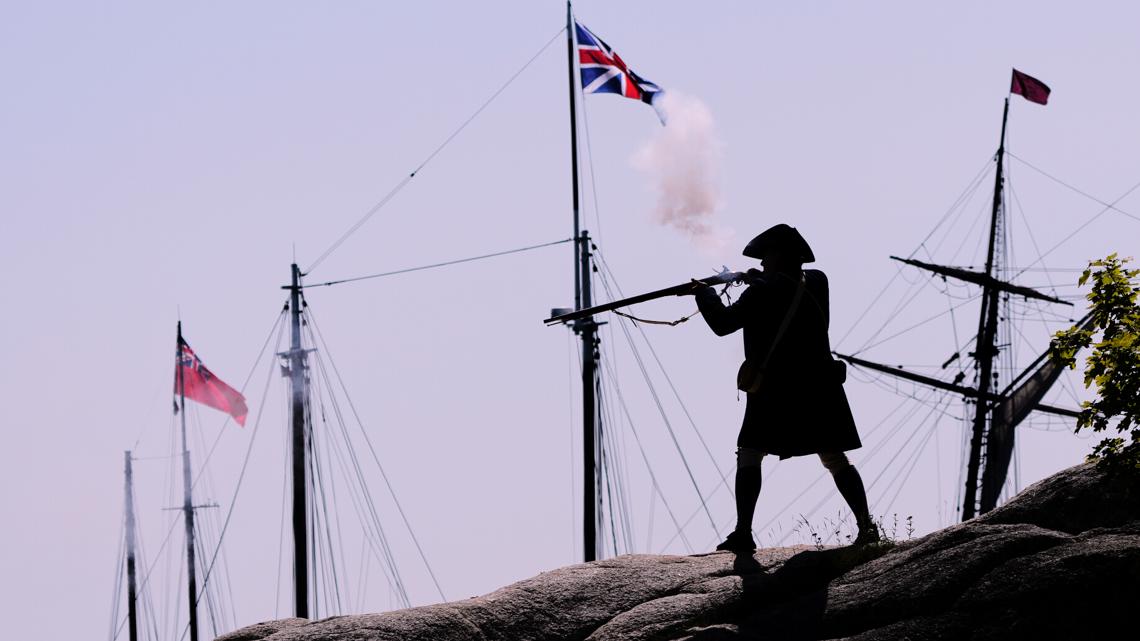
A day-long reenactment of the battle got underway Saturday morning with the seaside city of Gloucester standing in for Charlestown.
NEW YORK — As the U.S. marks the 250th anniversary of the Battle of Bunker Hill, it might take a moment — or more — to remember why.
Start with the very name.
“The name itself evokes a rhythmic intensity: Battle of Bunker Hill,” remarks award-winning historian Nathaniel Philbrick, author of “Bunker Hill: A City, A Siege, A Revolution,” published in 2013. “For those outside of the Boston region, the specific events may blur, but it remains etched in our collective memory and imagination.”
“Not many ‘ordinary’ Americans would recognize battles like Freeman’s Farm, Germantown, or Guilford Court House by name,” states Paul Lockhart, a history professor at Wright University and author of the 2011 book about Bunker Hill, “The Whites of Their Eyes.” “However, they’re certainly familiar with battles such as Gettysburg, D-Day, and Bunker Hill.”
Bunker Hill, Lockhart adds, “is the great American battle, if there is such a thing.”
Globally, the Battles of Lexington and Concord, fought in Massachusetts on April 19, 1775, are often viewed as the American Revolution’s onset. Yet, Philbrick, Lockhart, and other historians highlight Bunker Hill on June 17 as the true initiation—the first significant engagement where British and rebel forces entered into a prolonged conflict over a defined location.
A day-long reenactment of the battle got underway Saturday morning with the seaside city of Gloucester standing in for Charlestown. Organizers chose a state park some 35 miles (56 kilometers) from Boston to stage the battle because such activity is prohibited at the actual site.
Hundreds of onlookers watched as sharpshooters positioned on a rocky outcropping fired upon red-coated British sailors landing in the harbor. During the actual battle, British soldiers responded by setting a fire to drive them off and used the smoke to mask their movements.
“We’re in a volatile period, but this is a way that we can really celebrate our heritage and our diverse creation of what became America,” said Andrew Lyter, a reenactor who was overseeing the smaller vessels.
“I teach history at a college, and this is really neat to engage with an audience that’s very interested in being here and learning about their history,” he said.
Bunker Hill was an early showcase for two long-running themes in American history — improvisation and how an inspired band of militias could hold their own against an army of professionals.
“It was a horrific bloodletting, and provided the British high command with proof that the Americans were going to be a lot more difficult to subdue than had been hoped,” says the Pulitzer Prize-winning historian Rick Atkinson, whose second volume of a planned trilogy on the Revolution, “The Fate of the Day,” was published in April.
The battle was born in part out of error; rebels were seeking to hold off a possible British attack by fortifying Bunker Hill, a 110-foot-high (34-meter-high) peak in Charlestown across the Charles River from British-occupied Boston. But for reasons still unclear, they instead armed a smaller and more vulnerable ridge known as Breed’s Hill, “within cannon shot of Boston,” Philbrick says. “The British felt they had no choice but to attack and seize the American fort.”
Abigail Adams, wife of future President John Adams, and son John Quincy Adams, also a future president, were among thousands in the Boston area who looked on from rooftops, steeples and trees as the two sides fought with primal rage. A British officer would write home about the “shocking carnage” left behind, a sight “that never will be erased out of my mind ’till the day of my death.”
The rebels were often undisciplined and disorganized and they were running out of gunpowder. The battle ended with them in retreat, but not before the British had lost more than 200 soldiers and sustained more than 1,000 casualties, compared to some 450 colonial casualties and the destruction of hundreds of homes, businesses and other buildings in Charlestown. Bunker Hill would become characteristic of so much of the Revolutionary War: a technical defeat that was a victory because the British needed to win decisively and the rebels needed only not to lose decisively.
“Nobody now entertains a doubt but that we are able to cope with the whole force of Great Britain, if we are but willing to exert ourselves,” Thomas Jefferson wrote to a friend in early July. “As our enemies have found we can reason like men, now let us show them we can fight like men also.”
Rodrique Ngowi in Gloucester, Massachusetts, and Holly Ramer in Concord, N.H. contributed to this report.
Copyright 2025 Associated Press. All rights reserved. This material may not be published, broadcast, rewritten, or redistributed.