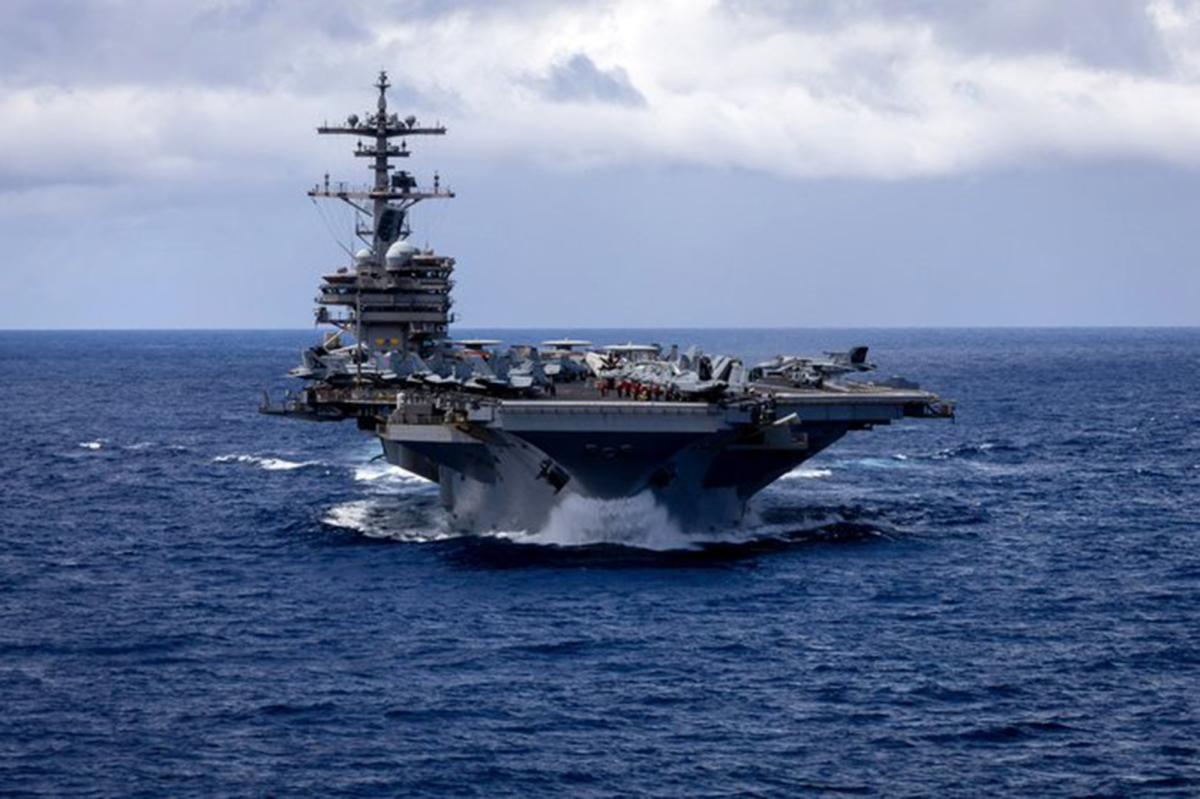


The United States has increased its naval presence in the Middle East, deploying a third aircraft carrier to the region. This marks the highest concentration of American warships in these waters in over 20 years, amid ongoing tensions in peace negotiations between Tehran and Washington.
The USS George H.W. Bush, a formidable 1,000-foot nuclear-powered carrier capable of carrying more than 80 aircraft, has joined the USS Abraham Lincoln and USS Gerald R. Ford in the Indian Ocean. This strategic deployment was announced by the US Central Command on X, formerly known as Twitter, on Friday.
The additional military might is expected to enhance the US naval blockade of Iranian ports within the Strait of Hormuz, a critical passageway through which 20% of the global oil supply is transported. This move comes in the wake of President Trump’s recent warnings to resume military action against Iran if diplomatic talks do not yield progress soon.
According to Central Command, these three carriers collectively host over 200 aircraft and a force of 15,000 sailors and Marines. The last time such a significant deployment occurred in the region was in 2003.
While a defense official opted not to disclose specific details about military force arrangements, ship movements, or locations to ensure the security of personnel and operations, the deployment of the USS George H.W. Bush is seen as a strategic maneuver. Retired US Navy Captain Carl Schuster told CNN that the presence of a third carrier heightens the diplomatic pressure on Iran as peace talks loom.
“The mere potential involvement of a third carrier intensifies the challenges facing the Iranian regime as negotiations for peace draw near,” Schuster remarked.
“The message is that Trump may apply more pain if the peace talks don’t advance in the way Trump wants. The political imagery is as, and possibly more important, than the military action,” he explained.
Unlike the Ford, the Bush is equipped to carry the newest F-35 fighter jets — which could be a beneficial war tactic if Trump and Iranian leaders can’t settle on a peace deal soon.
“Having two F-35-capable carriers adds a lot of firepower if Iran proves intransigent,” Schuster told CNN.
In order to avoid running into Iranian-armed Houthi proxies in the Suez Canal and Red Sea, the Bush reportedly took the long way to its destination — sailing around the Cape of Good Hope at the southern tip of Africa — after departing from its home port in Norfolk, Virginia, on March 31.
Earlier this week, tracking sites showed the Ford in the Red Sea and the Lincoln anchored in the Arabian Sea south of Iran, where it’s been since the war began in February, the outlet reported.
Senior Iranian leadership was expected to arrive in Pakistan on Friday or Saturday for talks, government sources from both countries told The Post.
However, the meeting will most likely be bilateral between Islamabad and Tehran only, an Iranian source said.
Trump said Thursday afternoon that he plans to resume bombing Iran if there’s no peace deal.
“If they don’t want to make a deal, then I’ll finish it up militarily with the other 25% of the targets,” he said from the Oval Office.