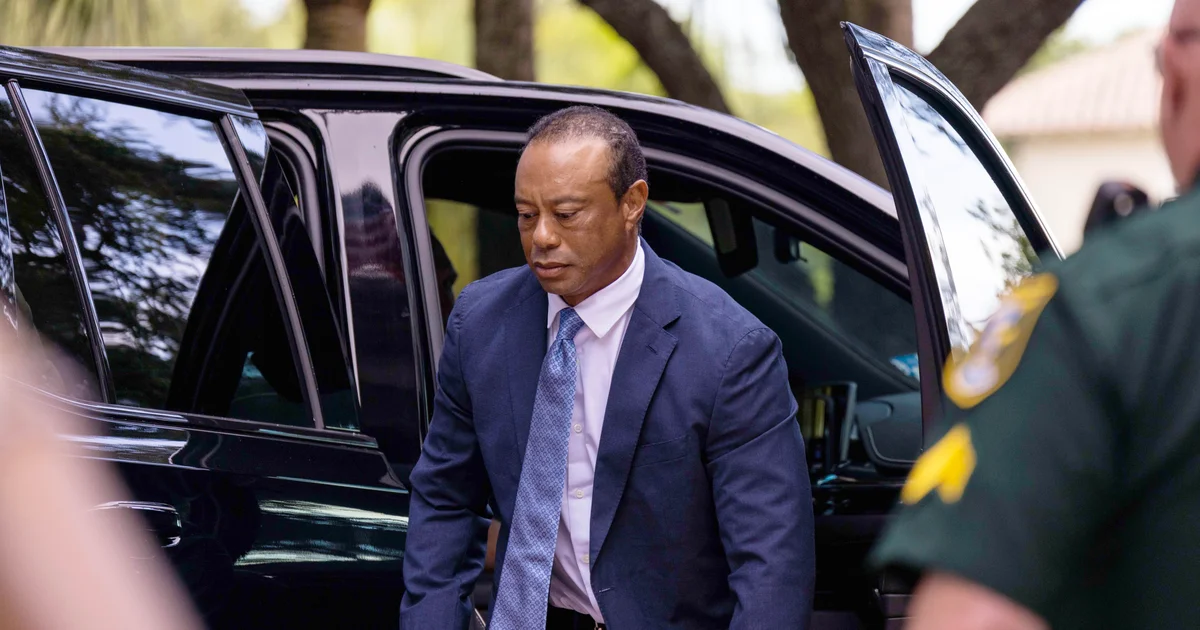

Tiger Woods entered a no contest plea to a reckless driving charge in his Florida DUI case, several months after he had pleaded not guilty to two misdemeanor counts.
As part of the agreement, the golf icon accepted a five-year suspension of his driver’s license and a $1,000 fine. Woods appeared at the Martin County Courthouse on Wednesday, where he was seen smiling during the hearing.
Woods had previously pleaded not guilty to charges of driving under the influence with property damage and refusing to submit to a lawful test.
A no contest plea does not require a defendant to admit guilt or deny the allegations, but it does mean the person agrees to accept the penalties imposed by the court.
The case stemmed from a rollover crash on Florida’s Jupiter Island in March. Officials said Woods’ Land Rover struck a truck and flipped onto its side. According to an arrest report, he had been driving at high speeds on a beachside residential road where the posted speed limit was 30 mph. The report also stated that Woods caused $5,000 in damage to the truck involved in the collision.
Woods was not injured in the crash. According to the report, he told a deputy he had been looking down at his phone and changing the radio station when the collision occurred. Deputies at the scene said Woods appeared impaired. He agreed to take a Breathalyzer test, which showed no alcohol in his system, but refused to provide a urine sample. The arrest report also said Woods told police he had taken “a few” prescription medications, and two pills later identified as the opioid hydrocodone were found in his pants pocket.
Thomas Bakkedahl, the state attorney for Florida’s 19th Judicial Circuit, said Wednesday that “at the end of the day, this case turned out to be a particularly difficult DUI to prove.”
Bakkedahl said proving drug impairment, as opposed to alcohol impairment, can be challenging. Because there was no urine test, investigators “don’t know what exactly was in his bloodstream” at the time of the crash, he said. Woods’ defense team also could have offered alternative explanations for signs such as difficulty walking, Bakkedahl noted, pointing to the golfer’s history of injuries. Although Woods acknowledged taking painkillers, records showed the medications had been prescribed and that he was taking them as directed, Bakkedahl said.
Two forensic toxicologists who were asked to review the case said they believed there was “insufficient proof” of Woods’ impairment, Bakkedahl said. The toxicologists said Woods likely had a tolerance to hydrocodone, so he was not impaired by its use, leaving prosecutors unable to prove a DUI, Bakkedahl said.
These combined factors meant prosecutors could not meet the burden of proof for a DUI, Bakkedahl said. That led to the decision to drop the DUI charge and replace it with a charge of reckless driving, which Woods pleaded no contest to.
Woods, 50, is considered one of the most influential figures in golf. In 1997, he became the first person of Black heritage to win the Masters. But while he has broken records, his career has been marred by car accidents, a pain pill dependence and multiple back and knee surgeries.
In 2021, Woods survived a crash in Los Angeles that injured his right leg so badly that he said doctors considered amputating the limb. In 2017, he was arrested on a DUI charge when Florida police found him asleep behind the wheel of his car. After the incident, he said he had taken a bad mix of painkillers. In 2009, his SUV plowed into a fire hydrant and tree outside his home near Orlando, Florida.
Woods said after the incident that he was “stepping away for a period of time to seek treatment” and “work toward lasting recovery.” He made his first public appearance after treatment in June, when he introduced the PGA Tour’s plans to revamp its schedule for 2028.
Correction: This story has been updated to reflect that Woods pleaded no contest.