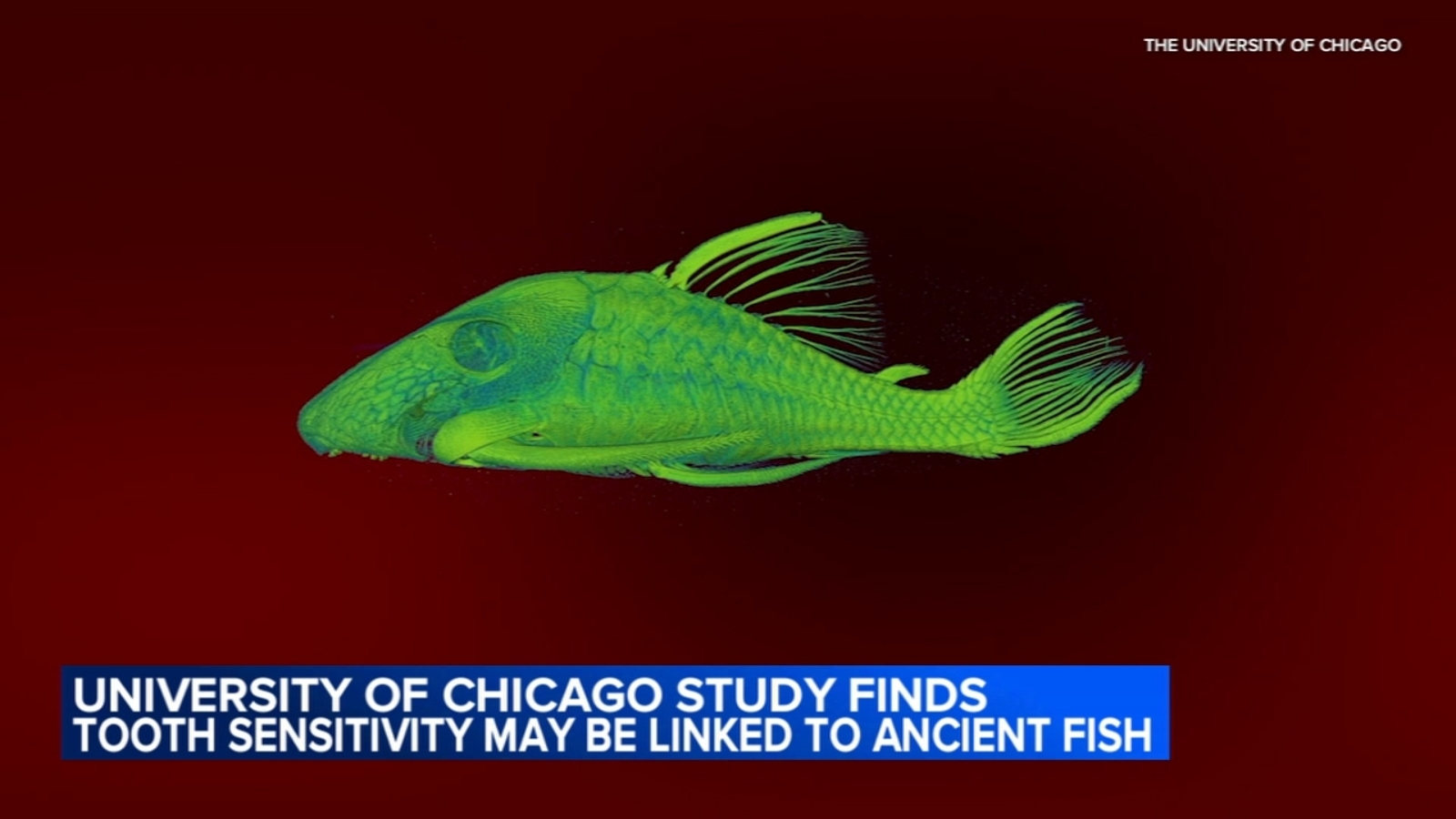

CHICAGO — The delicate, sensitive parts inside human teeth might have their roots in an unexpected source: sensory tissue found in fish that swam through Earth’s oceans 465 million years ago.
Our teeth are protected by a hard enamel surface, but it’s the dentine underneath – the tooth’s inner layer that transmits sensory details to the nerves – that senses pressure from biting down hard, pain, or sensations like sharp coldness or sweet flavors.
ABC7 Chicago is now streaming 24/7. Click here to watch
In exploring where teeth originated, one possibility researchers have debated for years is that teeth may have evolved from protrusions on the armored exoskeletons of ancient fish. However, the exact role of these structures, known as odontodes, has remained unclear.
Now, a new study and 3D scans of fossils have yielded evidence that the external bumps contained dentine, which likely helped fish sense their surroundings. Scientists reported the findings Wednesday in the journal Nature.
“Covered in these sensitive tissues, maybe when it bumped against something it could sense that pressure, or maybe it could sense when the water got too cold and it needed to swim elsewhere,” said lead study author Dr. Yara Haridy, postdoctoral researcher in the department of organismal biology and anatomy at the University of Chicago, in an email.
Dr. Haridy joined ABC7 Chicago on Wednesday to discuss the study. The full interview can be viewed in the video player above.
During its analysis, the team also uncovered similarities between the odontodes and features called sensilla, which exist as sensory organs in the shells of modern animals such as crabs and shrimp, and can be found in fossilized invertebrate arthropods. The development of odontodes in fish, which are vertebrates, and sensilla in arthropods, which are invertebrates, is a prime example of evolutionary convergence – when similar features evolve independently in different animal groups, Haridy said.
“These jawless fish and Aglaspidid arthropods (extinct marine arthropods) have an extremely distant shared common ancestor that likely had no hard parts at all,” Haridy said. “We know that vertebrates and arthropods evolved hard parts independently and amazingly they evolved similar sensory mechanisms integrated into their hard skeleton independently.”
While arthropods have retained their sensilla, odontodes appear to be the direct precursors to teeth in animals.
As the researchers compared sensilla and odontodes, they also arrived at another finding: One species, once considered to be an ancient fish, was actually an arthropod.
The search for the oldest vertebrates
Haridy’s original aim was to solve the mystery of the oldest vertebrate animal that exists in the fossil record. She approached museums across the country and asked whether she could scan any fossil specimens they had from the Cambrian Period, 540 million years to 485 million years ago.
Then, she settled in for an all-nighter at the Argonne National Laboratory, where she used their Advanced Photon Source to capture high-resolution computer tomography, or CT, scans.
“It was a night at the particle accelerator; that was fun,” Haridy said.
At first glance, a fossil of a creature called Anatolepis looked like a vertebrate fish – and indeed, previous research from 1996 had identified it as one. Haridy and her colleagues noticed that there was a series of pores filled with a material that appeared to be dentine.
“We were high fiving each other, like ‘oh my god, we finally did it,'” Haridy said. “That would have been the very first tooth-like structure in vertebrate tissues from the Cambrian. So, we were pretty excited when we saw the telltale signs of what looked like dentine.”
To confirm their discovery, the team compared the scans with those of other ancient fossils, as well as modern crabs, snails, beetles, sharks, barnacles and even miniature suckermouth catfish that Haridy had raised herself.
Those comparisons showed that Anatolepis more closely resembled arthropod fossils, including one from the Milwaukee Public Museum. And what the team thought were tubules lined with dentine were actually more similar to sensilla.
But they did find dentine-containing odontodes in ancient fish like Eriptychius and Astraspis during the scans.
The confusion over Anatolepis’ true nature had stemmed from the fragmentary nature of the fossils. The most complete pieces are only about 3 millimeters (0.1 inches) in size, Haridy said, which proved to be a challenge for comparative research reliant on external imaging.
But the new scans she conducted enabled a 3D look at the fossils, revealing their internal anatomy.
“This shows us that ‘teeth’ can also be sensory even when they’re not in the mouth,” Haridy said. “So, there’s sensitive armor in these fish. There’s sensitive armor in these arthropods. This explains the confusion with these early Cambrian animals. People thought that this was the earliest vertebrate, but it actually was an arthropod.”
The cutting edge modern imaging used in the study is resolving the debate over Anatolepis, said Dr. Richard Dearden, a postdoctoral research fellow at the Naturalis Biodiversity Center in Leiden, the Netherlands. Dearden was not involved in the new research.
“(The study authors) use cutting edge modern imaging approaches to try and settle this question, assembling an impressive swathe of comparative data to convincingly establish that Anatolepis is indeed not a vertebrate,” Dearden said in an email.
Armor against the elements
Armored jawless fish like Astraspis and Eriptychius and ancient arthropods like Anatolepis coexisted in the muddy shallow seas of the Ordovician period, which occurred between 485.4 million and 443.8 million years ago.
Other contemporaries of these animals included large cephalopods such as giant squid, as well as huge sea scorpions. Features like odontodes and sensilla would help fish and arthropods distinguish predators from prey.
“When you think about an early animal like this, swimming around with armor on it, it needs to sense the world. This was a pretty intense predatory environment and being able to sense the properties of the water around them would have been very important,” said senior study author Dr. Neil Shubin, the Robert R. Bensley Distinguished Service Professor of Organismal Biology and Anatomy at the University of Chicago, in a statement. “So, here we see that invertebrates with armor like horseshoe crabs need to sense the world too, and it just so happens they hit on the same solution.”
Several modern fishes have odontodes, while sharks, skates and some catfishes are covered in small toothlets called denticles, which cause their skin to feel like sandpaper, Haridy said.
Haridy studied the tissues of the catfish she raised and realized their denticles were connected to nerves much in the same way that teeth are in animals. When comparing teeth, odontodes and sensilla, they were all incredibly similar, she said.
“We think that the earliest vertebrates, these big, armored fish, had very similar structures, at least morphologically. They look the same in ancient and modern arthropods, because they’re all making this mineralized layer that caps their soft tissue and helps them sense the environment,” Haridy said.
It’s likely that the genes necessary to form odontodes also produced sensitive teeth in animals – including humans – later, according to the study authors.
The findings support the idea that sensory structures appeared first on exoskeletons, which then provided the genetic information that could then be used to create teeth as they became a necessary part of life, the study authors noted.
“Over time, fish evolved jaws, and it became advantageous to have pointy structures around and in the mouth,” Haridy said. “Little by little some fish with jaws had pointy odontodes at the edge of the mouth and then eventually some were directly in the mouth and then lost across the body. The relationship between odontodes and teeth is continuously being clarified by new fossils and modern genetics.”
The new research refines the timeline for the first appearance of hard tissues and the earliest ancestors of jawed fishes by removing Anatolepis from the fish tree of life, said Dr. Lauren Sallan, assistant professor and head of the macroevolution unit at the Okinawa Institute of Science and Technology in Japan. Sallan, who was not involved in the new study, said it also raises an intriguing new hypothesis that the scalelike precursors of teeth evolved to detect prey, friends or predators in the water.
“This is a real challenge to seemingly obvious assumptions that hard tissues like dentine and structures like scales and teeth evolved (primarily) for protection on the body or feeding in the throat,” Sallan said. “Instead, they may have been ‘exapted’ (subsequently modified) for these uses, much like how limbs evolved before they were used to walk on land. It’s also interesting to see the degree of convergence between early armored arthropods and fishes, and raises questions about how much ecological overlap occurred between these two groups.”
Haridy wants to continue the search for fossils that could lead to the oldest vertebrate, given that researchers expect there are earlier vertebrates than Astraspis and Eriptychius. And even though they didn’t discover it through this research, they made worthwhile findings, Shubin said in an email.
“We were disappointed that (Anatolepis) wasn’t a vertebrate but we were amazed by the new ideas that arose,” Shubin said. “And that took us in an entirely new direction. That’s science.”
ABC7 Chicago contributed to this report.


