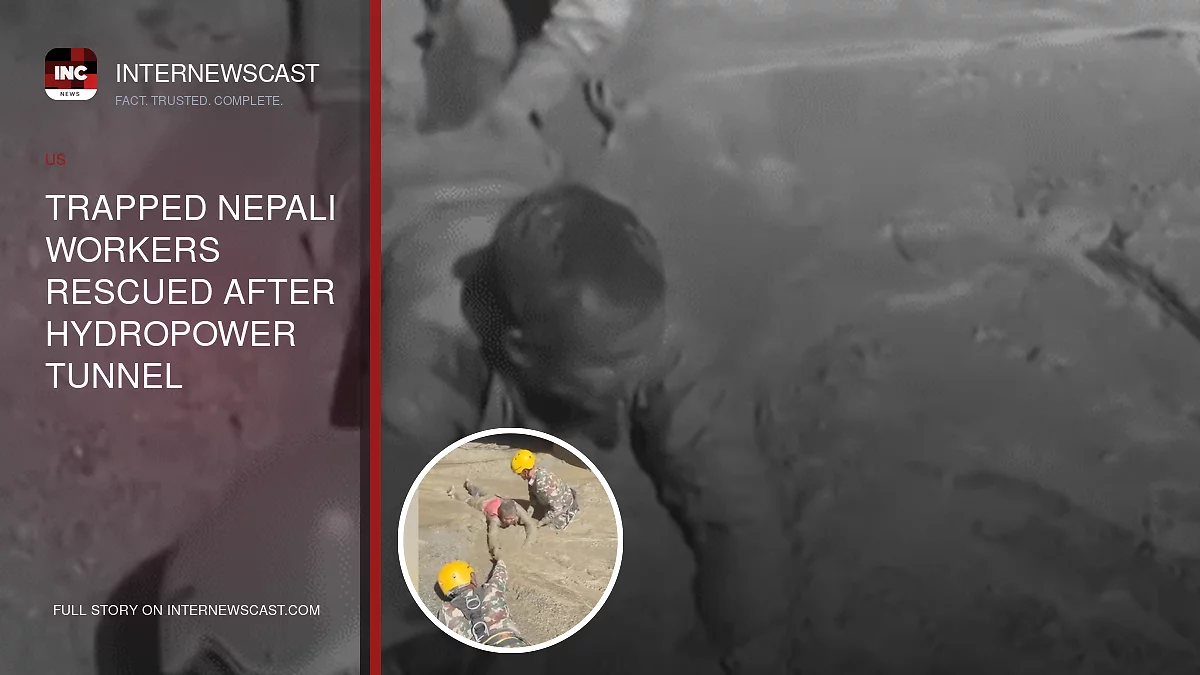

Dramatic footage from Nepal shows rescue crews hauling survivors through thick mud inside a hydropower plant tunnel, as authorities race to find those trapped after a catastrophic mudslide left more than 1,000 people unaccounted for.
The video, shared Friday by Nepal’s Prime Minister’s Office, captures teams of rescuers pulling people through a tunnel clogged and coated with mud following the disaster.
In a Facebook update, the Prime Minister’s Office said 350 people had been rescued from the tunnel so far, while efforts were ongoing to evacuate more than 100 others still believed to be trapped. Officials also said an additional 533 residents had been moved to safety from flood-hit areas.
The operation follows a devastating mudslide in a valley in northern Nepal’s Rasuwa district, a disaster that also affected neighboring Tibet in China.

Rescuers evacuate a person from a tunnel at a hydropower project after flash floods and a mudslide in Rasuwa, Nepal, in a still image from handout video released August 28, 2026. (PMO Nepal/Handout via Reuters)
At least 538 people have been confirmed dead in Nepal, according to the latest figures from the Nepal National Disaster Risk Reduction and Management Authority (NDRRMA) and Nepal Police.
MORE THAN 3,000 MISSING AFTER COLOMBIA EARTHQUAKE AS TRUMP ADMINISTRATION PROVIDES $15.5 MILLION IN RELIEF
The number of people missing on the Nepal side has climbed to as many as 1,924, The Associated Press reported.
Chinese authorities also report that, on the Chinese side of the border in Tibet, which was also affected by the deluge and ensuing mudslide, five people were confirmed dead with another 558 missing.

Aftermath of flash floods and mudslide at Trishuli Bazaar army training centre in Nuwakot, Nepal, August 28, 2026. (REUTERS/Francis Mascarenhas)
Of the many missing people are approximately 90 Americans, according to the U.S. State Department.
President Donald Trump commented on the disaster Thursday, telling reporters, “That was a brutal… that was mud and water. It’s a mixture that nobody’s ever seen anything quite like that, where very powerful, strong, well-built buildings were wiped out like they were toothpicks.”
The uniquely devastating natural disaster was likely caused by a giant ice rock that crashed into the Lhende Khola River after an earthquake, according to the U.S. Geological Survey (USGS).
“On Wednesday morning (local time), 26 August 2026, a catastrophic debris flow and flood was likely triggered by a glacial collapse in Langtang National Park, Nepal, near the border with China,” the USGS said in a post on its website.
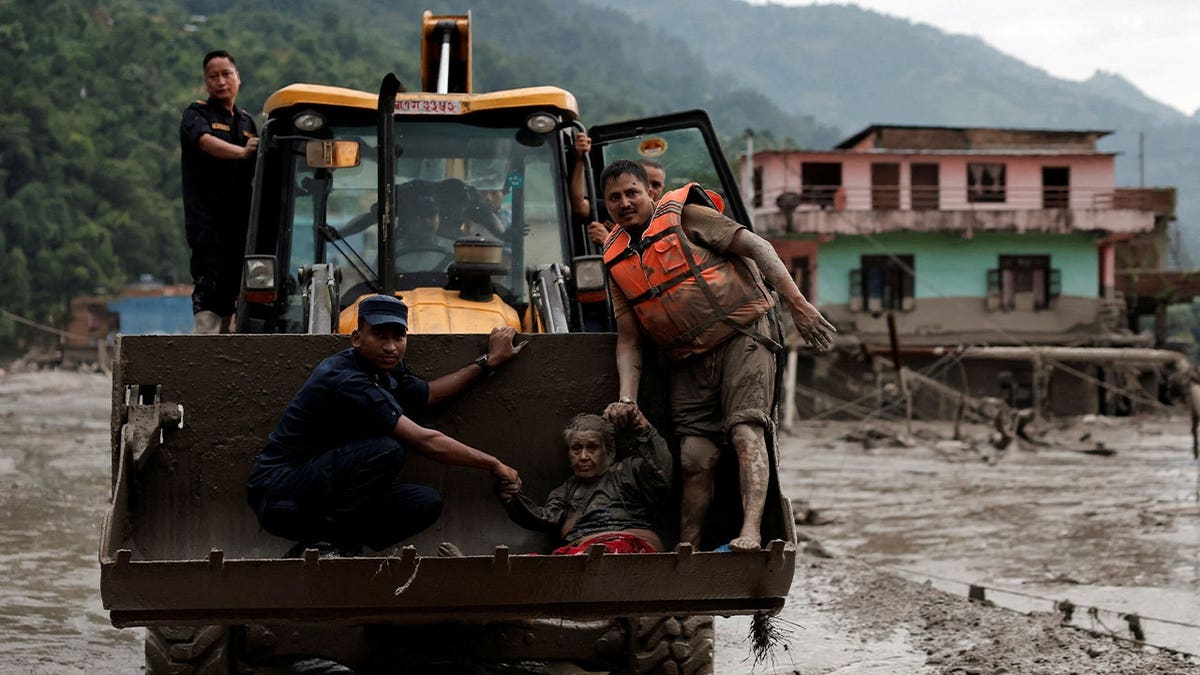
A survivor is transported to a safer place in a JCB following a flash flood at Trishuli in Nuwakot district, Nepal, August 26, 2026. (REUTERS/Navesh Chitrakar TPX IMAGES OF THE DAY)
TRUMP ADMINISTRATION PLEDGES $150M IN AID, DEPLOYS NAVY WARSHIPS AFTER DEADLY VENEZUELA EARTHQUAKES
“This debris flow and flooding travelled nearly 100 km and impacted populated areas downstream along the Trishuli and Bhote Koshi Rivers, including Gyirong Port, China. Preliminary media reports and imagery analysis indicate many buildings and infrastructure have likely been buried or destroyed, including a vital highway connecting China and Nepal,” the post added.
News Outlet contacted the Nepalese Foreign Ministry and the U.S. State Department for further comment.