
Share this @internewscast.com

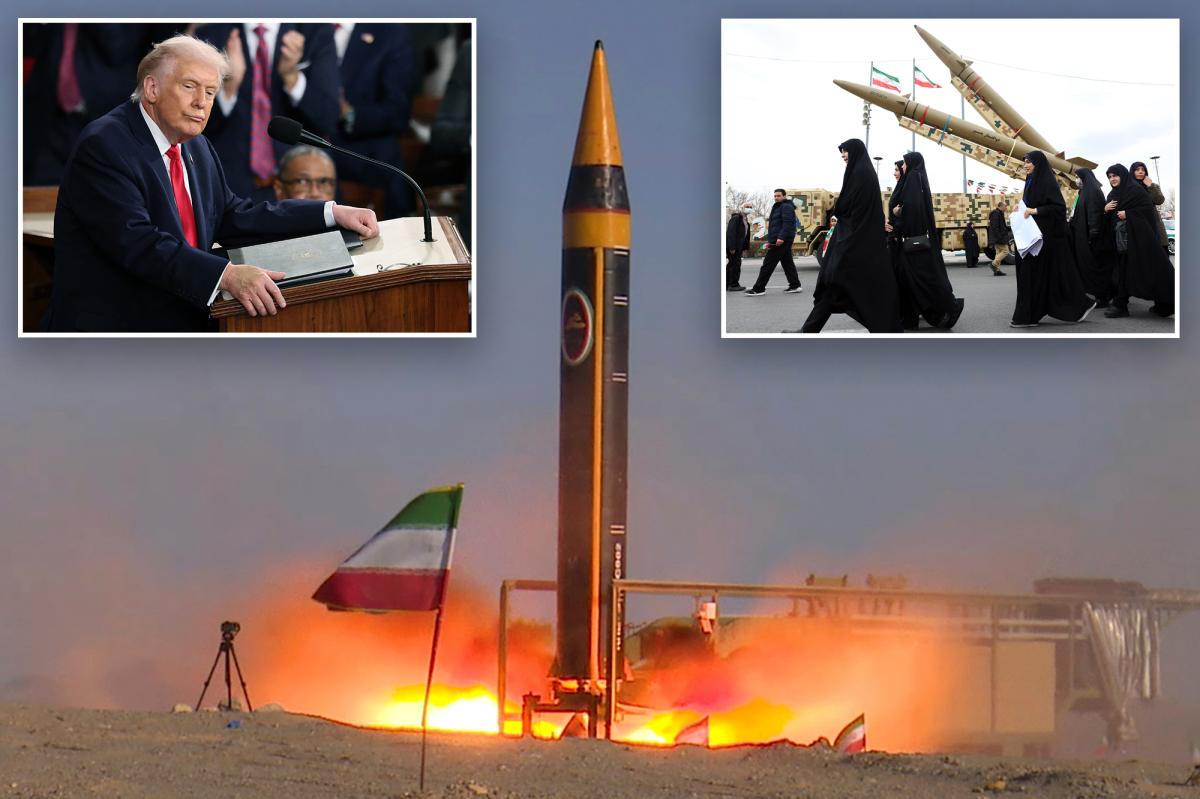
During his State of the Union address on Tuesday night, President Trump asserted that Iran has developed missiles capable of targeting U.S. military installations in both Europe and the Middle East. He further warned that Iran is advancing its missile technology with the aim of reaching the United States.
“These are some terrible people,” Trump remarked to lawmakers, referring to the Tehran regime, which dismissed the president’s assertions as “big lies.” He continued, “They have already created missiles that pose a threat to Europe and our overseas bases, and they are actively working on missiles that could soon reach the United States of America.”
The president noted that despite U.S. airstrikes on three significant Iranian nuclear facilities in June, the Islamic Republic appears determined to resume its atomic weapons development “all over again” and is currently pursuing its ambitions with renewed vigor.
“We are engaged in negotiations with them,” Trump stated. “They express a desire to make a deal, but we have yet to hear the crucial assurance: ‘We will never possess a nuclear weapon.’”
The forthcoming round of discussions between Washington and Tehran is scheduled for Thursday in Geneva, Switzerland. Leading the U.S. delegation will be Trump’s special envoy, Steve Witkoff. Notably, on February 21, Witkoff sparked concern when he claimed on Fox News that Iran was “possibly a week away from acquiring industrial-grade bomb-making material.”
Trump also cited reports indicating that the Iranian regime had killed 32,000 of its citizens during a harsh crackdown on anti-government protests. These demonstrations, which erupted across Iran in December and January, were fueled by the nation’s precarious economic situation.
The jaw-dropping figure had been widely reported on social media, but not repeated by any prominent Western official or human rights group.
The Human Rights Activists News Agency, which relies on a network of informants inside Iran, estimated Monday that just under 6,500 protesters had been killed in the crackdown, with a further 11,744 cases “under review.”
“Just over the last couple of months with the protests, they’ve killed at least, it looks like 32,000 protesters, 32,000 protesters in their own country,” the president said Tuesday night. “They shot them and hung them. We stopped them from hanging a lot of them with the threat of serious violence.”
Esmail Baghaei, a spokesman for Iran’s foreign ministry, dismissed Trump’s remarks as part of a “disinformation and misinformation campaign” Wednesday, saying: “Whatever [the US is] alleging in regards to Iran’s nuclear program, Iran’s ballistic missiles, and the number of casualties during January’s unrest is simply the repetition of big lies.”
Hours before Trump took the rostrum in the House chamber, Secretary of State Marco Rubio and CIA Director John Ratcliffe briefed congressional leaders at the White House on potential military action against Iran.
“This is serious, and the administration has to make its case to the American people,” Senate Minority Leader Chuck Schumer (D-NY) told reporters following the briefing, without elaborating on its contents.
“I’m very concerned,” added House Intelligence Committee vice chairman Jim Himes (D-Conn.). “Wars in the Middle East don’t go well for presidents, for the country, and we have not heard articulated a single good reason for why now is the moment to launch yet another war in the Middle East.”
Trump threatened on Jan. 2 to bomb Iran if authorities killed anti-regime protesters. He later paused an anticipated strike when Tehran claimed to scrap 800 planned executions, and subsequent talks have focused on Iran’s nuclear program.
At the same time, the president has ordered two US aircraft carrier groups into position for possible strikes.
Trump has publicly endorsed regime change in Iran, but it’s unclear if potential US strikes would seek to accomplish that — either by assassinating the country’s leaders or softening up the government for potential overthrow.
Earlier this week, the White House was forced to deny reports that Gen. Dan Caine, chairman of the joint chiefs of staff, had warned Trump about the risks of being drawn into a sustained Middle Eastern conflict.