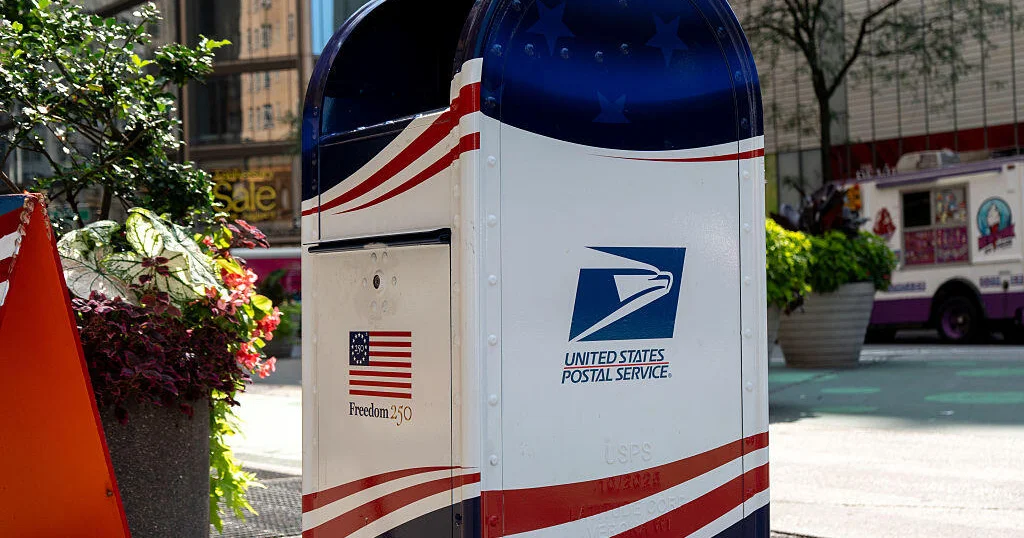
Washington — With the November midterm elections approaching, the Justice Department moved Thursday to bring the Supreme Court into a continuing legal fight over U.S. Postal Service standards for mail-in ballots, asking the justices to let the agency put the disputed rules into effect.
In an emergency application filed with the nation’s highest court, Solicitor General D. John Sauer urged the justices to pause a lower court order that temporarily bars the Postal Service from enforcing the new requirements.
The 14-day restriction, handed down by U.S. District Judge Indira Talwani last week, is scheduled to stay in effect for several more days. The Justice Department has already challenged Talwani’s ruling, though the appeals court has not yet issued a decision.
At the same time, Talwani is weighing whether to grant broader, longer-lasting relief to two dozen Democratic-led states and voting rights organizations that argue the mail ballot rules are unlawful. She convened a hearing earlier Thursday to review their request for a preliminary injunction.
Justice Ketanji Brown Jackson, who is responsible for emergency matters arising from the U.S. Court of Appeals for the 1st Circuit, directed the states and voting rights groups to file their response to the Trump administration’s request by Tuesday morning.
In the Supreme Court filing, Sauer described the Postal Service rule as a limited measure that “imposes only modest envelope-design and addressee-information requirements for federal-election ballots sent.”
“The Rule’s regulation of the U.S. Mail—not federal elections — is plainly constitutional,” Sauer wrote. “While the States have primary authority to regulate the manner of elections, they cannot choose to use the federal mails to carry out their elections but then insist that their election-related mail is somehow exempt from the Postal Service’s rulemaking authority, conferred by Congress, to regulate envelope design and addressee information.”
Sauer also contended that the lower court’s order effectively “nullifies” the Postal Service’s effort to guard against potential voter fraud tied to mail voting, which he described as “a particularly pernicious species of fraud that dilutes the votes of lawful voters, prevents election results from reflecting the will of the American people, and undermines ‘public confidence in the integrity of the electoral process.’”
The Trump administration has not put forth evidence of widespread voter fraud, and President Trump himself has voted by mail in elections in Florida this year.
The fast-moving legal battle is unfolding as states gear up to send mail ballots to voters. At least two municipalities in Wisconsin have already mailed ballots out, and in North Carolina, they will go out to certain voters Friday. More states will begin sending mail ballots around mid-September.
At issue in the case is a final rule issued by the Postal Service that requires states and localities to meet design requirements for mail ballots, including unique barcodes, and to submit to an online portal information about residents who will vote by mail, including their names, addresses and the individualized barcodes.
Those voters will be enrolled with the Postal Service and be included on state-specific “Mail-In and Absentee Participation Lists.”
The rule requires postal workers to review and verify ballot mail being sent to voters. Any ballot mailings that don’t comply with the requirements “will not be accepted and will be returned” to the election offices, the Postal Service said.
READ MORE: Married Doctor Named as Lucy Letby’s Secret Boyfriend
The Trump administration has said the rule imposes “modest informational requirements” on states and localities, and “should not prevent a single voter from voting by mail.”
“The Postal Service will not perform any verification of voter eligibility; its role is limited to ensuring that envelopes comply with the Rule’s design and informational requirements,” Sauer said in Thursday’s emergency appeal.
But state and local election officials have raised concerns about their ability to comply with the requirements so soon before the Nov. 3 midterms. They said in court filings that ballot envelopes have already been ordered and printed, and said submitting voters’ information to the portal would demand significant time and resources.
A top official with the Postal Service said in a filing Thursday that the agency continues to make “refinements” to the new Federal Ballot Mail Portal. The Postal Service anticipates the system will be available for voluntary use “by sometime next week,” Steven Monteith, executive vice president of the Postal Service, said in a filing.
The mail-voting limits were implemented by the Postal Service in response to an executive order signed by Mr. Trump in March.
In addition to the new directives for the Postal Service, the executive order calls for the Department of Homeland Security to compile “State Citizenship Lists” of residents who are U.S. citizens, and instructs the attorney general to prioritize investigations and prosecutions against election officials who issue ballots of people ineligible to vote.
But a contingent of Democratic-led states filed a lawsuit challenging Mr. Trump’s executive order. While Talwani in that case had blocked the Trump administration from moving forward with the directive, the Supreme Court last week froze her decision.
The Postal Service published its new rules for mail ballots and voting just days before the Supreme Court issued its ruling.
While the high court in that case involving the executive order granted the Trump administration relief, its decision was procedural. The Supreme Court did not rule on the merits of the mail-ballot restrictions that Mr. Trump directed the Postal Service and Homeland Security Department to impose. Instead, the Supreme Court’s conservative majority said the states’ lawsuit was premature.


