Share this @internewscast.com

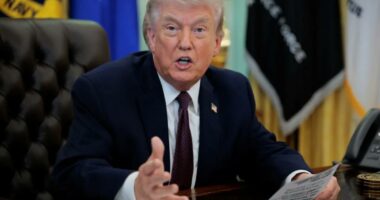
On Monday, former President Donald Trump called on oil tankers to “show some guts” and navigate the Persian Gulf, despite the looming dangers from the ongoing conflict involving the U.S., Israel, and Iran, which has significantly disrupted shipping lanes through the critical Strait of Hormuz.
With the U.S.-Israeli conflict with Iran intensifying, Trump suggested that oil tankers should face the risks posed by Iranian missiles and drones to help mitigate the dramatic surge in oil and gasoline prices.
In a statement to Fox News, Trump asserted, “These ships should go through the Strait of Hormuz and show some guts, there’s nothing to be afraid of,” claiming, “They have no Navy, we sunk all their ships.”
During the Fox interview, Trump mentioned that Iran is left with approximately 150 missile launchers, around 20% of its original arsenal, following severe strikes on both its military and civilian infrastructure.
Trump also criticized the new Iranian Supreme Leader, Mojtaba Khamenei, calling him a “lightweight” and speculated that his tenure would be short-lived.
The former president’s bold statements followed his earlier comments on Sunday, where he suggested that the soaring oil and gas prices would fall back to normal levels once the “Iranian nuclear threat is over,” though he did not specify a timeline for when this might occur.
“Short term oil prices (are) a very small price to pay for USA & world, safety and peace,” Trump posted on his social media site. “Only fools would think differently.”
Trump’s “small price to pay” post could sound a sour note with American consumers who were already expressing wide dissatisfaction with Trump’s handling of the economy in his second term.
Gasoline prices have already shot up by about 20% nationwide since Trump and Israeli Prime Minister Benjamin Netanyahu unleashed the war on Iran.
With oil prices shooting up past $100 a barrel, analysts predict the pain at the pump will only get worse in coming weeks, a development that could hurt the political prospects of Trump and his Republican allies in the upcoming midterm elections.
About 20% of the world’s oil supply normally is transported through the Straits of Hormuz, a narrow waterway that connects the oil-rich Persian Gulf to the Indian Ocean and the outside world.
Iran says it hasn’t officially said it has closed the straits to shipping traffic. But the companies that transport oil have parked their tankers on either side of the waterway, fearing their huge cargos would be sitting ducks for drone or missile attacks from Tehran as the war escalates.
Insurance companies that cover the oil tankers have raised premiums to unaffordable levels if they try to run the maritime gantlet, effectively preventing the ships from rolling the dice.
Trump has promised to introduce a new insurance program to cope with the problem, but it’s unclear how effective that proposal might be or when it could be implemented.
The U.S. has also discussed the possibility of using American ships to escort tankers through the Straits of Hormuz but no plan has been implemented yet.