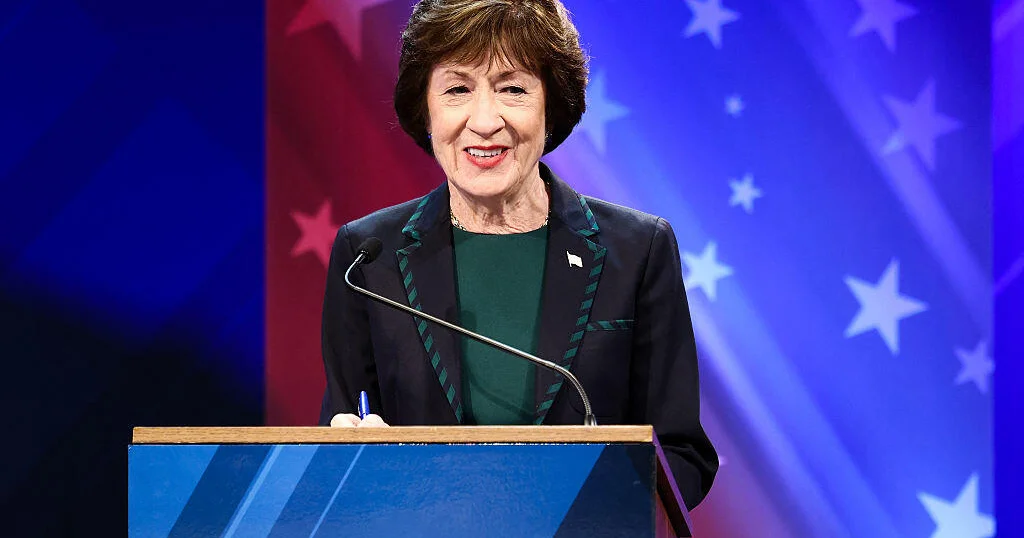

President Trump on Friday removed 50% tariffs from several Canadian goods heavily used by Maine’s agricultural sector, prompting praise from Republican Sen. Susan Collins as she fights to hold her seat in the New England state.
The exemptions cover corrugated boxes, crates, plastic bags, packing equipment, refrigeration machinery and seaweed, according to a White House proclamation. At the same time, the administration added a 50% duty to several other Canadian imports, including shampoo, vinyl flooring, coffins, carpets and window air conditioners.
Collins said the changes would offer relief to Maine farmers. She specifically cited wild blueberry growers who depend on “specialized harvesting boxes from Canada,” along with apple and potato producers who use Canadian supplies during harvest season.
Collins, who is seeking a sixth term in a state that leans Democratic, said she had pressed senior Trump administration officials to provide “tariff relief for these important products.”
“These producers are a vital part of our state’s economy and support our rural and coastal communities,” Collins said. “Many of our farmers and growers rely on specialized equipment, packaging materials, and other products from Canada that are either unavailable from American suppliers or cannot be replaced without incurring significant expense.”
Democrats, however, have denounced the exemptions as a politically driven move.
“After attacking Canada and crushing the American people, I can’t think of a more desperate admission of failed trade policy than temporarily lowering tariffs on select products to favor a political ally 11 days before an election,” Rep. Richard Neal of Massachusetts, the top Democrat on the House Ways and Means Committee, said. “This stunt only proves further that Trump’s trade strategy is not grounded in anything legitimate, but rather in naked politicization and manufactured chaos.”
The goods had been among billions of dollars’ worth of Canadian imports that Mr. Trump subjected to 50% tariffs in late August, after negotiators from the two countries failed to reach a trade agreement. Canada responded by imposing steep duties on certain U.S. products.
RELATED: CNBC Daily Open: Who Is Behind Ukraine’s Starlink Mystery?
Mr. Trump has defended the tariffs as necessary to address what he describes as unfair Canadian trade practices. Yet the threat of a broader trade conflict with one of the United States’ largest commercial partners has sparked resistance among some Republicans, particularly in an election year shaped by voter concerns over living costs.
Collins has voiced opposition to the trade war while also highlighting her efforts to secure exemptions for Maine, a state that shares a border with Canada and maintains deep economic ties to its neighbor.
“Canada is not China. It is our neighbor, our friend, our closest ally and our biggest trading partner,” Collins said earlier this month during a debate with Democratic challenger Troy Jackson. She added that she had been “also working behind the scenes.”
The senator also cited earlier tariff exemptions covering road salt and pulp.
Democrats contend that Collins has not gone far enough in urging Mr. Trump to eliminate the tariffs altogether. During a debate in early October, Jackson responded: “What about everything else? I mean, we can’t eat road salt.”


