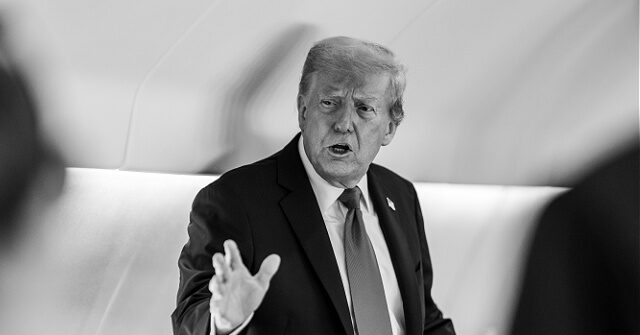

President Donald Trump expressed dissatisfaction on Friday with Iran’s latest peace proposal, cautioning that a resolution may remain elusive. He described the Iranian leadership as “very disjointed” and confirmed he has been briefed on potential military options should negotiations fail.
As he left the White House to speak with reporters, Trump emphasized that the revised offer from Iran, conveyed through Pakistani intermediaries, is insufficient despite ongoing diplomatic discussions.
“They want to make a deal, but I’m not satisfied with it,” Trump stated, explaining that Iran’s terms are unacceptable to him even though talks are still underway. He suggested that Iran’s eagerness for a deal indicates its vulnerability, remarking that the regime “wants to make a deal because they have no military left, essentially.”
Trump highlighted internal conflicts within Iran’s leadership as a significant impediment, noting that the country is struggling to unify after a sustained campaign by the U.S. and Israel that severely weakened its senior command.
“There’s tremendous discord—they’re having a tremendous problem getting along with each other,” Trump remarked. “The leadership is very disjointed. It’s got two, three, maybe four groups… they all want to make a deal, but they’re all messed up.”
This turmoil coincides with the reign of Iran’s new supreme leader, Mojtaba Khamenei, the son of former leader Ali Khamenei, who died in the early stages of the conflict. The younger Khamenei has yet to make a public appearance and is reportedly working from a secure location after sustaining serious injuries in the same attack.
The disarray comes as Iran’s new supreme leader, Mojtaba Khamenei — the son of former leader Ali Khamenei, who was killed in the opening phase of the conflict — has yet to appear publicly and is reportedly operating from a secure location following severe injuries sustained in the same strike.
In statements issued Thursday via Iranian state media, Khamenei signaled a hardline posture, warning Iran would continue to assert control over the region while pushing back against U.S. demands, even as competing factions jockey for influence behind the scenes.
While Trump said Iran has “made strides” in recent contacts, he expressed doubt the regime can ultimately align on terms acceptable to Washington. “I’m not sure they ever get there,” he said, referring to reaching an agreement that meets U.S. terms.
Trump also confirmed he was briefed Thursday by U.S. Central Command on potential next steps following the latest developments, describing a stark choice between renewed military action and continued diplomacy.
“There are options,” Trump said. “Do we want to go and just blast the hell out of them and finish them forever, or do we want to try to make a deal? Those are the options.”
While emphasizing he would prefer to avoid escalation “on a human basis,” Trump made clear military action remains on the table if negotiations collapse.
The remarks came as Iranian state media reported early Friday that Tehran had submitted a revised proposal to the United States via Pakistani mediators — a development later confirmed by Pakistani officials who said the response had been conveyed to U.S. officials.
According to reporting by the Wall Street Journal on Friday, the updated proposal softens some of Iran’s earlier conditions — including dropping its demand that the United States lift its naval blockade before talks begin — but continues to defer substantive negotiations over its nuclear program while seeking sanctions relief.
The report indicates Tehran is proposing to discuss conditions for reopening the Strait of Hormuz alongside U.S. guarantees tied to de-escalation, while pushing core nuclear issues to a later stage — an approach that remains a non-starter for Washington.
Trump has repeatedly emphasized — including earlier this week — that any agreement must directly address Iran’s nuclear program, warning there will be “no deal” unless Tehran agrees it will never obtain a nuclear weapon.
The diplomatic push comes as a fragile ceasefire — in place since early April following nearly six weeks of fighting that began with the February 28 launch of Operation Epic Fury — continues to hold, even as tensions remain elevated.
Trump has also pointed to the ongoing U.S. naval blockade as a central source of leverage, arguing this week that the pressure campaign has forced Tehran back toward negotiations while continuing to strain its economy.
Despite renewed diplomatic movement, Trump said he is “not satisfied” with Iran’s latest proposal, casting doubt on the regime’s ability to reach an agreement as the United States maintains its economic pressure campaign and keeps military options on the table.