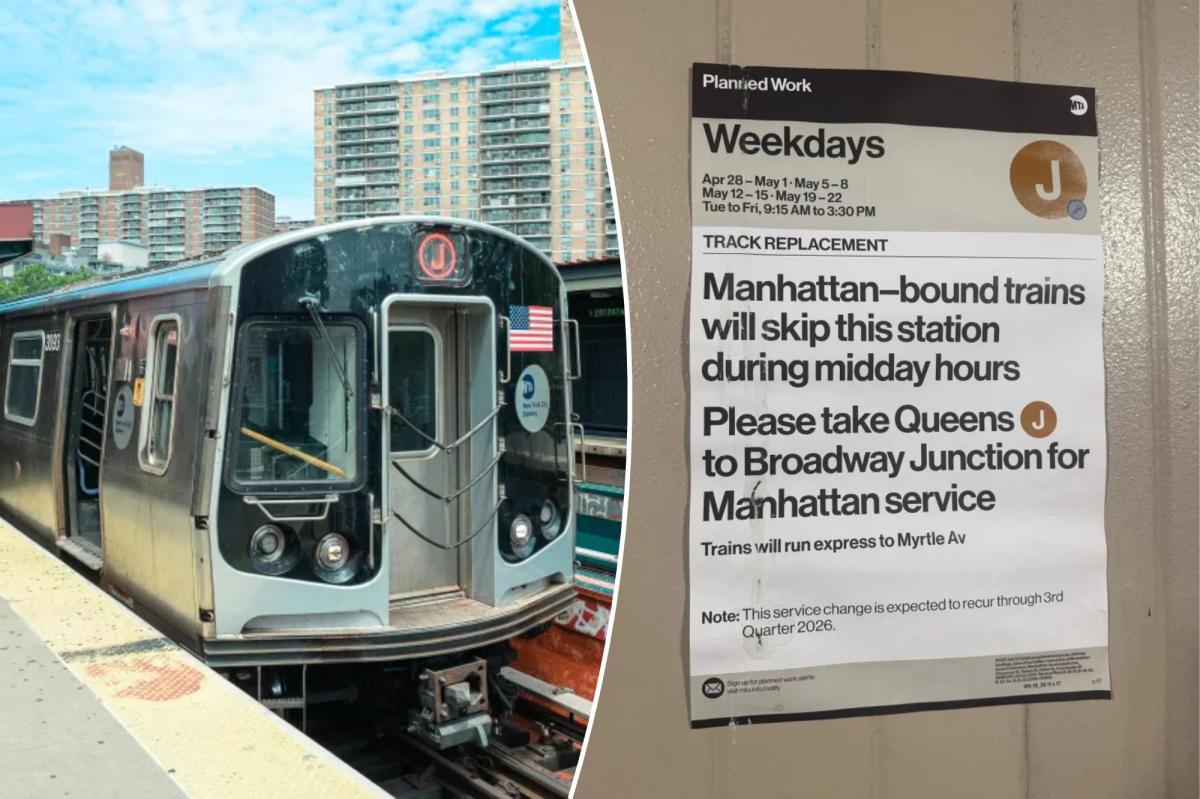


Introducing the latest twist in MTA commuting: a perplexing journey to Manhattan that begins by heading in the opposite direction.
No story about New York City would be complete without some significant and occasionally exasperating subway challenges.
Recently, Brooklyn commuters have voiced their frustrations as the Manhattan-bound J train bypasses multiple Brooklyn stations during weekday midday schedules. This change has led some travelers to endure convoluted, reverse commutes, transforming what should be a 30-minute ride into an hour-long expedition.
Since early March, J trains traveling toward Manhattan have skipped the Chauncey Street, Halsey Street, Gates Avenue, and Kosciuszko Street stations between the hours of 9:15 a.m. and 3:30 p.m., from Tuesday to Friday. This is due to ongoing track replacement efforts, which are anticipated to last until the third quarter of 2026.
Fortunately, the evening return journey remains unaffected. Brooklyn-bound commuters traveling from Manhattan after 3:30 p.m. are spared from the midday skip-stop dilemma.
Bold notices scattered across Brooklyn J stations inform riders: “Manhattan-bound trains will skip this station during midday hours. Please take the Queens J to Broadway Junction for Manhattan service.”
In other words: Want to go west? First, head east.
And for many commuters, that workaround has become a daily migraine.
One fed-up Reddit user vented in a viral post titled, “Manhattan-bound J train is skipping Chauncey, Halsey, Gates And Kosciuszko until Fall 2026. I’m PISSED.”
“I am EXTREMELY pissed that the J train is skipping my stop on weekdays until Fall 2026 minimum and we know they always delay the end date anyway, so I’m even more mad,” the user wrote.
“Now I have to take the Queens-bound J all the way to Broadway Junction just to transfer to the other J train to Manhattan,” another complained.
The rider stressed that it’s “f—king crazy that a simple 30-minute commute to Manhattan now takes me an hour, sometimes longer.”
Transit experts say the maddening “backwards commute” phenomenon is becoming an increasingly common side effect of maintaining NYC’s aging, and famously nonstop, subway system.
“What could be more frustrating than traveling in the opposite direction of your destination?” Aaron Shavel, a civil engineer at the infrastructure think tank Aii and former general contractor on major MTA projects including the Second Avenue Subway, acknowledged to The Post.
“Sometimes it’s simply unavoidable,” he said. “The MTA takes painstaking steps to ensure that, while maybe not the most efficient, you can still get where you’re going.”
Another Brooklynite argued on Reddit that the MTA’s definition of “midday” was wildly out of touch with reality: “… 9:15 is really prime morning hours.”
But Shavel emphasized to The Post that transit agencies typically schedule maintenance windows specifically to avoid the system’s busiest rush-hour crushes — even if riders traveling slightly later still feel caught in the crossfire.
“Maintenance windows are scheduled primarily around peak commuting periods, when the largest number of riders are using the system,” he explained.
“The goal is to minimize the impact on as many people as possible.”
Confusion surrounding the service changes appears to run even deeper than frustrated riders realize.
When a Post reporter visited Broadway Junction on May 21, signs still warned there was “no Manhattan service” from the affected stations and directed riders to board a Queens-bound train first.
Yet around 9:30 a.m., a Manhattan-bound J departing Broadway Junction unexpectedly made stops at Chauncey, Halsey, Gates and Kosciuszko anyway — despite signage suggesting otherwise.
The contradictory service left riders scrambling to figure out whether the dreaded “backwards commute” was actually necessary at all.
According to Shavel, inconsistent messaging can quickly erode commuter trust — especially when riders feel like they’re getting different answers from station signs and the trains themselves.
“One of the MTA’s biggest systemwide challenges is maintaining rider trust,” he said. “Clear communication is a huge part of that effort,” adding that “Static paper signage should not be the default in 2026.”
For weary commuters trying to plan out their mornings, the MTA’s latest service shuffle has become less “mass transit” and more “choose your own adventure.”
“I guess what I don’t understand is why don’t they at least just skip 1 or two stations at a time,” one user wrote. “Broadway Junction to Myrtle is like 2 miles of track, [there’s] no way they’re working on all of it at once.”
Another added, “this DOES affect my morning commute. It’s just so much extra stress and feels like we can’t catch a break on the J.”
But Shavel said large-scale station work often leaves transit agencies with limited options.
“Yes, sometimes skipping stations is unavoidable, especially when working inside the stations themselves,” he explained.
“To the MTA’s credit, they often go out of their way to minimize rider inconvenience — often to the detriment of the project itself,” he added. “Avoiding full shutdowns typically adds both time and cost to the overall work.”
As New Yorkers do best, many commuters have already begun crowdsourcing survival tactics.
One rider “started walking to Myrtle,” saying it’s easier not to have “to go backwards just to make the Manhattan-bound J.”
Others suggested bus detours, including the B26 route to Broadway Junction or nearby A/C trains, while another advised ignoring navigation apps entirely: “Google Maps and Apple Maps will never give you a good detour.”
And while Brooklyn J riders may feel uniquely doomed right now, in Queens, 7 train riders are now bracing for years of similar disruptions as station reconstruction and infrastructure work stretches into 2027 — with some trains already skipping multiple stops and forcing commuters into detours and extra transfers just to keep heading toward Manhattan.
The MTA has said the massive overhaul is tied to structural repairs and flood protection upgrades after crews uncovered severe deterioration along portions of the aging line.
Meanwhile, the agency is continuing major weekend shutdowns on parts of the G train between Queens and Brooklyn this summer as crews modernize signal systems and repair tunnels.
Even Bronx straphangers on the 4 train are dealing with station bypasses expected to last through September 2026 as part of ongoing station improvement projects.
“It is important to remember and appreciate that the New York City subway is the only truly 24-hour system in the world,” Shavel said.
“That comes with tradeoffs,” he added. “Would you rather be slightly inconvenienced every night or all at once every five years?”