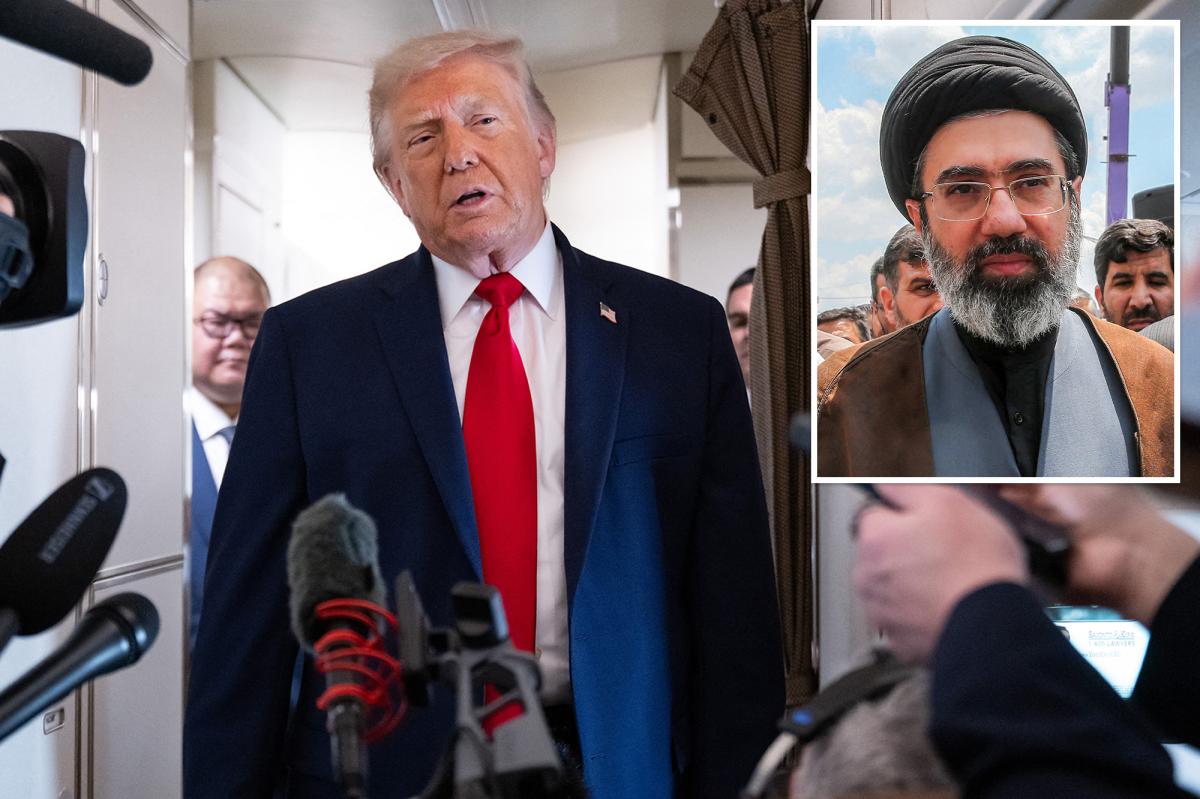


President Trump has voiced optimism about the potential for a more balanced approach from Iran’s new Supreme Leader, Mojtaba Khamenei. He shared his belief that a deal with Iran is “very close,” suggesting a shift in tone compared to previous interactions with the Islamic Republic.
During an appearance on NBC’s “Meet the Press,” Trump addressed concerns that his policies might lead the U.S. into another protracted conflict. He emphasized the strategic importance of preventing Iran from advancing its nuclear capabilities, including considering the use of force to seize Iran’s enriched uranium if necessary.
When asked about the differences between Mojtaba Khamenei and his late father, Ayatollah Ali Khamenei, Trump remarked, “Younger. I think more rational.” He also noted Mojtaba’s recent injury, sustained during an Israeli strike that killed his father on February 28. “Injured. He’s pretty badly injured. So there’s a certain bravery there,” Trump commented, highlighting the new leader’s resilience amid the ongoing conflict.
The U.S. and Iran, after enduring over five weeks of hostilities, reached a cease-fire agreement on April 8. Since then, both nations have been engaged in discussions to establish a framework for peace. A critical element of these negotiations, as emphasized by Trump, is Iran’s surrender of its 60% enriched uranium stockpile, which poses a significant proliferation risk due to its proximity to weapons-grade enrichment.
After over five weeks of fighting, the US and Iran agreed to a cease-fire on April 8 and have spent the past two months negotiating a framework for a peace deal.
Trump has been insistent that Iran surrender its stockpile of 60% enriched uranium, which is a few technical steps away from weapons-grade enrichment.
Other Trump administration officials have publicly insisted that the US should get Iran’s 20% enriched uranium supplies as well, though it’s not clear if that’s a dealbreaker for the president.
“I think we’re very close. We have a couple of points,” Trump said on the deal being negotiated with Iran. “They don’t even seem like big points. They’ve conceded the fact that they will not have nuclear weapons.”
Late last month, Trump sought edits to the framework being negotiated with Iran for a broader peace deal.
Trump also stressed that the status quo “isn’t sustainable” for Iran as the US blockade ensures Iran is “losing $400-500 million a day.” Trump imposed the blockade on Iran in April in response to the regime wreaking Havoc on the Strait of Hormuz.
“They’re strong. They’re proud. There are things they never thought they’d be doing that they’re going to have to do. They’ve got no choice. And it takes a little while,” the president replied when asked why Iran isn’t caving. “You know, you’re talking about 47 years of getting away with whatever they wanted.”
The war in Iran has divided elements of Trump’s MAGA base due to his railing against “endless wars” in the Middle East during his campaign for the presidency.
But the president rejected that backlash.
“I didn’t promise anything. I don’t like these endless wars. This is not an endless war. We’ve been doing this for three months. Much of it has been under the form [of] a pretty good form of cease-fire,” he said.
“We destroyed the capability of Iran in a matter of days. Nobody’s ever seen anything like it. Now I’m going to finish it. But remember, you were in Vietnam [for] 19 years because of stupid people. You were in so many different countries,” he added. “Look at Iraq. You were there for years.”
During his wide-ranging interview on “Meet the Press,” Trump also reiterated that he is willing to use military force to retrieve Iran’s highly enriched uranium, something that is widely seen as a highly complex and risky operation.
However, Trump stressed that he would prefer to send US troops into Iran once a deal with the theocratic regime has been inked.
“Yeah,” Trump said when asked. “But the way you do it is if we make a deal, if we make a deal now we’re friendly, we’ll all go together. It’ll be our equipment. We’ll take it out and destroy it, whether it’s on-site or whether we take it off-site.”
“Now, if we don’t make a deal, then we’re going to take them out militarily very harshly,” he added. “And we’ll wait till we do that before we go, in which case we’ll have safety either way.”


