Share this @internewscast.com

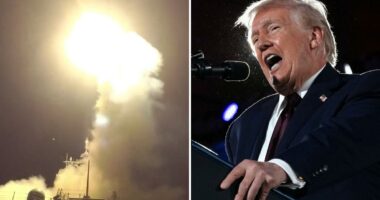
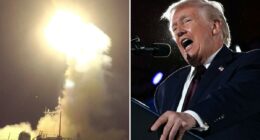
WASHINGTON — President Trump is “ready to unleash hell” on Iran should they refuse to “strike a deal,” according to White House press secretary Karoline Leavitt on Wednesday. This statement comes as thousands of US Marines have made their way to the region, potentially to ensure the reopening of the Strait of Hormuz.
“Should Iran fail to recognize their military defeat, President Trump is committed to striking them harder than ever,” Leavitt announced to reporters at the White House.
“President Trump does not make empty threats. He is completely prepared to unleash hell. Iran should avoid making another serious error. Their previous missteps led to the loss of their top leadership, navy, air force, and air defense systems.”
In response, Iranian officials expressed hostility towards a 15-point peace proposal sent through Pakistan on Tuesday, countering with demands for war reparations and recognition of Tehran’s control over the vital strait.
“Any further violence will be due to the Iranian regime’s refusal to accept their defeat and come to an agreement,” Leavitt emphasized.
The arrival of Marines near Iran’s coastline raises the possibility of the first ground missions by US forces since the conflict began on Feb. 28. There is significant speculation that these forces might target the strait or potentially move to seize Iran’s Kharg Island fuel loading site further into the Persian Gulf.
“Look, that’s a hypothetical question,” Leavitt said regarding possible ground operations. “It’s also a decision that would have to be made by the commander in chief, and I’m not going to get ahead of him.”
Trump is dramatically expanding the US troop presence near Iran — with roughly 7,000 Marines, sailors and Army parachutists en route to the Middle East.
The USS Tripoli, an amphibious assault ship capable of launching F-35B stealth fighter jets and helicopters, was spotted Monday at the Diego Garcia naval base south of Iran after arriving from East Asia. About 2,000 Marines and sailors are believed to be aboard the Tripoli and smaller support ships from the 31st Marine Expeditionary Unit.
Another amphibious assault ship, the USS Boxer, and supporting vessels from the 11th Marine Expeditionary Unit are expected to arrive from San Diego in mid-April.
Roughly 2,000 soldiers from the Army’s 82nd Airborne Division, which specializes in parachute missions, also are en route and could arrive soon.
The repositioning comes after Trump assembled a vast amount of US air power for the initial assault, including at American bases in countries near Iran and as part of two aircraft carrier strike groups: the USS Abraham Lincoln-led group in the Arabian Sea and joining the USS Gerald R. Ford, now moored to Crete for repairs following a laundry fire.
Trump told The Post on the third day of the conflict that he has no “yips” about committing troops on the ground if they were “necessary.”
Leavitt said the White House has no “specific timeline” for reopening the strait, but that “it’s obviously something the administration is working towards as quickly as we can.”
Iran has closed the strait to most commercial vessels for nearly a month — prompting Trump to deploy additional US troops and naval assets to the region.
Leavitt noted that the administration has sought to ease the effects of the fuel bottleneck with various actions over the course of the war.
She also insisted that US-Iran talks “continue” and are “productive” — despite Tehran publicly rebuffing an American framework for peace.
“They have not. Talks continue,” Leavitt said in response to a question about whether conversations between Washington and Tehran have halted.
“They are productive, as the president said on Monday, and they continue to be.”
Officials also described US-Iran negotiations in Geneva as “productive” days before Trump launched Operation Epic Fury Feb. 28.