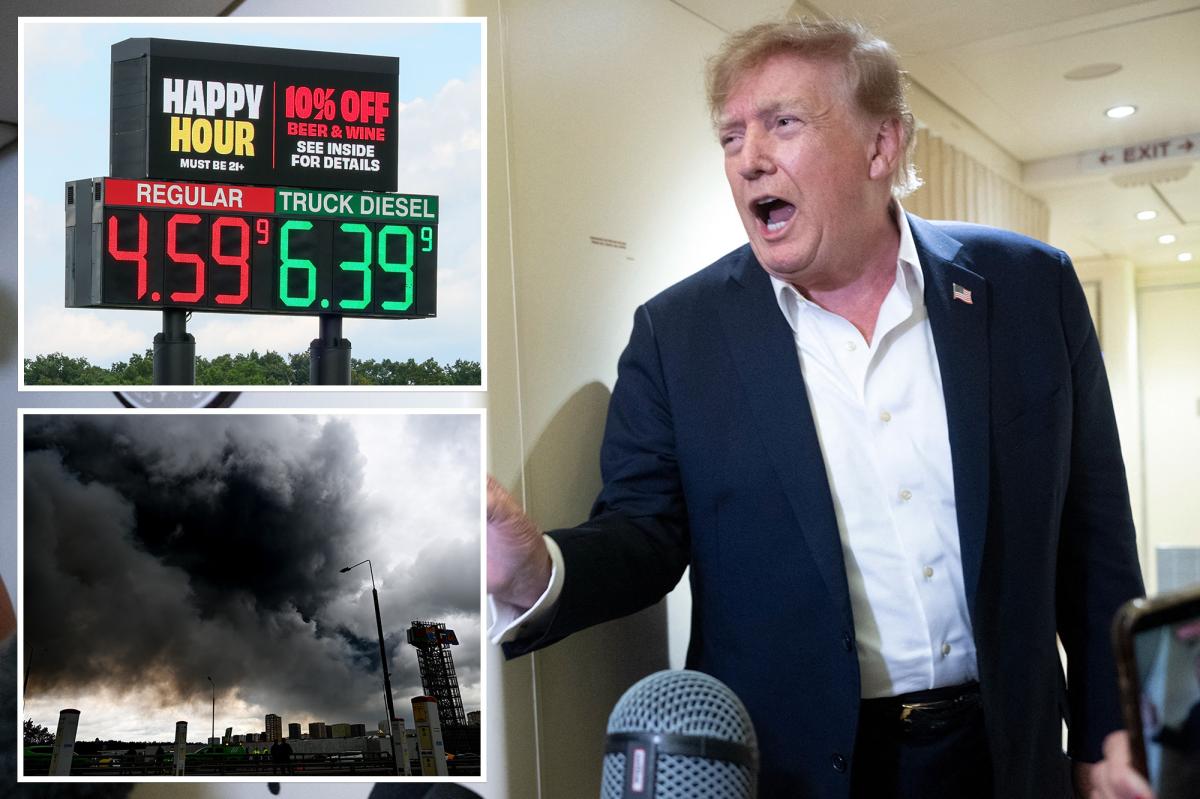

President Donald Trump said Monday that Russia and Ukraine had reached a mutual understanding to halt strikes against one another’s energy facilities. His announcement came a day after he accused Kyiv of “hurting the world” by attacking Russian diesel infrastructure.
“Ukraine has agreed not to hit Russian Energy targets,” Trump posted on Truth Social. “Russia has agreed to do, likewise!” He argued that the surge in global diesel prices was driven primarily by the Russia-Ukraine war rather than the conflict involving Iran.
Ukraine has spent months launching long-range attacks on Russia’s oil and gas sector. The strikes have contributed to fuel shortages and rationing inside Russia, prompting Moscow to suspend diesel exports in July. That decision further tightened supplies in an already strained global market, where petroleum shipments through the Strait of Hormuz have also declined amid the U.S. war with Iran.
AAA reported that the national average price for a gallon of diesel reached $6.23 Monday morning, the highest level ever recorded.
Speaking to reporters during the Irish Open golf tournament at his Doonbeg club, Trump said Ukrainian President Volodymyr Zelensky needed to stop targeting Russia’s diesel production.
“We spoke to Mr. Zelenskyy about it. There are plenty of other targets,” Trump said. “Don’t hit diesel fuel, because that’s hurting, that’s hurting the world.”
Ukrainian officials did not immediately comment on Trump’s announcement.
The International Energy Agency said in a report released Friday that Gulf nations’ combined net exports of diesel and gasoil in August had fallen to “just over a quarter” of their level before the war on Iran began in February.
The agency said damage to Russia’s refining network, combined with a near-total halt in Russian petroleum product exports following an escalation in Ukrainian attacks, had deepened the global supply losses. In February, diesel and gasoil exports from the Gulf and Russia together represented nearly 45% of worldwide seaborne trade, according to the IEA.
Kyiv maintains that Russia’s energy industry helps finance the invasion and supplies the fuel needed to sustain Moscow’s military campaign, now in its fourth year.
At the same time, Russia has intensified its aerial assault on Ukraine, deploying ballistic missiles and jet-powered drones to challenge the country’s defenses. Ukrainian officials say Moscow has been striking the power grid ahead of winter in an effort to weaken morale among civilians.
Local authorities said two people died and 14 others were injured near an oil and industrial center in Russia’s Tatarstan. Ukrainian officials, meanwhile, reported that Russian drones attacked the Black Sea port of Odesa and sparked a fire near a border crossing with Poland.
The two Russian civilians died after a drone slammed into a tree near their parked car in the city of Nizhnekamsk, according to the office of regional head Rustam Minnikhanov. Nizhnekamsk houses a key cluster of oil refineries and other industrial plants. Mayor Radmir Belyaev said that a fire had broken out at an unspecified “enterprise.”
Ukraine also claimed to have hit a major oil refinery in Slavyansk-on-Kuban, in Russia’s Krasnodar region near Crimea. The Defense Intelligence of Ukraine (DIU) agency said its drones struck a key oil processing unit and the refinery’s tank farm overnight into Sunday.
Krasnodar authorities said the strike on “an enterprise” in Slavyansk-on-Kuban injured three people and damaged an oil pipeline.
Russian forces shot down 389 Ukrainian drones during the night, Russia’s defense ministry said Sunday.
In Ukraine, at least nine people were injured in a “massive” Russian nighttime attack on Odesa, according to Serhii Lysak from the city’s military administration. Odesa is home to Ukraine’s main port hub on the Black Sea and has faced sustained drone and missile strikes, with Kyiv accusing Moscow of trying to choke off its exports.
With Post wires