
Share this @internewscast.com
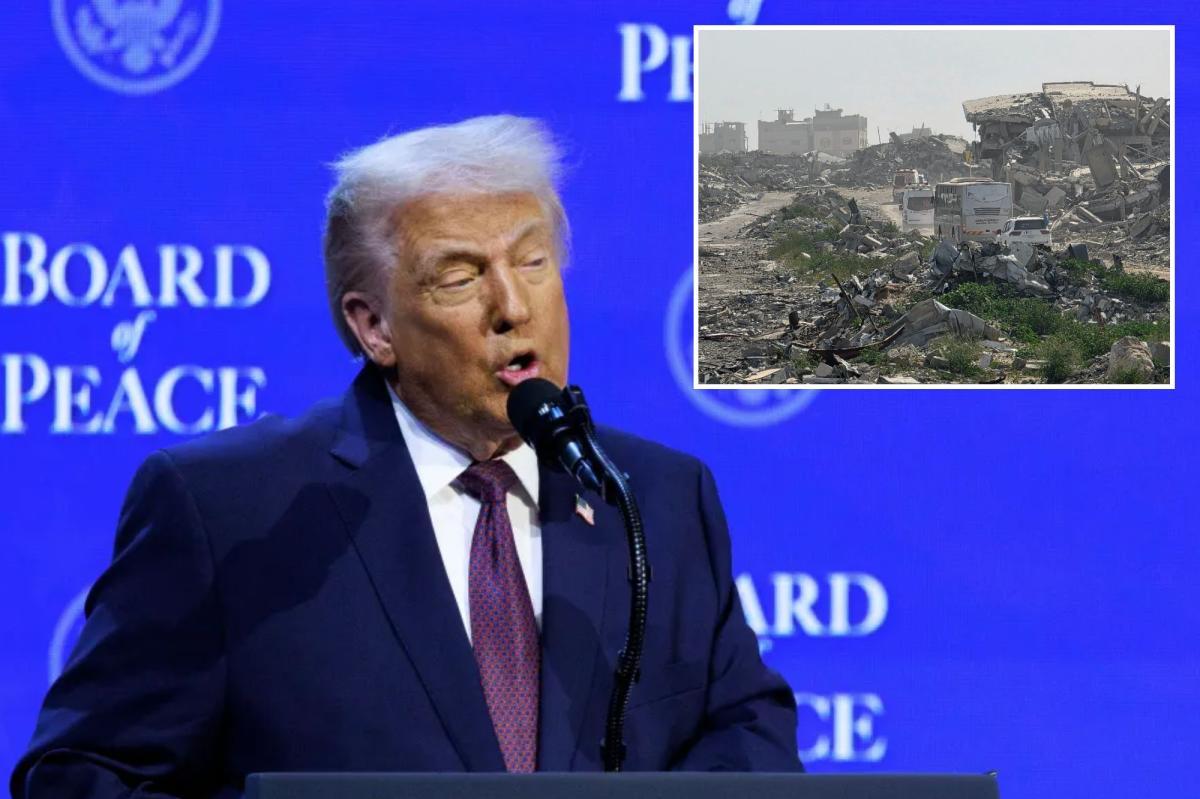
In West Palm Beach, Fla., President Trump made a significant announcement on Sunday regarding the Board of Peace, a newly established entity under his leadership. The board has committed to channeling $5 billion into the reconstruction of the war-torn Gaza region. Furthermore, it plans to deploy thousands of personnel to participate in international stabilization and policing efforts in the territory.
These commitments are set to be officially unveiled during the board’s inaugural meeting in Washington this Thursday, as President Trump revealed. “The Board of Peace will stand as the most impactful International Body in history, and I am honored to take the role of its Chairman,” Trump stated through a social media post highlighting these pledges.
While President Trump did not specify the nations involved in these pledges, a noteworthy development came from Indonesia. On Sunday, Indonesia’s military announced its readiness to mobilize up to 8,000 troops by the end of June, poised for deployment in Gaza as part of a humanitarian peace initiative. This marks the first concrete commitment under the Republican president’s administration.

The task of reconstructing the Palestinian territory is formidable. Joint assessments by the United Nations, World Bank, and European Union place the reconstruction costs at a staggering $70 billion, a reflection of the widespread devastation following over two years of Israeli military offensives.
A critical component of the ceasefire agreement involves deploying an international armed stabilization force to maintain security and achieve the disarming of the militant Hamas group—a primary requirement set forth by Israel. However, the proposal has yet to attract significant interest from other nations willing to contribute to the force.
The ceasefire deal calls for an armed international stabilization force to keep security and ensure the disarming of the militant Hamas group, a key demand of Israel. Thus far, few countries have expressed interest in taking part in the proposed force.
The Oct. 10 US-brokered ceasefire deal attempted to halt a more than 2-year war between Israel and Hamas. While the heaviest fighting has subsided, Israeli forces have carried out repeated airstrikes and frequently fire on Palestinians near military-held zones.

It is not clear how many of the more than 20 members of the Board of Peace will attend the first meeting. Israeli Prime Minister Benjamin Netanyahu, who held White House talks with Trump last week, is not expected to be there.
Trump’s new board was first seen as a mechanism focused on ending the Israel-Hamas war in Gaza. But it has taken shape with his ambition for a far broader mandate of resolving global crises and appears to be the latest US effort to sidestep the United Nations as Trump aims to reset the post-World War II international order.
Many of America’s top allies in Europe and elsewhere have declined to join what they suspect may be an attempt to rival the Security Council.
Trump also confirmed that Thursday’s meeting will take place at the US Institute of Peace, which the State Department announced in December it was remaining the Donald J. Trump US Institute of Peace.
The building is the subject of litigation brought by former employees and executives of the nonprofit think tank after the Republican administration seized the facility last year and fired almost all the institute’s staff.