
Share this @internewscast.com

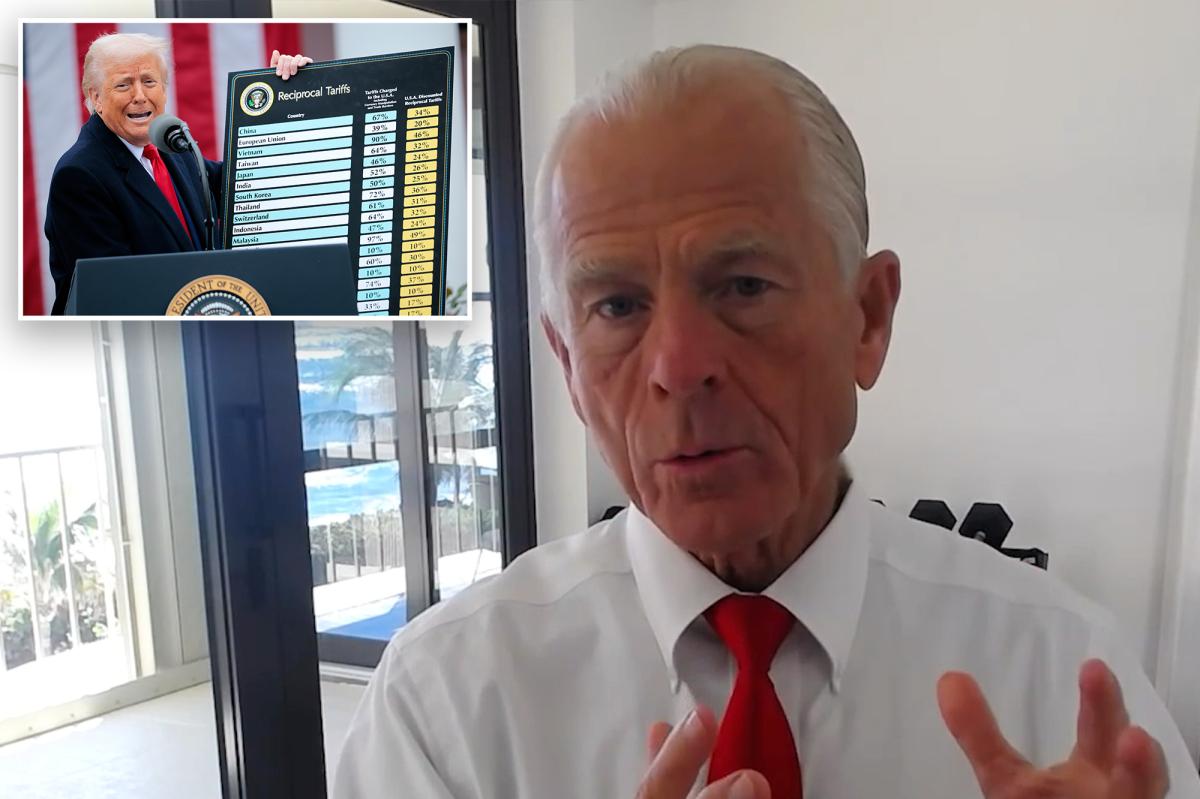
WASHINGTON — Peter Navarro, President Trump’s top advisor on trade and manufacturing, is prepared to implement “Plan B,” which involves imposing additional tariffs on trade partners following the Supreme Court’s rejection of “emergency tariffs.”
During an interview on “Pod Force One,” Navarro highlighted that while the Supreme Court dismissed the use of tariffs under the International Emergency Economic Powers Act (IEEPA), it did not address tariffs under other executive authorities. These include Sections 301 and 122 of the Trade Act of 1974, Section 232 of the Trade Expansion Act of 1962, and Section 338 of the Smoot-Hawley Tariff Act of 1930.
“The President has several powers delegated by Congress, and we intend to utilize them,” Navarro explained to Miranda Devine of The Post in the latest podcast episode released on Wednesday.
Navarro further noted that the Supreme Court’s decision has inadvertently reinforced these powers, as several justices cited them. He expressed confidence that in future legal challenges, the administration would have the Supreme Court’s backing.
Last Friday, the Supreme Court ruled against Trump’s application of the IEEPA to impose tariffs unilaterally.
Although the court’s majority opinion did not address the legality of Trump’s other tariff powers, conservative Justice Brett Kavanaugh mentioned these as viable alternatives in his dissenting opinion, a point Navarro emphasized during his discussion with The Post.
“We don’t see this as having struck a heavy blow,” Navarro explained, referring to how the Supreme Court shut down the IEEPA tariffs specifically. “We believe that this will actually be a very good thing for the Trump tariff policy, because if you analyze the decision, Miranda, it was very narrow in scope.”
IEEPA tariffs constituted about $133 billion of the roughly $251 billion worth of tariff revenue collected in fiscal years 2025 and 2026 as of last December, according to data from US Customs and Border Protection.
Trump favored IEEPA, a statute that never mentioned the word “tariff” and has never been used by another US president to impose them, because his other trade authorities are more onerous and complicated.
Every week, Post columnist Miranda Devine sits down for exclusive and candid conversations with the most influential disruptors in Washington on ‘Pod Force One.’ Subscribe here!
After the setback from the Supreme Court, Trump reimplemented a baseline tariff rate under Section 122 of the US Trade Act of 1974, bumping it up from its prior 10% to 15%.
The increase in worldwide baseline tariffs is because Trump’s ability to easily impose customized rates on specific countries under IEEPA has been shut down.
To impose country-specific tariffs, Trump’s team intends to use Section 301 of the Trade Act of 1974, which requires US Trade Representative Jamieson Greer to first conduct investigations on the trade practices of other countries before imposing specific retaliatory duties.
The Section 122 tariffs are set to expire after 150 days of issuance unless Congress re-ups them, which is not expected. That’s why the Trump administration is conducting studies and taking other steps to tap into his other authorities.
“It’s a very flexible tool,” Navarro stressed when asked about why the Trump administration went with IEEPA to impose the “Liberation Day” tariffs.
“We knew going in that there was a possibility that they [the IEEPA tariffs] would be struck down.”
Full Episode
Navarro, who has long been an advocate of protectionist trade policies, contended that Trump’s tariff regime has been critical to bringing back manufacturing to the US.
The White House manufacturing honcho noted that his favorite economic indicator for tracking the US is the Institute of Supply Management Manufacturing Index.
“When it’s below 50[%], then manufacturing is in decline,” he said. “When it’s above 50[%], manufacturing is expanding,” the trade adviser continued. “It’s been since August of 2022, during the Biden regime, that that index fell below 50[%].”
“I mean, [former President Joe] Biden was just killing our manufacturing. And when we got in, that thing was stubbornly lagging below 50[%] for many, many months, even as some of these other manufacturing indicators said, ‘No, things are good,’” he added.
“Finally, in the last time around, it jumped five points, well into above 50[%] territory. And that’s what’s happening,” he said.