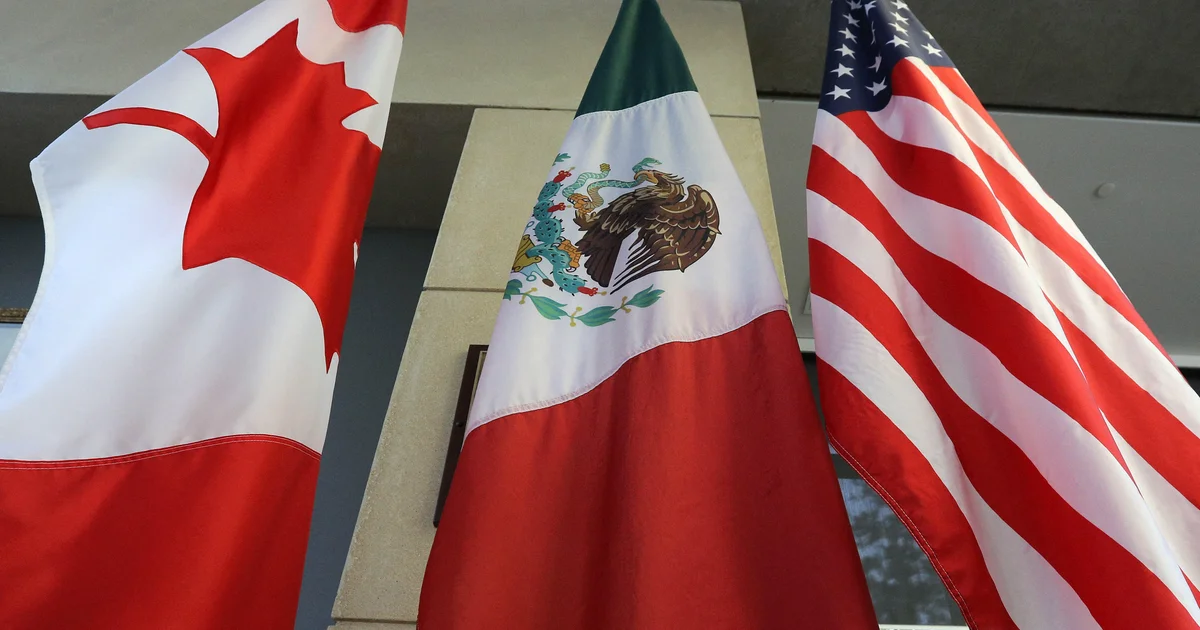

The United States will not move to extend a major trade agreement with Canada and Mexico at this time, the Office of the United States Trade Representative said.
The decision came ahead of a July 1 deadline for the three nations to determine whether the United States-Mexico-Canada Agreement, known as the USMCA, should be extended through 2042. With the Trump administration declining to support an extension, the pact will remain in place under its current terms, with annual reviews continuing for the next 10 years. Unless the countries reach a new arrangement, the agreement is set to expire in 2036.
“The United States will continue to engage with Mexico and Canada to address the agreement’s shortcomings and our trade deficits with these countries,” U.S. Trade Representative Jamieson Greer said in a statement. “However, the agreement remains in force pending resolution of these issues or until the agreement’s termination.”
Focus on the U.S. trade deficit
President Trump signed the USMCA into law in 2020, replacing the North American Free Trade Agreement, the 1994 pact that had governed trade across the continent for more than two decades.
The agreement was designed to reduce trade barriers among the U.S., Mexico and Canada while boosting American jobs and strengthening domestic manufacturing. One of its most notable provisions reshaped rules for the auto industry, requiring 75% of a vehicle to be produced in North America in order to qualify for duty-free treatment.
When promoting the deal at a Michigan event in 2020, Mr. Trump described it as the “fairest, most balanced and beneficial trade agreement we have ever signed into law.” His view has since shifted. Speaking with reporters in June, Mr. Trump said the U.S. would “do better as a country” without the agreement.
A senior Trump administration official told reporters that the USMCA has not succeeded in narrowing the U.S. trade deficit with Canada and Mexico. “We believe that the USMCA does not operate to control the deficit like the president intended,” the official said.
Figures from the Trade Representative’s office show the U.S. trade deficit with Mexico reached nearly $197 billion in 2025, while the trade gap with Canada topped $46 billion.
U.S. officials are scheduled to meet with Mexico represenatatives the week of July 20 for another round of bilateral negotiations. During those talks, the two countries will discuss rules of origin, intellectual property and concerns surrounding Mexico’s compliance with labor obligations, the senior administration official said.
The official did not discuss specific plans to meet with Canada, but said, “We will continue our discussions with our Canadian partners.”
Talks could take years
The Trump administration could decide to withdraw from the USMCA altogether before it expires in 10 years, though that decision will likely depend on how negotiations unfold. Those talks could drag on for years, according to trade experts.
ALSO READ: Unmasking the Church: Hugh Jackman's Faith and Emily Watson's Chilling Accusations
The senior administration official expressed interest in resolving the major sticking points of the trade deal quickly, adding that Mr. Trump could reach an agreement with Mexico and Canada to alter their trade pact before his term expires in 2028.
“The president remains skeptical of this, but I think it’s in the interest of our country to keep negotiating,” the person added.
The impact of a U.S. withdrawal from the USMCA would depend on whether any bilateral trade agreements replaced the pact, according to trade experts.
“Absent bilateral deals, growth would slow in both Canada and Mexico as the tariff exemption, which has kept both countries’ external sectors afloat over the past year, was removed,” economists with investment advisory firm Capital Economics said in a report.
“But given the average tariff rate would only rise to 10%, rather than the much higher rates previously threatened under IEEPA, recessions could be avoided,” they added, referring to the International Emergency Economic Powers Act.
Alain Sherter