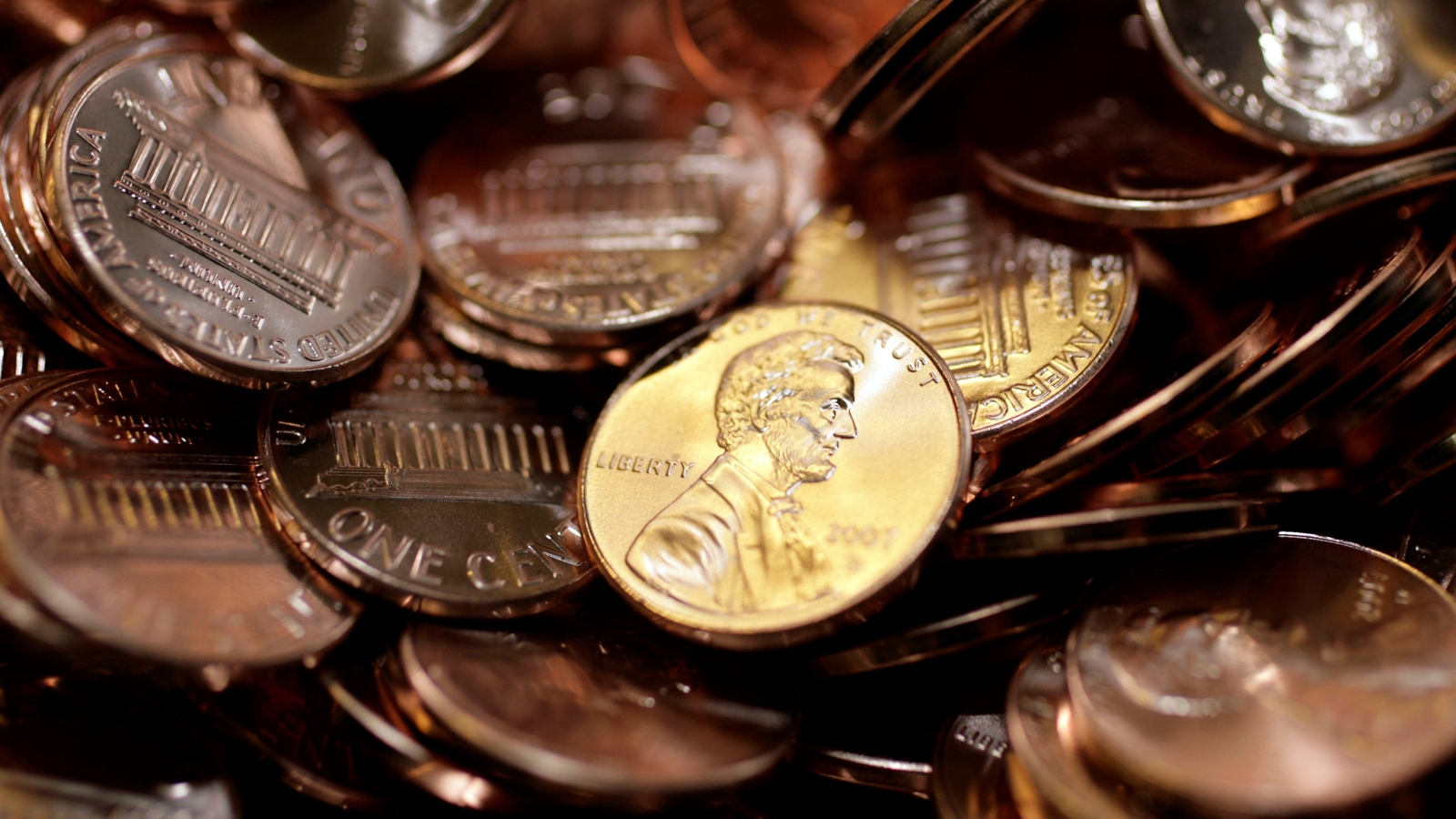

WASHINGTON — The U.S. Treasury Department has announced plans to gradually halt the production of new pennies starting early next year. This decision follows a directive from President Donald Trump to cease production of the coin, which has been a staple of American currency for over 230 years.
The Treasury Department stated that the U.S. Mint, which is under its jurisdiction, will cease the production of new pennies once the existing stock of blank templates, which are primarily composed of copper and zinc, is exhausted. The agency has confirmed that its final order for these penny blanks was placed this month.
According to a report by the Wall Street Journal, discontinuing the penny is anticipated to save the Treasury Department approximately $56 million each year by reducing material expenses, as outlined in the department’s statement.
“Additional savings will accrue as facility usage is adjusted and other efficiencies are achieved with the reduced production,” the Treasury Department said.
The agency announced the move just months after Trump criticized production of the coin in February as being “wasteful.”

In an announcement in February on his Truth Social platform, Trump said the cost of minting the coin featuring the profile of the country’s 16th president, Abraham Lincoln, is more than twice the currency’s face value.
“For far too long the United States has minted pennies, which literally cost us more than 2 cents. This is wasteful!” Trump wrote. “I have instructed my Secretary of Treasury to stop producing new pennies. Let’s rip the waste out of our great nation’s budget, even if it’s a penny at a time.”
According to the U.S. Treasury Department, the cost of producing a single penny has more than doubled in the past 10 years, from 1.3 cents to 3.69 cents in 2024.
Printing a paper $1 bill is cheaper than producing a penny, which, according to the U.S. Mint, is comprised of 97.5% zinc and 2.5% copper and requires a smelting process to mold the metals. According to the Federal Reserve, it costs Treasury’s Bureau of Engraving and Printing 3.2 cents to print a $1 note less than the cost of minting a penny.
The U.S. Mint reported losing $85.3 million on making pennies in fiscal year 2024, according to the Mint’s annual report to Congress.
The one-cent piece has been part of the fabric of America since 1792. Lincoln’s portrait has been embossed on it for 116 years, according the U.S. Mint’s website.
There are about 114 billion pennies currently in circulation in the United States, but they are severely underutilized, according to the Treasury Department.
“Given the cost savings to the taxpayer, this is just another example of our administration cutting waste for the American taxpayer and making the government more efficient for the American people,” the Treasury Department said in it’s statement.
The move would usually require the approval of Congress. Even though it’s part of the U.S. Treasury, “Congress authorizes every coin and most medals that the U.S. Mint manufactures and oversees the Mint’s operations under its Public Enterprise Fund,” according to the Mint’s website.
However, Laurence H. Tribe, the Carl M. Loeb University professor of constitutional law emeritus at Harvard Law School, told the Associated Press in February that the U.S. Code, a list of general and permanent federal statues, gives Treasury Secretary Scott Bessent the authority to scrap the penny.
“This action seems to me entirely lawful and fully constitutional,” Tribe said.
The penny will become the 12th U.S. currency denomination to be retired, joining the half-cent coin, the 2-cent coin, the 20-cent piece and the “trime” a silver three-cent piece issued from 1851 to 1873, Caroline Turco, assistant curator of the Money Museum in Colorado Springs, Colorado, told ABC News.
“We retired them for multiple different reasons, but normally because they were not being used or they just became too expensive to produce,” said Turco.
Is it a good idea?
Mark Weller is executive director of Americans for Common Cents, a Washington, D.C., organization that provides research to Congress and the executive branch on the benefits of the penny. He told ABC News that he believes eliminating the coin “is an absolutely horrible idea.”
“It would be bad for consumers and it would be bad for the economy. It really would, in fact, not save money, but it would increase government losses and have some unintended economic consequences,” Weller said.
Weller who disclosed to ABC News that he is also a lobbyist for companies in various industries, including Artazn, a Tennessee-based manufacturer of zinc products, some of which are used in making pennies said doing away with the penny would prompt the U.S. Mint to increase production of the nickel.
According to the U.S. Mint, the cost of minting a single nickel is nearly 14 cents, almost three times the coin’s face value and more than three-and-a-half times the cost of minting a penny.
“Without the penny, nickel production could nearly double, which would increase the Mint’s losses,” Weller said. “So, it’s just hard to understand how you could produce more nickels that are losing more money than the penny and say you’re going to save money.”
Weller further said that ditching the penny could lead to the cost of goods going up for American consumers.
“If there’s one thing most economists agree on is that private business has a profit motive. So, the assumption would be that they would price things in a way that they would round up, not round down,” Weller said.
Although digital payments are increasingly more common, Weller said cash remains a crucial tool, “especially for someone economically underserved and under-banked.”
The U.S. Mint produced 3.2 billion pennies in fiscal year 2024, according to the Mint’s annual report to Congress, with an estimated 250 billion pennies currently in circulation.
History of the penny
Turco, whose museum is the education branch of the American Numismatic Association, told ABC News that one big misconception about the penny is that, technically, it has never existed in the United States.
“The American system does not have a ‘penny.’ That is a misnomer,” Turco said. “We have a cent because when we rebelled against the British they had pennies and that is a British word.”
Turco said the 1-cent piece was first produced in the United States in 1792 and was originally the size of the present-day quarter.
Turco said Lincoln, whose likeness is also on the $5 bill, was added to the coin in 1909.
The United States wouldn’t be the first country to eliminate the coin, Turco said. Canada, for example, decided to phase out its penny in 2012. In the U.S., the Department of Defense stopped using pennies at its overseas bases in 1980 because it became too expensive to ship them.
Regardless of the penny’s fate, Turco said she believes it will always be a part of the United States, at least colloquially, adding that such phrases as “a lucky penny” and “a penny saved is a penny earned” will likely always be a part of the American lexicon. Perhaps, ironically, the penny’s value could increase if its discontinued.
“I think collectors will still enjoy having them,” Turco said. “But I don’t think that the value of a penny will just skyrocket overnight.”