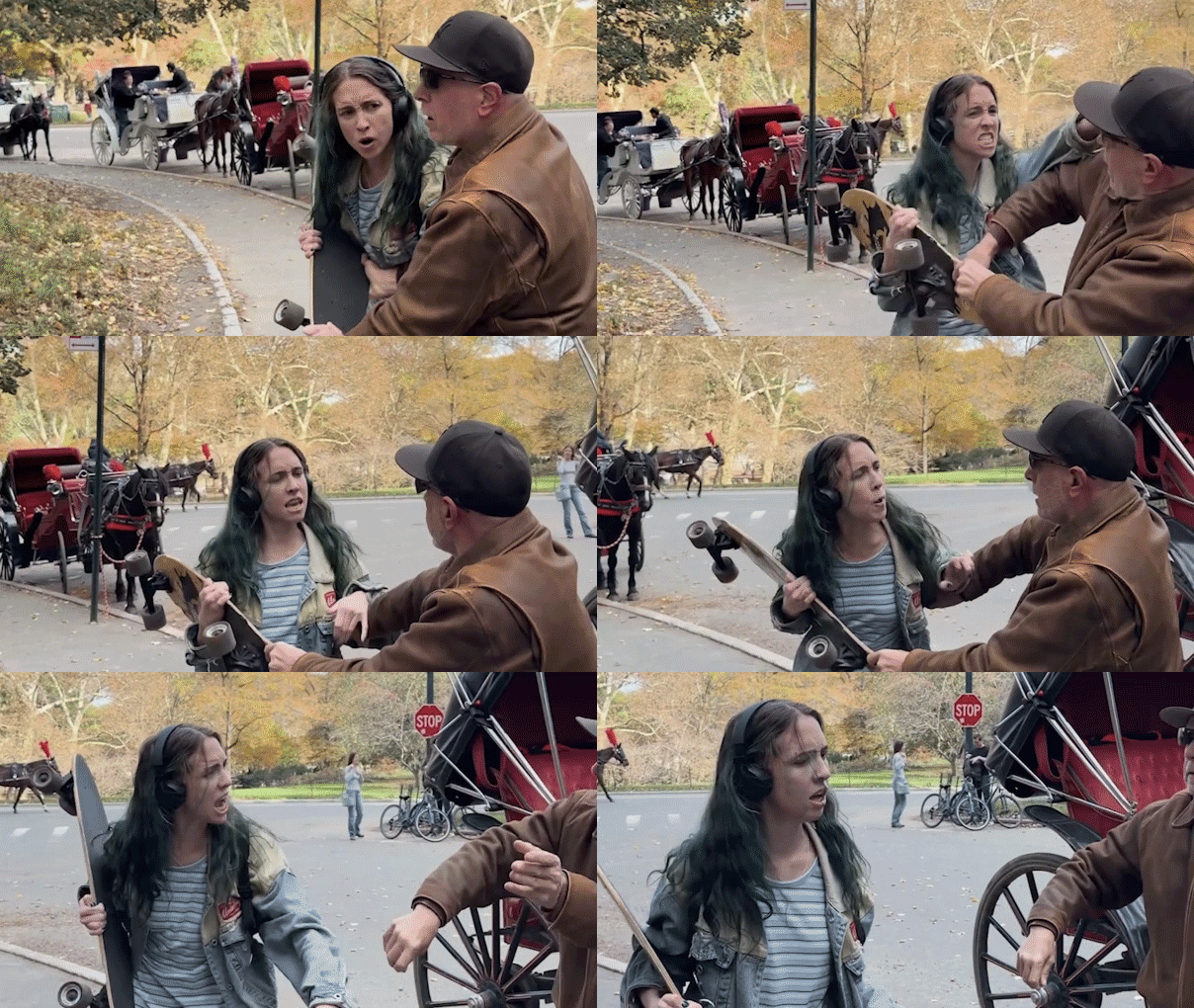

An animal rights activist allegedly attacked two horse-drawn carriage drivers in Central Park on Tuesday, using a skateboard during an angry, profanity-filled confrontation that unfolded in front of visiting families, according to union officials.
Abigail Holbrook, 27, of Philadelphia, was arrested after allegedly yelling at carriage operators and accusing them of animal abuse near a carriage stand, police and video from the scene show.
“You’re animal abusers! Horses do not do well in New York City. They are very sensitive to light and noise,” Holbrook shouted in footage of the confrontation. “The people that are f—— using these horses are animal abusers. I’m Squid the Kid, bro. Y’all will know my f—— name.”

Abigail Holbrook, 27, faces charges after police say she assaulted horse-carriage drivers in New York City’s Central Park. (Ali Yildirim)
The Transport Workers Union of America, or TWU, said Holbrook punched both 45-year-old drivers and hit one of them in the head with her skateboard during the dispute.
The two men sustained minor injuries but declined medical attention at the scene. New York City police arrested Holbrook, who faces two assault charges.

Police say Holbrook struck one of the victims with her skateboard during the confrontation. (Ali Yildirim)
“This is outrageous and unacceptable,” TWU Local 100 Administrative Vice President Alexander Kemp said in a statement. “We need a more visible police presence for our members at horse-carriage stands in the park to protect against these wackos. This is their place of work and people are coming just to harass and attack them. All workers deserve to be safe at work.”
Christina Hansen, a union shop steward who witnessed the alleged assault and contacted police, said the incident reflected rhetoric from city officials and animal rights advocates.
“The problem is that a lot of people, you know, don’t know anything about horses, and they get misled by these animal rights groups who liken it to slavery, and say that the horses are being tortured by being forced to drag heavy carriages around as if carriages don’t have wheels,” Hansen told News Outlet.
CHECK THIS OUT: Mystery Deepens in Search for Autistic Teen Missing From Camp
Hansen also argued that carriage drivers have a direct financial incentive to keep their horses healthy and properly cared for.
“Let’s face it, these organizations … make money by getting donations and there’s no money to be made by telling people that our horses are well taken care of,” she said. “I only make money if my horse is well taken care of because I can’t go to work if he can’t pull the carriage, if he doesn’t enjoy his job … so my monetary interest is that my horse is taken care of. Their monetary interest is that the horses are being abused or exploited or whatever.”
The confrontation comes as New York City’s horse-drawn carriage industry remains at the center of an ongoing political and legal fight.
Last month, the City Council voted 40-7 to approve Romanch’s Law, named for 18-year-old Romanch Mahajan, who died in June after being thrown from a runaway carriage in Central Park.
The measure would eliminate horse-drawn carriage operations by June 1, 2028, and require the city to create a transition program for more than 150 drivers and other industry workers.
People for the Ethical Treatment of Animals, or PETA, rejected the union’s criticism in a statement to News Outlet.

Horse-drawn carriages travel through Central Park on Wednesday, Oct. 14, 2026, in New York. (AP Photo/Yuki Iwamura)
“If the horse-drawn carriage trade is suddenly concerned about hostility and violence, it might start by looking in the mirror,” the organization said.
Horse-drawn carriages have long been part of the Central Park and Fifth Avenue landscape, offering tourists a traditional way to see New York City.
“Carriage horses have been pulling carriages in Central Park since the day the park opened in December 1858,” Hansen said. “They’ve been living on Manhattan since 1625. The city would not be the city that it is, and Central Park would not be the park that it is, except for horses.”


