

States are in a fierce competition to secure a portion of the newly established $50 billion rural health fund. However, concerns are mounting that the program’s lack of strict regulations and a hurried timeline could result in the most vulnerable providers being overshadowed by larger, politically influential health systems.
This substantial fund was introduced through the One Big Beautiful Bill Act as a financial safety net for states facing a projected $1 trillion reduction in Medicaid funding over the next decade.
According to Heather Howard, a Princeton University professor and former health official in New Jersey, while the fund certainly cannot compensate for the deep cuts introduced by H.R. 1, states are nonetheless eager to apply for any available federal support during such fiscally challenging times.
For some rural hospitals and health clinics, this funding could be a lifeline. However, there is skepticism among these providers about whether their urgent needs will be overshadowed by larger entities.
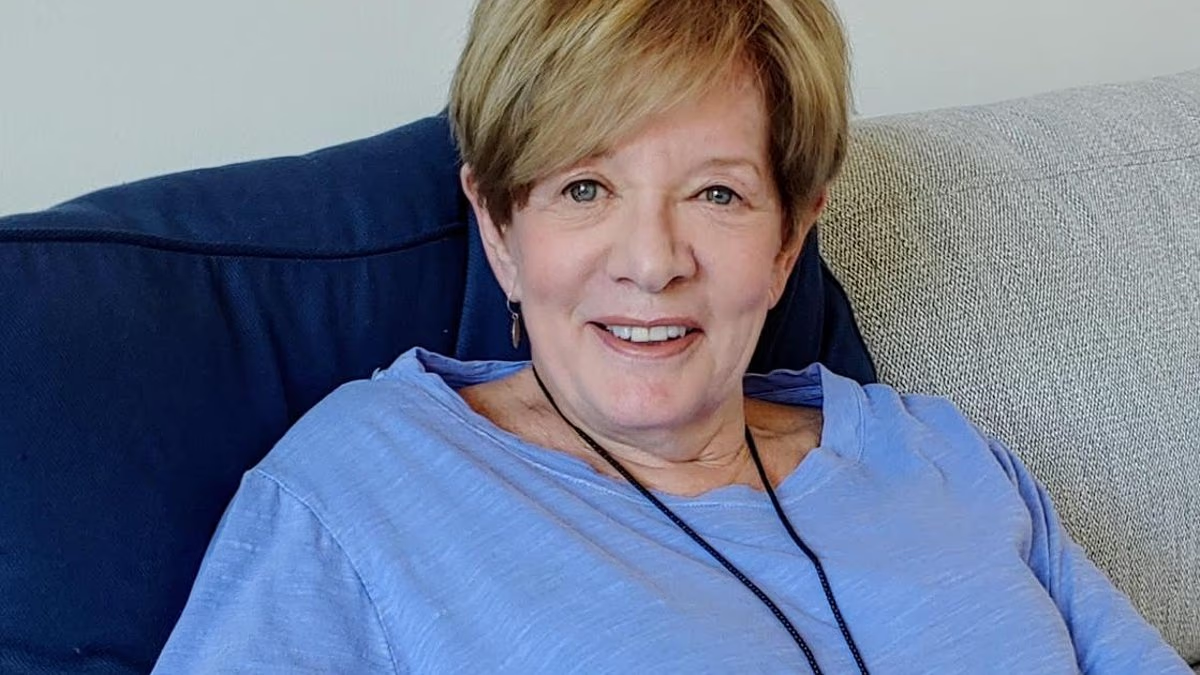
“There’s a real concern that, ultimately, these insider systems might prevent those who need help the most from receiving it, leading to missed opportunities in delivering essential health care,” expressed Michael Chameides, a county supervisor in Columbia County, N.Y., who also serves as the communications director at the Rural Democracy Initiative.
This initiative, the five-year $50 billion Rural Health Transformation Program, was included as a last-minute addition to President Trump’s major tax-and-spending bill, which passed into law this summer. The fund played a crucial role in garnering support from hesitant Republican lawmakers representing rural states.
However, there is no requirement that states direct the money to rural providers.
“The [notice of funding] from the feds does leave it a little bit loose as far as who’s eligible in the state, and they’re using the state to determine who is going to be best to get that money,” said Ryan Kelly, the executive director of the Alabama Rural Health Association.
The Federation of American Hospitals wrote to Centers for Medicare and Medicaid Services (CMS) Administrator Mehmet Oz in August, urging the agency to require states to prioritize rural hospitals in the funding decisions.
Kelly said his organization has been advising governors’ offices across the South about the importance of making sure the money benefits the rural providers as much as possible. Still, Kelly said he understands the states are going to need a balance if urban health systems or vendors can help advance the goals of improving health outcomes for rural residents.
The administration this week received applications from all 50 states. Federal health officials need to review and dispense the money by Dec. 31.
Under the program, $25 billion will be allocated to all states equally, meaning each state with an approved application would receive the same amount regardless of the size of its rural population.
The other $25 billion will be awarded at the discretion of Oz, based on criteria including whether states have adopted Health and Human Services Secretary Robert F. Kennedy Jr.’s “Make America Healthy Again” policies — rules that go beyond the statutory scope of the program.
For example, a state gets extra points on an application if it reintroduces the Presidential Physical Fitness Test, or if the state pursues a waiver to limit Supplemental Nutrition Assistance Program benefits for soda, candy and sugary beverages.
“This program moves us from a system that has too often failed rural America to one built on dignity, prevention, and sustainability. Every state with an approved application will receive funding so it can design what works best for its communities—and CMS will be there providing support every step of the way,” Oz said in a statement.
When applications opened in September, the CMS said it would consider individual state metrics as well as “applications that reflect the greatest potential for and scale of impact on the health of rural communities.”
The agency outlined several approved uses for the funds, which include prevention and chronic disease management; payments to health care providers; and hiring new workers with commitments to serve rural communities for a minimum of five years.
Each state has different approaches, but common themes include modernizing care delivery — such as telehealth services in underserved areas — access to healthy food and nutrition programs, and workforce development initiatives.
“So there’s the question of whether the state gets the money, but then there’s a question of within, when the state gets the money,” Howard said. “There’s politics at the national level, but there’s also politics in the state capitals, as stakeholders are also fighting.”
The other key component, Howard said, is sustainability. The fund only lasts for five years, while the Medicaid cuts in the law are permanent, so states need to invest in programs that are scalable and sustainable even when the funding dries up.
In Alabama, Kelly said, “every vendor in the entire world is calling” and asking to be included, though it’s still premature.
“The governor’s office doesn’t play a role in writing people into a grant. So if a vendor has a cure for cancer, I don’t think we would put them into this grant application just yet,” Kelly said.
Most experts and stakeholders agree the rural health fund can’t make up for the massive cuts included in the law that created it.
The One Big Beautiful Bill Act cuts about $1 trillion from Medicaid, primarily through stringent work requirements as well as reductions to how states can fund their Medicaid programs through provider taxes and state-directed payments.
Still, any influx of funding is helpful.
“In some ways, this Rural Health Transformation fund, best-case scenario is it cannot solve the damage that’s being done to health care this year, but at least it can do something helpful,” Chameides said.
Lisa Hunter, a senior director at advocacy group United States of Care, said there’s a lot of vagueness in certain CMS definitions, but she thinks the administration is giving states the right amount of flexibility.
“Not providing a one-size-fits-all … is, I think probably a benefit for states to be able to help define and make sure that the money is actually going somewhere that is useful.”