

On Tuesday, two American families took their battle to Italy’s highest judicial authority, challenging the breadth of a law that has been in place for over a year. This legislation, instituted by the government of Giorgia Meloni, restricts citizenship claims for Italian descendants beyond two generations.
Representing the families, attorney Marco Mellone presented arguments to the Cassation Court, suggesting that the law should only impact individuals born after its enactment. If accepted, this interpretation could potentially pave the way for millions of people in the U.S. and certain Latin American regions to claim Italian citizenship. Another attorney in the case is advocating for Italian descendants from Venezuela.
The court’s expanded panel is set to deliver a decision in the weeks ahead, which will hold authority over lower court rulings.
In March 2025, a decree from the conservative government altered previous regulations that allowed anyone who could trace their lineage back to Italy’s unification in 1861 to apply for citizenship.
Although Italy’s constitutional court recently upheld the validity of this law, Mellone contends that the supreme court has the jurisdiction to further clarify its implications.
“The families in this case are descendants of an Italian forebear who migrated to the United States in the late 19th century, similar to many other Italians,” Mellone stated prior to the hearing. “They are now asserting their right to Italian citizenship.”
Mellone’s case would clarify the citizenship rights of the descendants of some 14 million Italians who emigrated between 1877 and 1914, according to Foreign Ministry statistics, and beyond.
While Mellone’s case involves two families, another dozen people whose citizenship claims were stopped by the law were present outside the courthouse in solidarity.
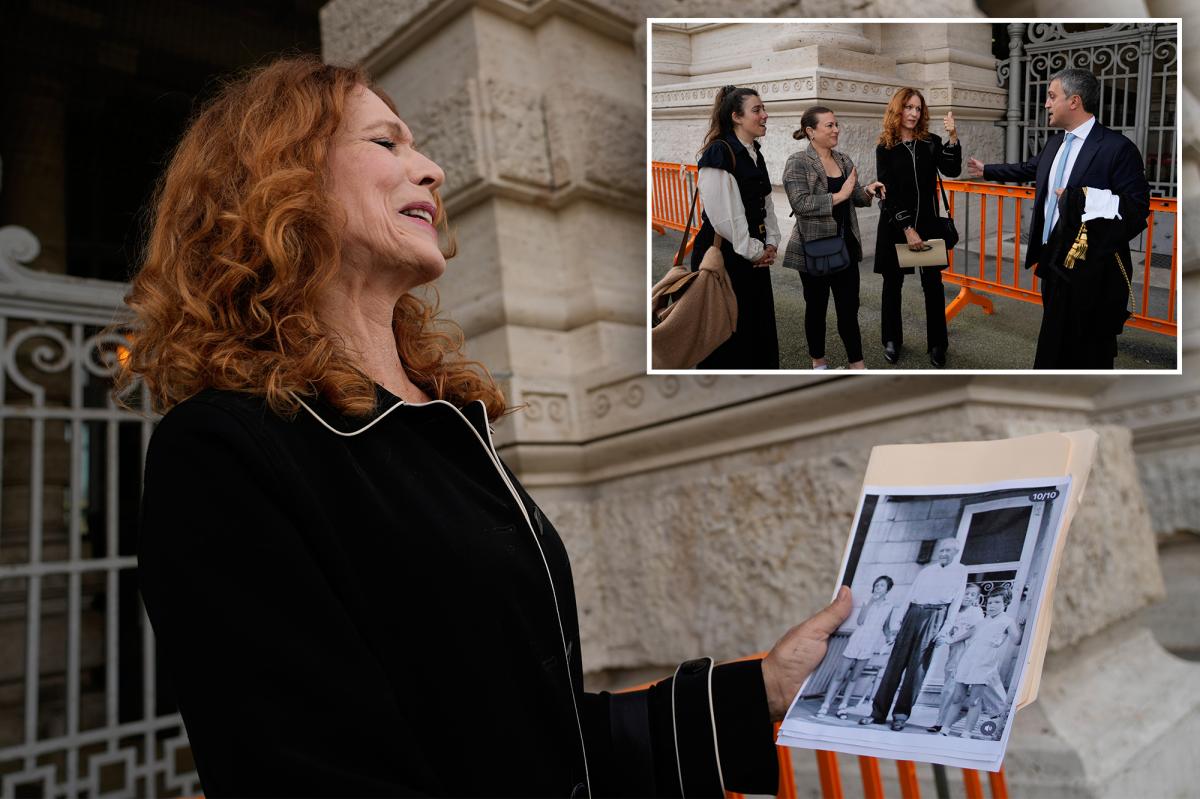
Karen Bonadio said she hopes one day to move to Italy on the strength of her ancestry.
She brought photos of her as a young girl alongside her Italian-born great-grandparents, who emigrated from Basilicata in southern Italy to upstate New York, along with their birth certificates.
“The new law says, ‘all these great-grandchildren didn’t know their great-grandparents.’ This is from 1963, I think I was 3 ½,’’ she said, showing the photograph.
At least one of Mellone’s cases had been rejected in lower courts before the new law, hinging partially on rulings that Italian emigrants who took on another citizenship before having children cannot pass on Italian citizenship.
Jennifer Daley’s case has been working its way through the Italian bureaucracy for nearly a decade. Her grandfather, Giuseppe Dalfollo, immigrated to the US in 1912 from the northern province of Trento when it was under Austro-Hungarian control. He later married an Italian woman and brought her over, and at some point became a naturalized US citizen.
Daley said she always had a strong Italian identity that transcended her last name anglicized by US immigration officials. She petitioned for citizenship because “it is truly a recognition of who I am, where I am from. It’s so much more than citizenship. It’s everything,” Daley, a historian, said by phone from Salina, Kansas.
Outside the courthouse, Alexis Traino said great-grandparents on both her maternal and paternal sides had come from Italy, where she now lives, mainly in Florence.
“My entire life, I grew up knowing — and my parents always emphasized — that I was Italian. I had a very, very strong connection with Italy,” said Traino, 34, who was waiting for documents from Italy and the US when the law passed, blocking her case.
“I want to be Italian. I want to contribute to Italy and be a citizen,’’ she said.