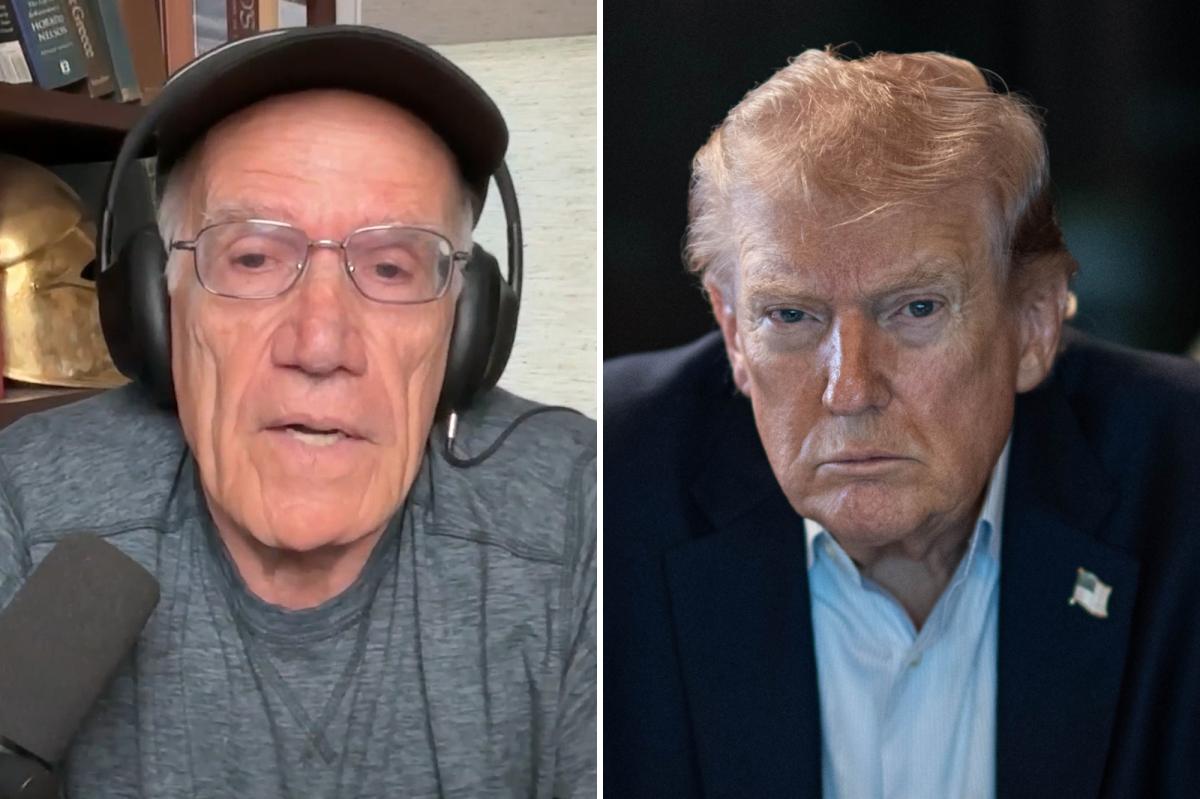

WASHINGTON — President Trump faces the challenge of concluding the Iran conflict well before the 2026 midterm elections, aiming for a timeline at least four months prior. This strategic move, coupled with involving China, is crucial to shield Republicans from potential political fallout, according to historian Victor Davis Hanson on the “Pod Force One” podcast.
In an insightful conversation with The Post’s Miranda Devine during Wednesday’s podcast, the conservative thinker and classicist suggested that Trump is working with a “self-imposed timeline.” This timeline is intended to wrap up the military engagement, thus preventing a potential loss of Republican control in the House of Representatives, which could lead to another impeachment effort by Democrats.
Hanson argues that a gap of “at least four or five months” before the midterms could stabilize the oil prices, steady the stock market, and potentially lower interest rates. He also mentioned that the Republicans’ comprehensive tax-and-spending policy from last year would have more time to produce visible results.
Should Hanson’s predictions hold true, the conflict might conclude by early June or July. This would leave the Republican Party with a limited window to persuade voters to maintain their hold on the House and Senate.
According to data from the RealClearPolitics polling aggregator, Democrats currently enjoy a five-percentage-point lead over the GOP on the generic congressional ballot.
Hanson emphasized that Operation Epic Fury, despite facing criticism from congressional Democrats and former right-wing allies like Tucker Carlson and Megyn Kelly, has been a military success. He asserts that there are no substantial military issues with the operation.
However, he added, “since we’re getting into week six, whatever they’re going to have to do, they’re going to have to do it in two or three weeks, and then they’re going to have to stop.”
“It’ll be a political benefit and give them [the White House] some momentum if they were to open the Strait [of Hormuz] and they could have certification that the [Iranian] uranium is buried deeply into a mountain [or] scattered,” Hanson noted.
“Or they close the Strait, and then they let that ghost of a regime sort of just simmer and let the people deal with it.”
Every week, Post columnist Miranda Devine sits down for exclusive and candid conversations with the most influential disruptors in Washington on ‘Pod Force One.’ Subscribe here!
Hanson emphasized that enlisting Beijing — which purchases roughly 80% of Iran’s oil exports — to add pressure on the regime in Tehran would help conclude the conflict even more quickly.
Trump is planning to visit Chinese President Xi Jinping in mid-May, which Hanson said would provide an easy opportunity for him to “get their attention.”
“I think when he goes to China, he’s going to tell the Chinese … that if they want their oil, they’re going to have to pressure the Iranians as well,” he explained.
Full Episode
“He could do it in an ‘Art of the Deal,’ not an adversarial way,” added Hanson, referring to Trump’s 1987 best-selling book.
“Just say, ‘Look you can’t re-arm these people. They’re a threat to even your suppliers in the [Persian] Gulf. You just can’t come in here, but we want to eliminate this problem so you can go in here. And if you’re willing to help us, we will not destroy Kharg Island. If you’re not willing to help us, there might not be any oil for you anyway.’ Something like that.”