
Share this @internewscast.com
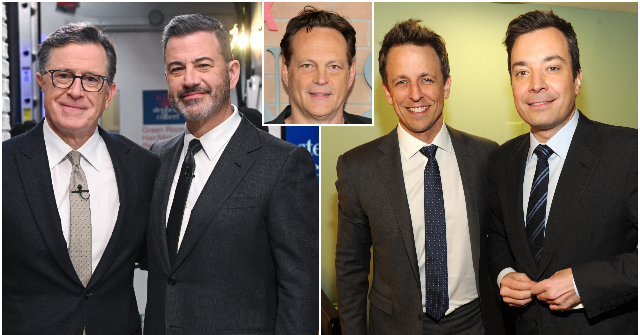
Vince Vaughn, the acclaimed Hollywood actor known for his roles in films such as Wedding Crashers, recently expressed his discontent with the evolution of late-night comedy, which he believes has veered into the realm of political ideology rather than humor. During a candid conversation on Theo Von’s podcast, This Past Weekend, Vaughn shared his perspective on how these shows have transformed over the years.
Vaughn acknowledges that discussing politics is an inevitable aspect of late-night television, given its focus on current events. However, he voiced his concern that hosts have ceased to poke fun at everyone equally, opting instead to stick to a singular narrative. “You don’t want to become part of a group and feel like you’re a champion for one ideology. You want to make fun of everybody,” he remarked, emphasizing the importance of balanced humor.
When Theo Von highlighted Hollywood’s reputation as a “liberal place,” Vaughn offered a nuanced view, suggesting it resembles more of a monolithic culture where certain ideas are universally accepted. Vaughn elaborated, “It’s more like, ‘We’re smart and got it figured out, and if you don’t agree then you’re an idiot.’” He pointed out that this prevailing mindset often casts those with differing opinions in a negative light.
Both Vaughn and Von concurred that this mentality has significantly influenced the direction of late-night television, shaping its tone and content to align with a specific ideological viewpoint. Through their discussion, Vaughn highlighted a shift in the comedic landscape, where the essence of humor seems overshadowed by the weight of political discourse.
“It’s more like, ‘We’re smart and got it figured out, and if you don’t agree then you’re an idiot,’” said Vaughn. “There was definitely a culture that if you didn’t agree with these ideas, you were looked at as bad.”
The two agreed that this mentality became a governing principle with late-night TV.
“A lot of the late shows have struggled because … the only person they could make fun of at a certain point was white, redneck kind of people, and then everything tanked after that,” said Von.
“The podcasts have gotten so much more popular with less production, less writers, less staff. And the reason is … people want authenticity,” added Vaughn. “The talk shows, to a large part, became really agenda-based. They were going to [evangelize] people to what they thought. And so people just rejected it because it didn’t feel authentic. It felt like they had an agenda. It stopped being funny, and it started feeling like I was in a fucking class I didn’t want to take. I’m getting scolded.”
Vaughn also dismissed those who would blame technology for the decline in late-night TV viewership.
“The phenomenon isn’t what they say. They always blame technology, but the reality is it’s the approach,” he said.
“People are going to tune into a podcast more so because they want to feel like people are having a real conversation. It’s interesting to them,” he continued. “But if you look at what happened to the talk shows and why their ratings are low, it’s got only to do with the fact of what you just said, which is they all became the same show. They all became so about their politics and who’s good and who’s bad.”