CARACAS, Venezuela — A century-old territorial dispute deepened by the discovery of oil is boiling over between neighbors Guyana and Venezuela. Steeped in patriotism, the Venezuelan government is seizing on the fight to boost support ahead of a presidential election among a population fed up with a decadelong crisis that has pushed many into poverty.
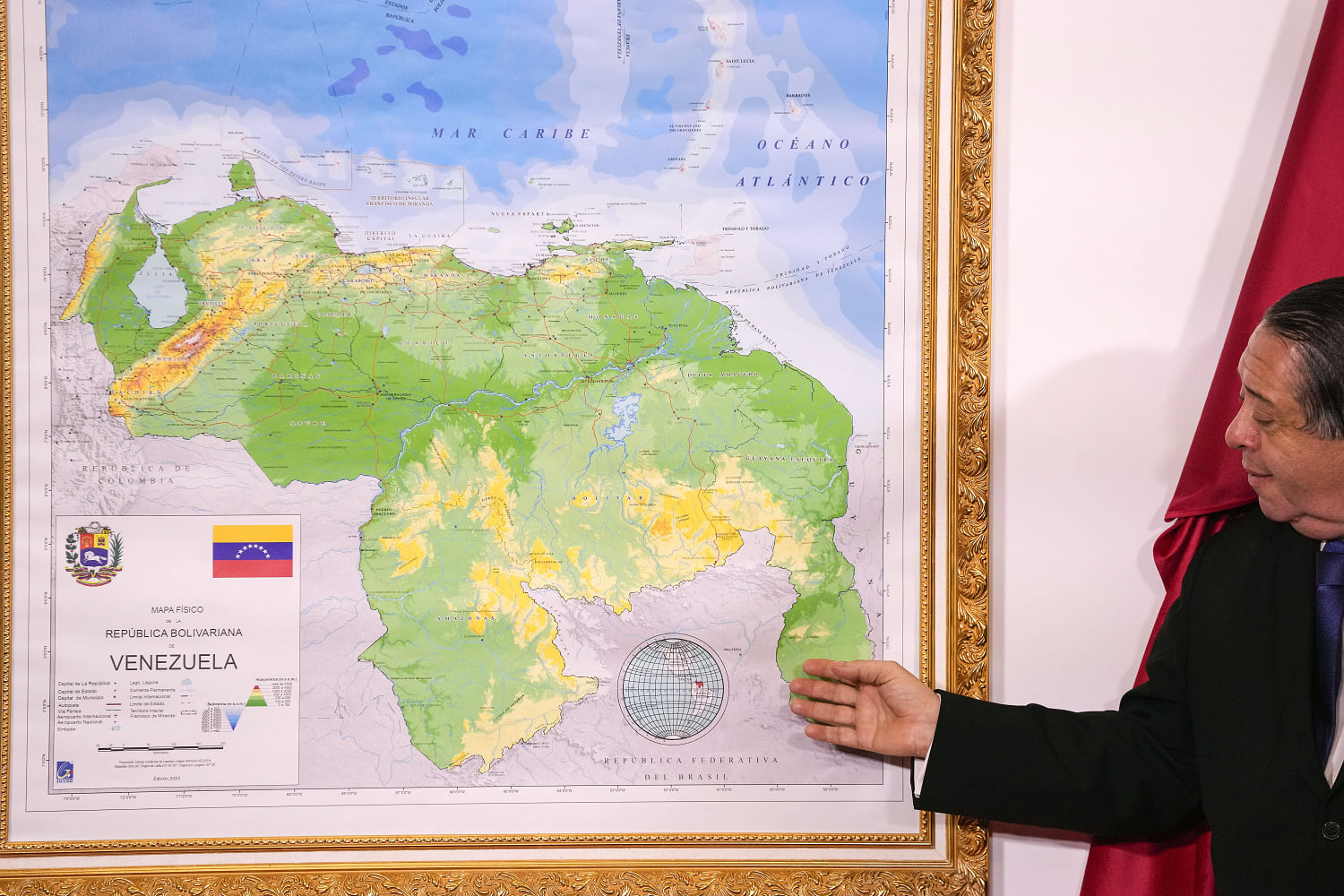
Venezuelans on Sunday approved a referendum to claim sovereignty over Essequibo, a mineral-rich territory that accounts for two-thirds of Guyana and lies near big offshore oil deposits. Military confrontation appears unlikely for now, but several countries have echoed Guyana’s concerns over an annexation by its neighbor to the west.
These are some of the key aspects of the growing dispute:
Why is the border under dispute?
Venezuela says it was the victim of a land theft conspiracy in 1899, when Guyana was a British colony and arbitrators from Britain, Russia and the United States decided the boundary. The U.S. represented Venezuela in part because the Venezuelan government had broken off diplomatic relations with Britain.
Venezuelan officials contends Americans and Europeans colluded to cheat their country out of the land. They also argue that an agreement among Venezuela, Britain and the colony of British Guiana signed in 1966 to resolve the dispute effectively nullified the original arbitration.
Guyana maintains the initial accord is legal and binding and asked the United Nations’ top court in 2018 to rule it as such, but a decision is years away.
What is oil’s role?
In 2015, major oil deposits were first discovered off Essequibo’s shore by an ExxonMobil-led consortium, piquing the interest of Venezuela, whose commitment to pursuing the territorial claim has fluctuated over the years.
The consortium began pumping oil in December 2019, converting largely agrarian Guyana into the world’s fourth-largest offshore oil producer. Operations generate some $1 billion a year for the impoverished country of nearly 800,000 people that saw its economy expand by nearly 60% in the first half of this year.
The current daily production of some 380,000 barrels is expected to hit 800,000 barrels in upcoming years. Guyana’s crude exports were heading largely to the Netherlands and Panama last month, with much of the oil from Panama then re-exported to the U.S. West Coast, according to S&P Global.
In September, Guyana opened bids for 14 additional offshore oil blocks available for exploration and development, with six companies and groups submitting bids. Among them were ExxonMobil, which teamed up again with U.S.-owned Hess Corp. and China National Offshore Oil Corp., and French-owned Total Energies, which partnered with companies in Qatar and Malaysia.
While Guyana’s oil industry has boomed, Venezuela’s has plummeted. Venezuela has the world’s largest proven crude reserves, but its oil industry has been crippled by years of mismanagement and economic sanctions imposed on the state-owned oil company following President Nicolás Maduro’s re-election in 2018, which was widely considered fraudulent.
Venezuela’s National Assembly has not released the text of the law it will use to try to enforce the referendum results. But a portion lawmakers discussed Thursday would ban local and foreign companies from operating in Venezuela if they also do business in Guyana.
Why is Maduro interested in Essequibo now?
For Maduro and his ruling party, the Essequibo dispute is an opportunity to drum up internal support and to distract Venezuelans from U.S. pressure to release political prisoners and wrongfully detained Americans as well as to guarantee free and fair conditions in next year’s presidential election.
Read Related Also: Quaker Oats recalls granola products due to salmonella risk
Before the Dec. 3 referendum, Venezuelans were bombarded for weeks with Essequibo-themed music, nationally televised history lessons, murals, rallies and social media content.
That appears to have backfired.
The government claims about 10.5 million people — just over half of eligible voters — cast ballots. It says voters approved rejecting “by all means” the 1899 boundary, turning Essequibo into a state, giving area residents Venezuelan citizenship and rejecting the U.N. court’s jurisdiction over the dispute. But Associated Press journalists and witnesses at voting centers said the long lines typical of Venezuelan elections never formed.
What’s next?
Maduro’s government on Saturday announced in a statement it had accepted a proposal “to hold a high-level meeting” with Guyana to preserve its “aspiration to maintain Latin America and the Caribbean as a zone of peace, without interference from external actors.”
Maduro “received” the proposal in conversations with Brazil President Luiz Inácio Lula da Silva and Saint Vincent and the Grenadines Prime Minister Ralph Gonsalves, according to the statement. Gonsalves in a letter to Maduro and Guyana President Irfaan Ali expressed an “urgent need to de-escalate the conflict” and said both presidents have agreed to meet Thursday in his Caribbean country.
Meanwhile, international security firm Global Guardian expects Venezuela to gradually ramp up tensions and go as far as conducting naval exercises near Guyana, said Zev Faintuch, a senior intelligence analyst at the firm.
“We might even see some sort of very small scale, cross-border activity,” he said, adding that he expects activities to escalate until elections are held in Venezuela. “Maduro’s interest is to get himself reelected and get some more of his oil onto oil markets.”
He said that it would be nearly impossible to invade the entire Essequibo region, which is vast, lacks roads and is sparsely populated.
Guyanan Vice President Bharrat Jagdeo on Thursday urged oil companies that have concessions near the Essequibo region to ignore Maduro’s comments and actions and warned Guyana would take any necessary steps to protect its sovereignty.
“Any attempts by his state oil firms or state corporations to explore for petroleum in our area will be viewed as an intrusion by Guyana,” Jagdeo said. “If (Maduro) believes that belligerence and threatening Guyana will lead to the desired bilateral conversations, he is profoundly incorrect.”
The U.N. Security Council held an emergency, private meeting on the issue Friday as world leaders and international organizations backed Guyana. Separately, members of a regional trade bloc known as Caricom also called a closed-door meeting Friday to talk about the dispute.
The Organization of American States said in a statement that the 1899 boundary is “in force and legally binding on all parties under international law.” It also accused Maduro’s government of taking an “aggressive stance” and of “continuing to take and promote unlawful actions against Guyana.”
The organization added that it was profoundly worried about the situation, “which has escalated to a point of significant concern for regional security and constitutes a matter that threatens the stability and territorial sovereignty within our hemisphere.”