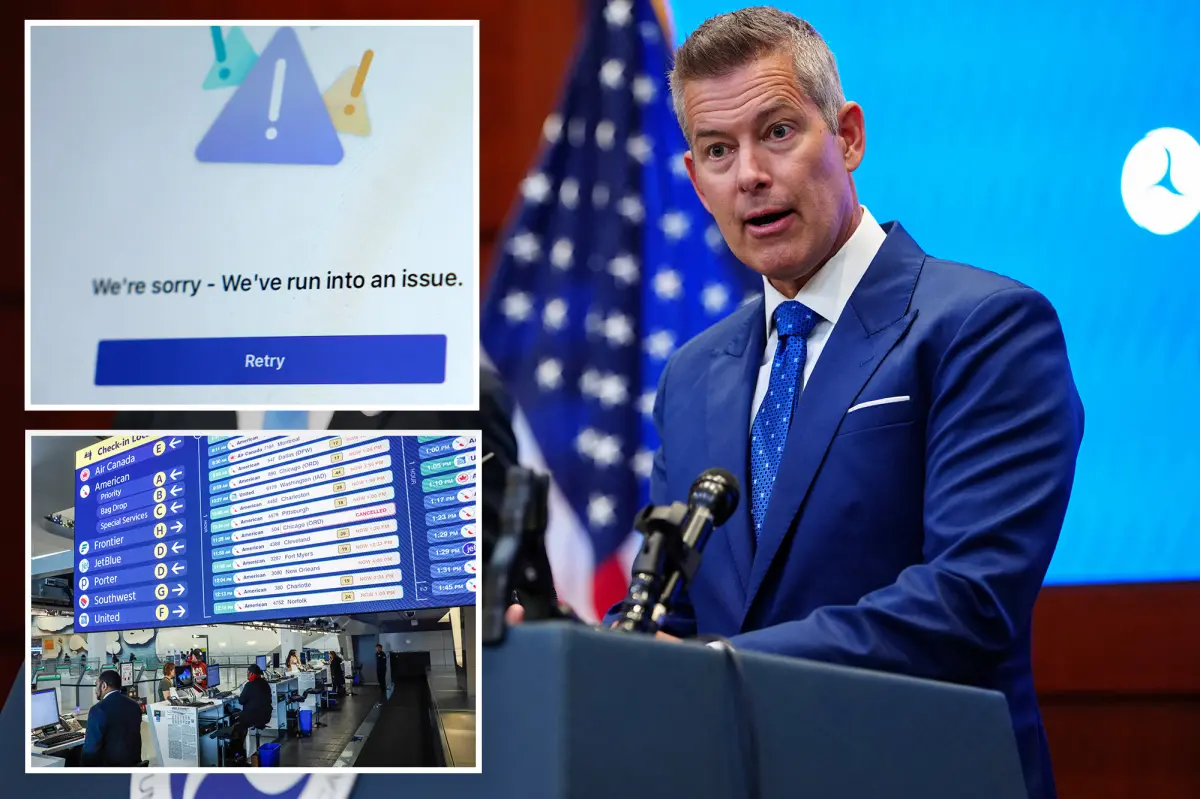

The intelligence may be artificial, but the disruptions are very real.
Cybersecurity specialists warn that major infrastructure failures like the recent breakdowns affecting financial services, technology companies and air travel could become increasingly common over the next several months as businesses rapidly introduce AI-powered systems.
“It’s going to be bumpy for the next six months,” David Kennedy, a former National Security Agency hacker and the CEO of cybersecurity firm TrustedSec, told The Post.
“I’ve never seen so many service outages in a week’s span in my entire life.”
Several recent, high-profile failures — including the historic FAA ground stoppage on Nov. 13 and widespread problems involving Microsoft and major banks — have been blamed on technology glitches rather than hacking. Some of those breakdowns were linked to AI-related system changes and transitions.
Justin Cappos, a professor at NYU’s Tandon School of Engineering, agreed that the Microsoft and FAA incidents were “absolutely abnormal events.” But he said many of the other problems that followed appeared to stem from flaws in newly automated systems, not deliberate cyberattacks.
“If you’re going to be doing things like integrating AI into systems and laying off people, then you do need to be very concerned about what impact this is going to have,” he said.
Not all experts, however, are persuaded that the other major disruptions were unrelated to hacking.
“The combination of timing, the volume, the companies, and the industry verticals that were in play is definitely very suspicious to me,” Kennedy said. He noted that the affected targets “are very much what an adversary would go after.”
He said it was “absolutely possible” that the recent glitches — including a cyberattack on Equinor, Europe’s major gas supplier — reflected intelligence-gathering by a foreign government ahead of a larger attack.
Lisa Palmer, CEO of AI company Neurocollective.Ai, said she has a similar instinct about the recent string of incidents.
“In many cases, you’ve got AI-powered humans that are on offense, and you have traditional software-powered humans that are playing defense,” she said.
“I particularly worry about certain government agencies that are underfunded – and that includes local and state government agencies as well.”
Palmer’s remarks came after Google published a report describing Russian bots carrying out what it called a first-of-its-kind automated cyberattack. They also followed an FBI warning about a Chinese AI program.
RELATED: Ohio School Investigates Viral Video of 10th-Grader Punched, Choked on Bus
The developments came alongside a targeted cyberattack on municipal services in South Portland, Maine, and another incident that affected nearly 200 major commerce and news websites.
If a foreign government is behind the recent outages, “Iran is a potential, but I would put my eggs in the basket around China,” Kennedy said.
“China is very methodical. They don’t think in a two-year, four-year political cycle. They think 20 years, 30 years, 40 years ahead,” he said, speculating that Beijing could seek to disrupt US infrastructure if it invaded Taiwan.
“They’ve been hacking our grid for 20 years. We’ve been booting them out for 20 years.”
The experts also pointed to sweeping technology-sector layoffs and the growing use of artificial automation. Microsoft alone eliminated 9,000 jobs in 2025, they noted, potentially leaving systems more exposed as malicious actors use AI to identify and exploit weaknesses previously overseen by human employees.
“I’ve been a hacker for 25 years, and [AI] hacks better than I can,” Kennedy said. “It’s creating a lot of chaos in the enterprise right now.”
“Corporations are looking at AI for cost savings, and that’s not realistic in cybersecurity right now.”
Kennedy also said recency bias may be influencing public perceptions, with smaller outages now receiving intense scrutiny — much as airline problems did after the 2024 Alaska Airlines Boeing 737 door-plug incident.
J.S. Nelson, a University of Pittsburgh law professor who specializes in cybersecurity, said the competing explanations may both be valid.
“These problems with our automated systems could have multiple sources,” she said, identifying “at least three categories.”
Those categories include “foreign state or criminal actors exploiting vulnerabilities, companies rushing to fix vulnerabilities ahead of — or in the wake of — such potential attacks, and use of AI that creates new problems as the systems start to act in unexpected ways.”
Whatever the cause, experts say dramatic lifestyle changes and extreme doomsday preparations are not warranted.
“I think we’re going to be able to handle it. I don’t think it’s going to be catastrophic or the end of human civilization or the United States or things like that,” Kennedy said.
“But I do think we’re going to have disruptions.”