

CHANNEL ISLANDS, Calif. (AP) — In the early morning light off California’s Channel Islands, the kelp beds shimmer as fish and sea lions dart through the lush underwater foliage. This thriving ecosystem is the outcome of more than 20 years of conservation efforts in one of California’s earliest marine protected areas.
Contrastingly, out in the Pacific Ocean, the future of the vast Pacific Remote Islands Marine National Monument is uncertain. The Trump administration has decided to open up 500,000 square miles (around 1.3 million square kilometers) of these previously safeguarded waters to commercial fishing, marking a significant reversal of federal ocean conservation policies.
In contrast, California might be taking a different path. As the state embarks on the first 10-year evaluation of its marine protected area network, government officials, scientists, tribal representatives, and environmental activists are advocating not just for the preservation, but also for the expansion of these protected zones.
“These areas are like our underwater Yellowstone,” said Douglas McCauley, director of the Benioff Ocean Science Laboratory at the University of California, Santa Barbara, speaking aboard a dive boat heading to the Channel Islands. “It’s important to protect that biological heritage, but it also creates an extremely lucrative tourism industry. People want to go see all that nature and wildlife in action.”
The state’s marine protected areas have become magnets for scuba divers and snorkelers drawn by their rich life. Over time, these reserves allow fish populations to rebound and spill over into nearby waters – a long-term investment with large returns for fishermen, as McCauley sees it.
Launched in 2003, the network now spans 124 distinct sections along the coast. Some areas are “no-take” zones where all fishing is prohibited, while others allow limited use. The network covers roughly 16% of state waters, with proposed expansions that would add 2%. The goal, under the 1999 Marine Life Protection Act, was to create a science-based system to rebuild ecosystems after decades of overfishing and habitat loss.
The Channel Islands were among the first sites established. About 20% of the waters surrounding the eight-island chain are now fully protected.
But expansion proposals have sparked debate among fishermen.
Some anglers would like the restrictions to be relaxed
Blake Hermann, a fourth-generation commercial fisherman from Ventura County, grew up fishing around the Channel Islands, where he harpoons swordfish by hand. He supports keeping much of the marine protected network intact, but he argues that some closures go too far and has petitioned the state to allow limited fishing in three no-take zones around the islands.
Protected areas can help nearshore species like sea bass and lobster recover, Hermann said, but offer little benefit to wide-ranging ocean-goers like swordfish and tuna that may pass only briefly through a protected zone during migration.
He questions whether it makes sense to restrict selective, low-impact fishing methods in places where these migratory species are only temporary visitors and will likely be caught when they move into unrestricted waters.
“These islands are the best thing on the planet,” Hermann said. “We can still protect what makes sense to protect in the right areas, but you can also still give some access back too.”
‘We’re really protecting ourselves’
Others warn that reopening any part of the protected network could set a troubling precedent, especially as climate change disrupts ocean ecosystems.
“When we protect the oceans, we’re really protecting ourselves,” said Sandy Aylesworth, director of the Pacific Initiative for the Natural Resources Defense Council. “If the additional 2% is added, it will better prepare California’s ocean for future stressors like climate change and new industrial uses of the ocean. So I see it as being a real benefit to all of the ocean users in California — including recreational and commercial fishermen.”
Final decisions from the review are expected early next year.
“Marine protected areas are probably the most controversial thing that we work on, because you’re essentially telling a group of individuals that they can’t do what they’ve historically done in an area,” said Craig Shuman, marine region manager at the California Department of Fish and Wildlife.
Shuman said the fishing community has become particularly vocal in response to petitions to expand the MPA network. Many aren’t asking for more access, he said, just for existing opportunities not to be taken away.
“They’re asking, ‘If you take all the places we can fish, where do we go?’” he said. “That’s the challenge: how to find the right balance between protection and access, especially in a state like California where we already have very strong fisheries management laws.”
Overall, he said, the data shows the network is working. “It’s not consistent — each MPA is a little bit different — but more often than not, we’re seeing the MPAs are working to achieve the goals of the Act.”
Trump administration moves to open up previously protected waters
The president’s executive order lifted fishing restrictions in waters between 50 and 200 nautical miles around a remote Pacific island chain — areas first protected by President George W. Bush in 2009 and expanded by President Barack Obama in 2014. Supporters said doing so would boost commercial fishing interests in Hawaii and American Samoa. Conservationists fear the impacts from fishing in an area that’s home to coral reefs, sea turtles, whales and thousands of other species.
“It makes it even more critical here at the state level that there is this expansion of protections to really balance out some of those rollbacks,” said Molly Morse, senior manager at the Benioff Ocean Science Laboratory.
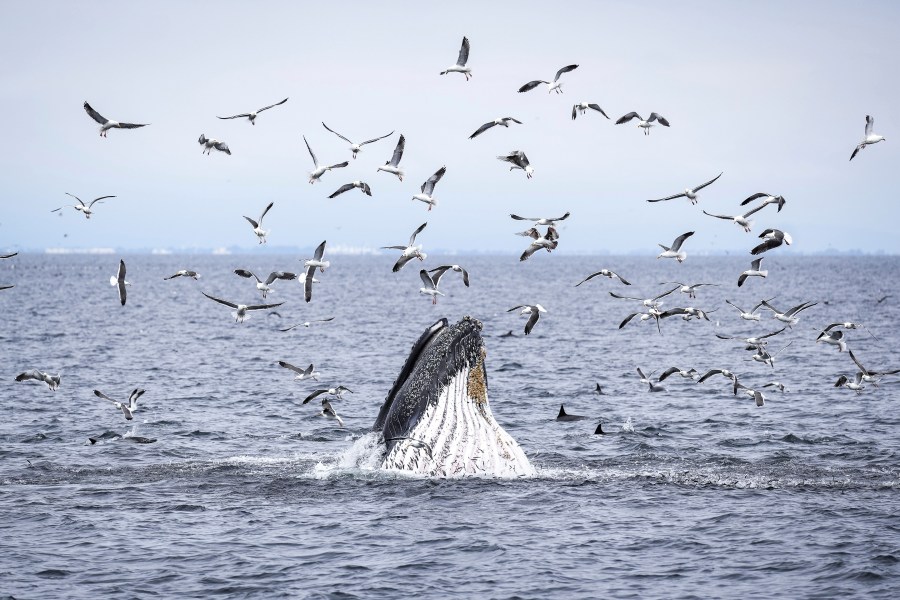
Back on the boat, still within the protected waters off Anacapa Island, a shimmering school of sardines and anchovies draws a frenzy of seabirds and dolphins. Humpback whales surge from the depths, mouths agape, swallowing fish by the gallon. Along the border of the protected area, a sport fishing boat drops its lines as a container ship rumbles past in the distance.
“We’ve got the largest port in the United States. We’ve got offshore oil and gas. We’ve got fishing boats coming and going,” McCauley said. “But still, in the middle of all that, we still have this wildness — a place where all the stakeholders who want value out of the ocean can find it.”
___
The Associated Press receives support from the Walton Family Foundation for coverage of water and environmental policy. The AP is solely responsible for all content. For all of AP’s environmental coverage, visit