
A Washington state resident has become the third person in the United States to die from complications linked to bird flu, health officials said.
The patient lived in Yakima County, roughly 140 miles southeast of Seattle, and died from complications associated with avian influenza, or H5N1, after being hospitalized with a severe illness, the health department announced Sunday.
When the Yakima Health District disclosed the infection last month, officials said the person was not seriously ill at the time and had not been admitted to a hospital.
Authorities have not released the patient’s name, age, gender or specific symptoms. They said the individual had underlying health conditions.
Health officials believe the person contracted the virus after exposure to infected dairy cattle.
There is currently no evidence of person-to-person transmission. Yakima County experts described human-to-human spread as “extremely rare” and said it has never been documented in the United States.
Yakima health authorities said the threat to the wider public remains low.
“Those at greatest risk include dairy workers and anyone else who has close or prolonged contact with infected animals or areas contaminated by the virus,” officials said.

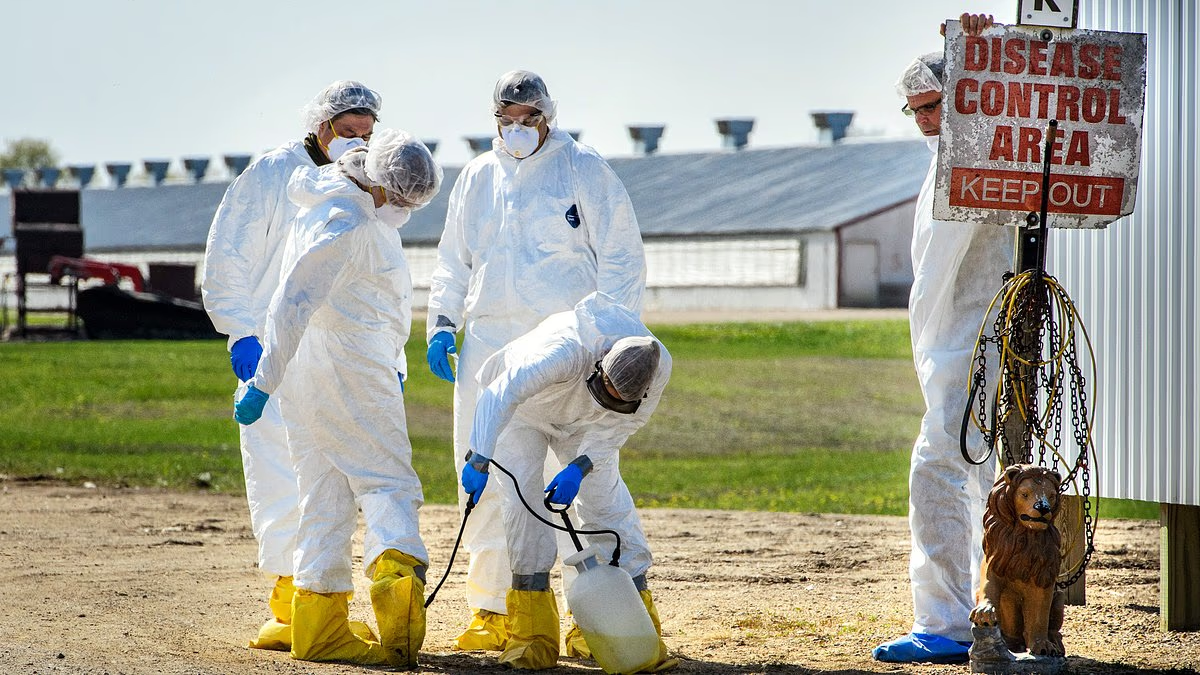
A Washington state resident has died after developing complications from H5N1 bird flu. USDA farm workers are pictured above in 2015
The health department is coordinating with local public health agencies to find and contact people who may have had close contact with the patient. Those individuals will be monitored for possible symptoms, including eye redness or irritation, fever and a sore throat.
The death is the third bird flu-related fatality reported in the US since 2024 and the second recorded in Washington state.
Washington’s earlier death, reported in November 2025, involved a patient infected with the H5N5 strain of avian influenza.
Louisiana reported the nation’s first bird flu death in January 2025. That patient was infected with H5N1.
All three victims were reported to have underlying medical conditions that increased their risk of severe illness or death.
READ MORE: Court Hears Husband Who Advertised Wife Called Sex a ‘Great Thrill
The Centers for Disease Control and Prevention says the US has identified 73 human infections involving H5 bird flu strains since the beginning of 2024.
California accounts for slightly more than half of those cases, with 38 infections reported.
Washington has recorded the next-highest number, with 13 cases.
The remaining cases include 10 in Colorado, two in Michigan and one each in Oregon, Nevada, Iowa, Missouri, Texas, Louisiana and Ohio.
Earlier human infections with H5N1 have been associated with exposure to droppings, saliva or other material from infected birds and animals.
Since H5N1 began spreading among dairy cattle in 2024, many human cases have involved contact with infected herds. Workers can be exposed while handling sick animals, their saliva or equipment contaminated by the animals.
Pasteurized milk is not considered a significant source of infection. During pasteurization, milk is heated and rapidly cooled, a process that destroys pathogens and viruses that may be present.
CDC figures link 42 cases to dairy cattle exposure, 24 to poultry farms or culling operations, three to other animal contact and three to sources that remain unknown.
The Washington State Department of Agriculture reported that, as of October 29, H5N1 had been detected in 33 dairy herds in Yakima County and one herd in neighboring Benton County.
H5N1 bird flu was first detected in the United States in 2022. Since then, the virus has been confirmed in cattle, chickens, cats, raccoons, skunks, wild dogs, bears and dolphins.
Human symptoms can include conjunctivitis, or red and irritated eyes, as well as mild fever, coughing, sore throat, a runny or congested nose, body aches, headache and fatigue, according to the CDC.
In uncommon but severe cases, the infection can lead to pneumonia, respiratory failure, kidney injury, organ failure, sepsis and inflammation of the brain known as meningoencephalitis.
The US Department of Agriculture has detected H5N1 in 268 wild bird samples over the past 30 days. Positive samples were reported in Michigan, Pennsylvania, New York, Vermont, Maine, Virginia, Georgia, Florida, Arkansas, Texas, Illinois, Iowa, Wisconsin, Minnesota, North Dakota, South Dakota, Nebraska, Kansas, Colorado, Utah, Nevada, California, Oregon and Montana.


