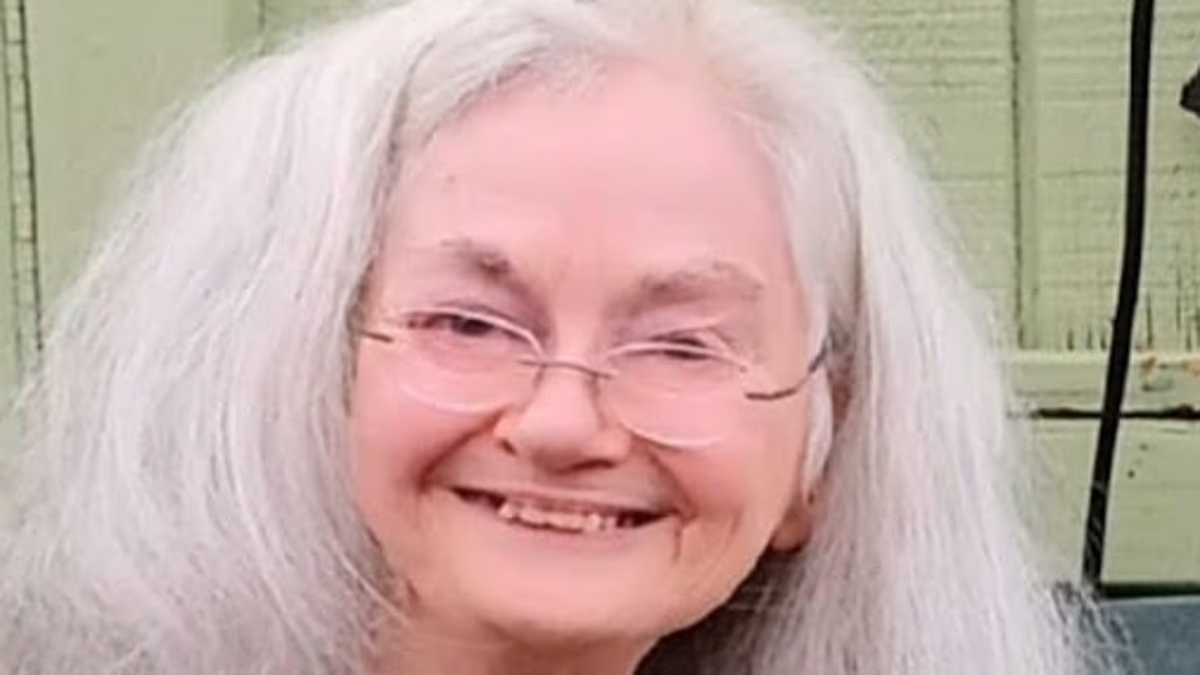

The last known polio survivor in the United States still living with the help of an iron lung has died after the decades-old machine that sustained her began failing and could no longer be repaired.
Martha Ann Lillard, 78, died on June 26 after depending on the 1940s-era device for more than 70 years.
Lillard was diagnosed with polio on her fifth birthday in 1953, and she continued to vividly remember the day her symptoms first appeared.
‘I woke up, and it was sunny outside, and I started to sit up, and my neck was killing me,’ Lillard, of Shawnee, Oklahoma, told KFOR last month. ‘I couldn’t lift my head off the pillow.’
Within four days, she had lost consciousness and was unable to breathe or move on her own. The iron lung was credited with keeping her alive.
‘They usually didn’t like to put children in because they fought it, but I didn’t,’ she said. Iron lungs are sealed metal chambers that use negative pressure to help a patient’s lungs expand and contract when the body can no longer manage the process naturally.
For much of her life, Lillard was able to maintain a measure of normalcy. But her health declined in recent years after she contracted Covid twice and also suffered from shingles.
Compounding those challenges, her family said the iron lung she relied on began to malfunction. Replacement parts had become increasingly rare, and the machine was ultimately too old to fix before her death.

Martha Ann Lillard, 78, the last US polio patient who used an iron lung to survive, has died

Lillard lived with just 25 percent lung capacity, scoliosis and a paralyzed right arm. She insisted that she preferred the iron lung over more modern respirators

Lillard had to relearn to walk and breathe on her own after learning she had polio. She was only able to go to school for one hour per day
‘Some of the parts are from the chevs of the forties, and they’re hard to locate,’ her sister, Cindy McVey, said. ‘We have a spare motor, but we don’t have anyone to put it back in if we needed it.’
After being diagnosed with polio, Lillard spent six months in the hospital learning to breathe on her own.
She was required to live in the iron lung for 23 hours of the day, with the remaining tiny sliver of spare time used to rehab her paralyzed limbs.
But perhaps surprisingly, Lillard explained that she enjoyed the feeling of going into the iron lung because of her exhaustion.
‘When I got in it, I was tired,’ she said. ‘Always getting in there felt wonderful.’
Still, polio ravaged Lillard’s early childhood, as she had to learn how to walk again and the disease severely disrupted her early life.
For instance, Lillard never attended prom and she was only able to go to school for one hour per day.
She was forced to take high school classes over the phone, but could not graduate since everything she needed for a diploma was not being offered by the district.

Lillard learned she had polio on her fifth birthday in 1953. She had to learn how to breathe on her own and extensively rehabilitate her paralyzed limbs

At one point she spent up to 23 hours inside the device but said entering into the machine was always a relief for her body
Lillard learned she had polio two years before a vaccine was widely available in America in 1955.
Until then, polio killed or severely paralyzed millions around the world, and thousands in the US.
Though Lillard tried other, more modern respirators, she ultimately stayed loyal to her trustworthy iron lung.
‘None of them could get up to 21 pounds [per square inch], which is what I needed to breathe,’ she told the outlet. ‘So they just weren’t effective.’
When she was at her healthiest, Lillard only used the iron lung for about nine hours at night to sleep.
A GoFundMe fundraiser to honor Lillard’s legacy after her death said she ‘spent her life as normally as possible’ despite living with just 25 percent lung capacity, scoliosis and a paralyzed right arm.
‘She was incredibly creative, painting, writing poems, and composing music for the left hand piano,’ the fundraiser read.
‘Even as post-polio syndrome continued to affect her, she maintained a wonderful fighting attitude, making the most of what she had left and enjoying life as much as she could,’ it continued.

In the months before her death, Lillard was forced to be inside the iron lung for the entire day (Picture of an iron lung)
Lillard would typically use a portable ventilator when not inside the iron lung. However, her quality of life changed when the pandemic rolled around.
‘She didn’t really require a caretaker until Covid-19,’ McVey, her sister, said. ‘She fixed her own meals and, and took care of everything herself.’
A public obituary for Lillard noted that she died of long-haul Covid.
Shortly before her death, Lillard was unable to breathe on her own when lying on her back and unable to sit up by herself.
She had been living inside the iron lung for 24 hours a day in the months leading up to her death.
However, the aging equipment had also begun faltering, which included an instance last year when a tornado knocked out Lillard’s power.
Her husband, Baha Seleh, was forced to perform mouth-to-mouth resuscitation on Lillard until she received further aid.