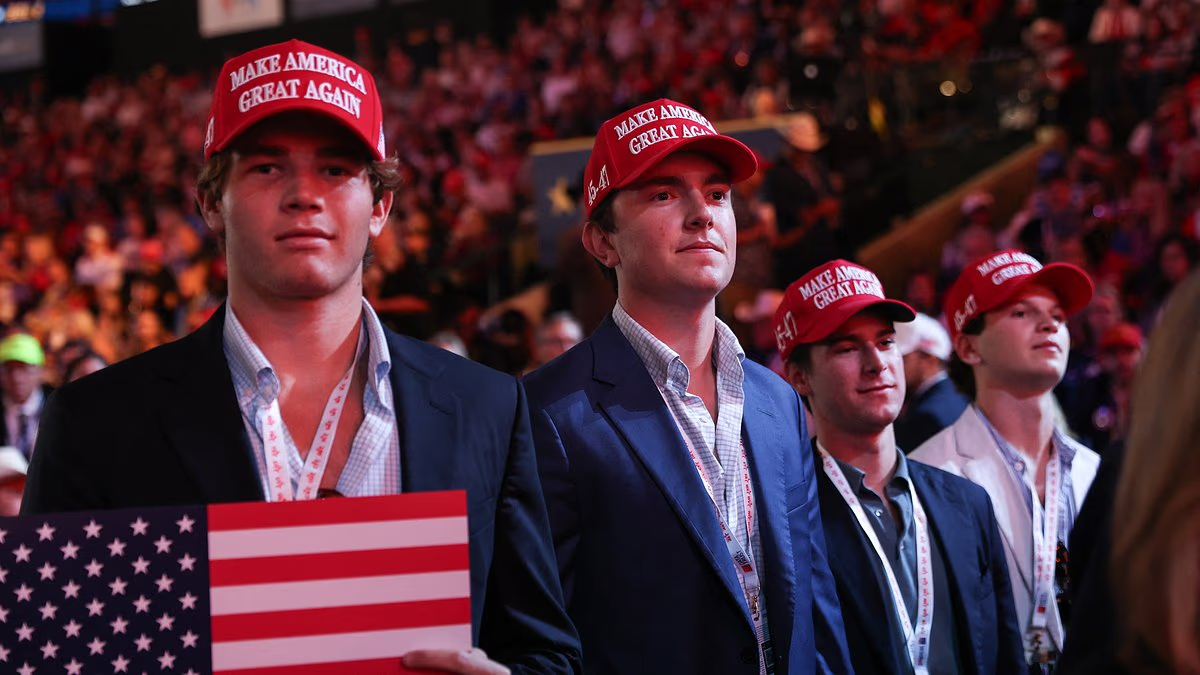
A group of young MAGA supporters has broken with President Donald Trump, accusing him of abandoning the America First agenda that first drew them to the Republican Party. Some said they supported Democratic candidates for the first time, while others chose not to vote at all.
Members of the Clemson College Republicans in South Carolina told New York Magazine that their frustration with the GOP had grown so intense that they were prepared to cross party lines—or stay home—rather than back Trump-endorsed candidates in the midterm elections.
Steven Pittman, 25, said he had never previously split his ticket. But his disillusionment led him to vote for Democrat Annie Andrews in the Senate contest and Republican Alan Wilson in the governor’s race.
Both candidates ultimately won.
‘I was never someone who would vote split ticket ever in my entire life and then these past midterms I was just so disgusted,’ he said.
Several other students said they would have backed Andrews as well if they had been eligible to vote in South Carolina.
Jackson Heaberlin, a former club member, offered an especially bleak view of the party. He said Trump’s endorsement of Darline Graham helped persuade young Republicans that the GOP was no longer capable of reform.
Graham, who is the sister of outgoing Senator Lindsey Graham, was Trump’s preferred candidate in the race.

Members of the Clemson College Republicans told New York Magazine that their anger at the GOP was strong enough to make them consider voting across party lines or remaining at home rather than supporting Trump-backed candidates

‘When Darline Graham won her primary, it felt as though the GOP — they were like your evil father,’ one student said

The students also criticized Vice President JD Vance, who attributed the party’s midterm results to the war in Iran
‘When Darline Graham won her primary, it felt as though the GOP — they were like your evil father,’ Heaberlin said.
Heaberlin ridiculed what he described as a party trapped in ‘boomerworld,’ where Trump’s endorsement carried unquestioned authority and Republicans could nominate ‘the worst candidate ever’ without facing a serious challenge.
Their anger did not reflect a new commitment to Democrats or an embrace of Democratic policies.
Instead, the students said their votes were intended to punish Republican leaders for what they saw as a retreat from the movement they thought they had joined in 2024.
Jane Kihne, 22, a club co-chair who interned at the White House last summer, said the motivation was straightforward.
‘It was literally to punish the GOP,’ she said.
The students’ strongest objection centered on Trump’s decision to launch military action against Iran. They viewed the move as a violation of his pledge to keep the United States out of overseas conflicts.
In their view, Trump had discarded the anti-war message that helped build his America First coalition and returned to the interventionist foreign policy long associated with the Republican establishment.

The students regarded Trump’s decision to go to war with Iran as a betrayal of his promise to keep America out of foreign conflicts

They were also angry that Trump had not pursued immigration enforcement aggressively enough, arguing that his deportation campaign fell well short of what they had been promised

One student praised Trump’s decision to replace outgoing chief of staff Susie Wiles with immigration hard-liner Stephen Miller, calling the appointment ‘definitely a step in the right direction’
MORE STORY: Russian Warship Reportedly Destroyed in Libya Port Drone Attack
The students were equally dissatisfied with Trump’s approach to immigration, believing the administration had not gone nearly far enough.
Rather than objecting to excessive deportations, they argued that the government had failed to deliver the sweeping crackdown they expected.
They wanted deportations to take place on a far larger scale, along with stronger enforcement against businesses that employ undocumented workers.
Kihne described highly publicized immigration raids as ‘smoke-and-mirrors’ and said the administration should have targeted corporations directly.
She called immigration the Republican Party’s ‘one winning issue.’
Emerson Cooke, another club member, said the group had expected at least 10 million deportations.
They also opposed the H-1B visa program, arguing that employers should be giving more opportunities to young Americans rather than hiring foreign workers.
Their frustration also extended to Vice President JD Vance, who blamed the GOP’s midterm showing on the war in Iran.
Pittman questioned why Vance had not confronted Trump before the election, saying the vice president remained quiet instead of defending the movement’s anti-war commitments.
One student called Vance a ‘Peter Thiel acolyte,’ while Pittman offered an even harsher description.
‘He’s a skin suit,’ he said.
The remarks come as Vance is increasingly viewed as a possible successor to Trump’s political movement. The Clemson students, however, showed little confidence that he could successfully lead it.
Even while condemning Trump, the group was not advocating a wholesale shift to the Democratic Party.
They remained opposed to many Democratic positions and described their ballots as protests against Republican leaders, not endorsements of their political rivals.
Kihne did praise Trump’s decision to replace outgoing chief of staff Susie Wiles with immigration adviser Stephen Miller, calling the move ‘definitely a step in the right direction.’
The dispute underscores the challenge Republicans face in retaining younger voters who were attracted to Trump’s promises to put America first, restrict immigration and avoid new foreign wars.
For the Clemson students, the central complaint was not that Trump had pushed his agenda too far.
They believed he had failed to follow through on the promises that brought them into the America First movement.
An October Harvard Youth Poll found that young Republicans were far less enthusiastic about voting in the November midterms.
According to the survey, 50 percent of young Republicans who identified as MAGA said they were certain to vote, compared with 29 percent of Republicans who did not identify as MAGA.
At the same time, 63 percent of young likely voters said their congressional ballot would be intended to oppose Trump and his policies, while only 14 percent said they planned to vote in support of him.


