
The Supreme Court took the unusual step of releasing a public statement Friday after a tense disagreement between two justices drew national attention.
Justice Samuel Alito, a member of the court’s conservative wing, had a pointed exchange with liberal Justice Sonia Sotomayor after the court handed down a closely watched immigration ruling Thursday that marked a significant victory for Donald Trump.
The moment followed Alito’s announcement of the majority opinion in Mullin v. Al Otro Lado, a 6-3 decision that allowed federal immigration authorities to deny entry to asylum seekers at the U.S.-Mexico border.
Sotomayor then took the notable step of reading her dissent from the bench. While not routine, the practice is not unprecedented, and justices are typically informed in advance when a colleague plans to do so.
That appeared to be the arrangement Thursday, when Sotomayor, who was appointed by former President Barack Obama, delivered portions of her forceful 35-page dissent aloud as the opinions were released.
But her roughly 10-minute statement seemed to surprise Alito.
“There’s much that I would have added to my bench statement had I known there would be a dissent read,” Alito said in a terse response.
More than 24 hours after the remarks sparked widespread coverage, the court sought to defuse the episode with a statement describing the matter as a “misunderstanding.”
It’s now fueling speculation about rising underlying tensions among the justices.

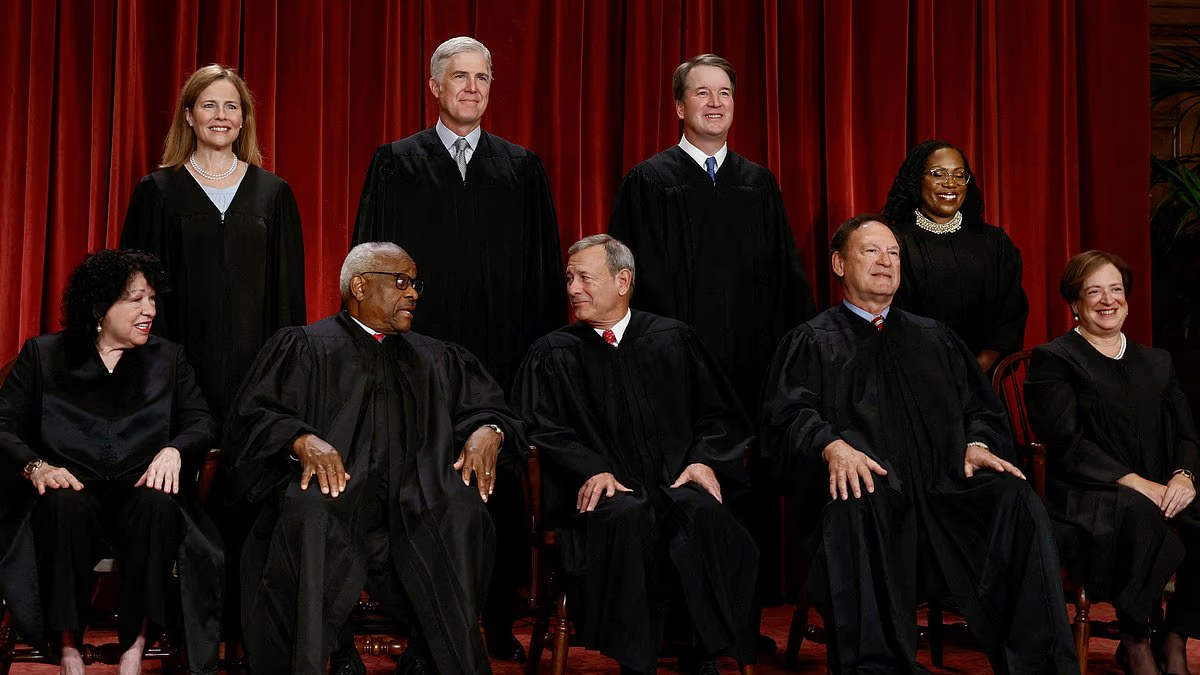
The Supreme Court justices are seen posing for a group portrait. Justices sided with the Trump administration 6-3 on two major immigration and asylum cases

Immigration protesters outside the Supreme Court
The Supreme Court on Friday said in a statement that the incident in question was a ‘misunderstanding.’
‘Justice Alito was notified in advance by Justice Sotomayor’s chambers that she would be reading a dissent from the bench,’ a spokesperson for the high court told CNN.
‘It was a misunderstanding on Justice Alito’s part,’ they added.
The Supreme Court did not immediately respond to the Daily Mail’s request for comment on the back-and-forth between Alito and Sotomayor.
Justices ruled along ideological lines that migrants seeking refuge do not ‘arrive’ in the country by ‘attempting, and failing, to step foot’ in the United States – clearing the way for the administration to restart its so-called ‘turn back’ policy. Alito read the majority opinion for the court.
In writing the majority opinion, Alito said the case ‘presents a straightforward question’: whether someone is considered having ‘arrived’ to the US while still at the US-Mexico border, or when they are physically present in the United States.
The majority of justices ruled that they must be physically present in the United States.
Sotomayor and the court’s other liberal justices sharply disagreed.

The Supreme Court building in Washington, DC

The highly-anticipated immigration decision that was a win for Trump

Demonstrators protest against US President Donald Trump and his administration’s immigration policies in Washington, DC

Members of the TPS, or Temporary Protected Status Alliance, rally outside the Supreme Court
‘The Court today holds that the Executive Branch may circumvent all these mandatory procedures by having US immigration officers stand at the border and physically block noncitizens from setting a foot onto U.S. soil,’ Sotomayor said in her dissent.
‘They may do so even if the asylum seeker is at the threshold of a port of entry designated to receive all noncitizens who seek entrance into the country,’ Sotomayor continued.
‘Even if the port of entry has ample capacity to inspect that person, including an available asylum officer trained to process asylum applications. Even if the asylum seeker is certain to be persecuted, or killed, if she is turned away.’
It’s not the first time the Supreme Court justices have made headlines for breaking, even slightly, with a time-honored sense of decorum.
Sotomayor issued an apology earlier this year for what she described as ‘hurtful’ public comments about her colleague, conservative Justice Brett Kavanaugh.
‘At a recent appearance at the University of Kansas School of Law, I referred to a disagreement with one of my colleagues in a prior case, but I made remarks that were inappropriate,’ Sotomayor said in a statement earlier this year.
‘I regret my hurtful comments. I have apologized to my colleague.’


