
Share this @internewscast.com

In a decisive move on Thursday, the National Capital Planning Commission (NCPC) gave its almost unanimous support to President Donald Trump’s proposed ballroom project, even though the construction remains mired in legal uncertainties. This decision followed a board meeting where the project received approval from nearly all members, with just one dissenting voice. Democratic D.C. City Council Chairman Phil Mendelson cast the sole vote against, citing the ballroom’s excessive size as his primary concern. Meanwhile, two commissioners opted to abstain by voting ‘present.’
White House Expansion Defended Amid Media Criticism

During the proceedings, NCPC Chair Will Scharf, who also serves as President Trump’s Staff Secretary, staunchly defended the necessity of the ballroom and the scrutiny process it had undergone. In a notable moment, Scharf read aloud negative reviews from major publications like the New York Times and the Washington Post, relating them to past White House projects. He pointed to historical examples, such as President Teddy Roosevelt’s West Wing addition and President Richard Nixon’s briefing room expansion, to illustrate that criticism from preservationists and media outlets has historically accompanied White House developments. “Such dire predictions from so-called historic preservationists and their allies in the press are nothing new to the history of the White House,” Scharf remarked.
Concerns Raised Over Scale and Speed of White House Project

Expressing his vision for the project, Scharf stated, “I believe that in time, this ballroom will be considered every bit as much of a national treasure as the other key components of the White House.” Despite Scharf’s optimism, Mendelson urged the board to reconsider the timing of their decision, arguing that the process was being rushed. He clarified his position, noting, “It’s just—I’m trying to be nice here—it was just too much. It’s just too large.” Echoing Mendelson’s sentiments, Linda Argo, appointed by Washington D.C.’s Democratic Mayor Muriel Bowser, voiced her agreement with his concerns.

Mendelson was the project’s one no vote, while Argo and Arrington Dixon, who was also appointed by Bowser, voted present. The vote comes as the ballroom is already in legal jeopardy. On Monday, U.S. District Judge Richard Leon ruled the construction on the ballroom needed to be halted within two weeks, siding with the National Trust for Historic Preservation, which had argued Trump needed to seek Congressional approval for the project. In his decision, Leon said the Trust would likely be victorious in court, as no statute ‘comes close’ to giving the President the authority to make such major changes to the White House . ‘The President of the United States is the steward of the White House for future generations of First Families. He is not, however, the owner!’ Leon wrote.

The only construction that could continue on the project had to be relevant to the security of the White House, Leon said. ‘It is not too late for Congress to authorize the continued construction of the ballroom project,’ the judge also wrote. ‘The President may at any time go to Congress to obtain express authority to construct a ballroom and to do so with private funds.’ On the heels of Leon’s orders, Trump told reporters in the Oval Office that he had no plans to put the project before Congress. Public Citizen’s Jon Golinger, who was leading a small protest in front of the NCPC on Thursday, ahead of the vote, told the Daily Mail that more lawsuits could be filed to stall the ballroom project. Golinger, who got into a spat with NCPC Chair Will Scharf at the group’s March meeting over Scharf’s credentials to chair the planning group, said that the issue remained outstanding.

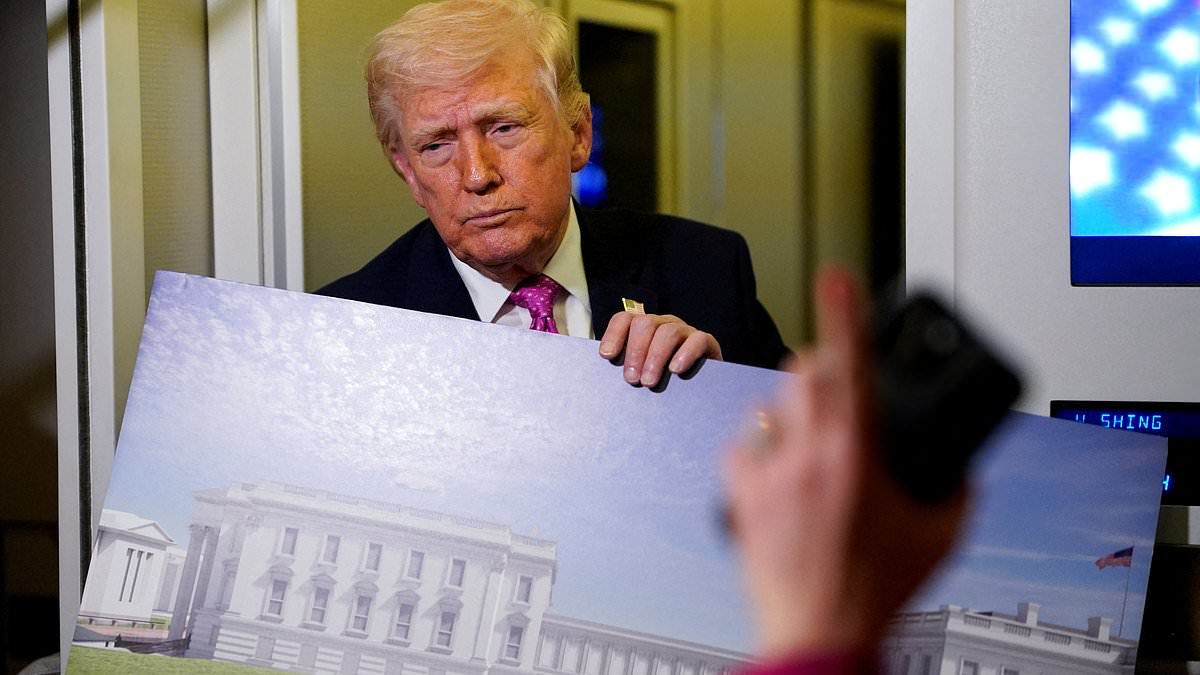
He said that Scharf and other White House staffers, James Blair and Stuart Levenbach, all Trump appointees to the NCPC, didn’t have the requisite experience to be in their positions. ‘If the three of them vote for this project, and those votes push this thing through. I think they make it very legally vulnerable to challenge,’ Golinger argued. Trump showed new designs for the ballroom – which showed that the controversial ‘stairs to nowhere’ had been removed – to reporters Sunday night aboard Air Force One. Golinger argued that this could create legal problems because it shows the design isn’t fully baked.

‘They didn’t present this new project with a legitimate, legally required notice for this meeting today. So I also would suggest that if they vote to approve a project that wasn’t actually calendared today, they’re putting themselves in legal jeopardy,’ Golinger said. Scharf appeared to give the group legal cover by having the NCPC vote on the amended design plans ahead of the final approval vote. All NCPC members voted in approval, with Mendelson voting present.