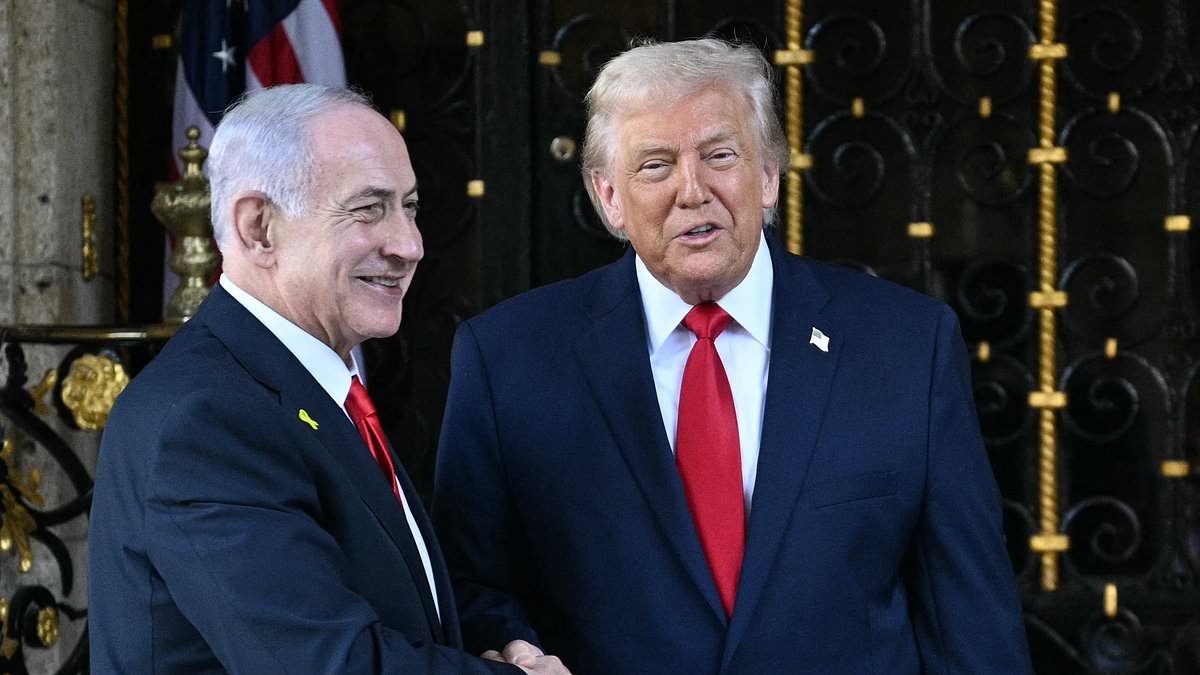

In the weeks leading up to Donald Trump’s decision to launch U.S. strikes on Iran in late February, his senior advisors were skeptical of a “ludicrous” briefing delivered by Israeli Prime Minister Benjamin Netanyahu.
Netanyahu, alongside key Israeli figures and Mossad Director David Barnea, showcased an audacious strategy aimed at destabilizing the Islamic Republic during a presentation to President Trump and his team in the Situation Room, as reported by the New York Times.
The February 11 meeting convened some of Trump’s closest advisors: Secretary of State Marco Rubio, CIA Director John Ratcliffe, Secretary of War Pete Hegseth, Chairman of the Joint Chiefs General Dan Caine, White House Chief of Staff Susie Wiles, and Trump’s son-in-law Jared Kushner, along with special envoy Steve Witkoff.
Within the confines of the White House Situation Room, Netanyahu and his delegation presented a comprehensive argument on why the timing was ripe for action against Iran.
Their proposal was clear-cut: with Iran’s key leaders gathered in one location, it was an unparalleled chance for a decisive strike. Trump seemed captivated by the idea, particularly after the success of previous strikes on the nation, as detailed in an excerpt from the upcoming book, “Regime Change: Inside the Imperial Presidency of Donald Trump.”
The outlined plan aimed to dismantle Iran’s ballistic missile capabilities, secure the Strait of Hormuz, and significantly limit Tehran’s ability to counterattack against the U.S. or its allies.
The Israelis went further, suggesting Kurdish fighters in Iraq could join the assault, that ordinary Iranians might rise up against the regime, and that the threat would only grow if left unchecked.
The following day, after US intelligence analysts reviewed the Israeli blueprint spanning four objectives: killing Supreme Leader Ayatollah Ali Khamenei; crippling Iran’s power projection; stoking a popular uprising; and triggering regime change – the verdict was pointed. Spooks were convinced by the first two aims. The final two, they were not.
Weeks before Trump approved strikes on Iran, Secretary of State Marco Rubio and CIA Director John Ratcliffe poured cold water on an Israeli plan stating that the offensive would bring about popular uprisings and regime change
CIA Director John Ratcliffe told the President and his advisers that the Israeli assessment that regime change and a subsequent uprising were imminent after a US strike was ‘farcical’
‘In other words, it’s bullshit,’ Rubio added after the CIA director’s assessment
At a follow-up meeting on February 12, Ratcliffe and Rubio poured cold water on the plan, particularly the twin promises of regime change and a popular uprising, which the CIA director dismissed as ‘farcical.’
‘In other words, it’s bulls***,’ Rubio added.
According to the Times, US officials believed the first two objectives were achievable with American intelligence and military muscle – but concluded that Netanyahu’s third and fourth aims, including the prospect of a Kurdish ground invasion of Iran, were detached from reality.
JD Vance, absent from the February 11 meeting but present the following day, was equally sceptical that regime change would materialise.
Trump then turned to General Caine. ‘What do you think?’
‘Sir, this is, in my experience, standard operating procedure for the Israelis,’ Caine replied. ‘They oversell, and their plans are not always well-developed. They know they need us, and that’s why they’re hard-selling.’
Faced with the verdict that the Israeli plan had serious holes, Trump told the room that regime change would be ‘their problem’ – though it remained unclear precisely who the President had in mind.
Many of Trump’s advisers distrust Netanyahu, according to the New York Times report
Joint Chiefs Chairman General Dan Caine noted how Netanyahu was ‘hard-selling’ his presentations to the President

Smoke rises from the site of a US-Israeli strike on the Iranian capital Tehran on April 7, 2026
Though many of Trump’s advisers ‘distrusted’ Netanyahu, the President was keen on taking out the Ayatollah and limiting Iran’s ability to project power regionally and through its many proxies, like Hamas, Hezbollah and the Houthis, the report states.
No one did more to talk Trump out of the planned strikes than Vance.
But weeks later, just days before the President green-lit US strikes on Iran in conjunction with Israel, Trump’s advisers deferred to the commander-in-chief’s judgement.
‘If we just mean killing the supreme leader, we can probably do that,’ Ratcliffe reportedly told the President.
Rubio noted he didn’t think that regime change or a popular uprising were in the cards.
But that didn’t prompt Trump to change course.
‘I think we need to do it,’ the 79-year-old told the room.
The following day, Trump approved the strikes on Iran.
‘Operation Epic Fury is approved. No aborts. Good luck,’ the President told Caine.


