
Share this @internewscast.com
President Donald Trump’s NASA administrator is eagerly anticipating a return to the moon, in part to showcase America’s enduring capability to achieve such a monumental feat.
“We owe it to every pioneer from the 1960s and to all the astronauts to demonstrate that their achievements were just the beginning of an incredible journey, not the conclusion,” said NASA Administrator Jared Isaacman in an exclusive interview at NASA’s Kennedy Space Center in Florida.
Isaacman, who is an entrepreneur and pilot with a deep-seated passion for space exploration, has participated in two SpaceX missions, including the groundbreaking all-civilian mission in 2021.
While acknowledging that some Americans still believe the Apollo moon landings were a hoax, Isaacman firmly asserted his confidence in the truth, given his privileged access as NASA’s chief.
“I literally have access to all the materials, the boots worn on the moon, and I’ve seen the Apollo 11 command module. I’ve spoken to the astronauts, the true heroes who accomplished this. There’s no question about it,” he stated.
The persistence of moon landing conspiracy theories has long frustrated those involved in the Apollo missions. Notably, in 2002, astronaut Buzz Aldrin famously punched conspiracy theorist Bart Sibrel in the jaw outside a Beverly Hills hotel after being harassed about the legitimacy of his lunar achievements.
Isaacman pointed to America’s reluctance to build upon the moon missions as probably to blame for more people questioning the authenticity of the mission.
‘I don’t blame people. Hey, it’s been a long time, more than a half century, like, why is it so hard to get back?’ he asked. ‘Well, we owe them that outcome.’
What NASA accomplished in the 1960s with the moon landing, he said, was ‘near impossible’ but recalled that it rallied the entire nation in the space race with Russia.

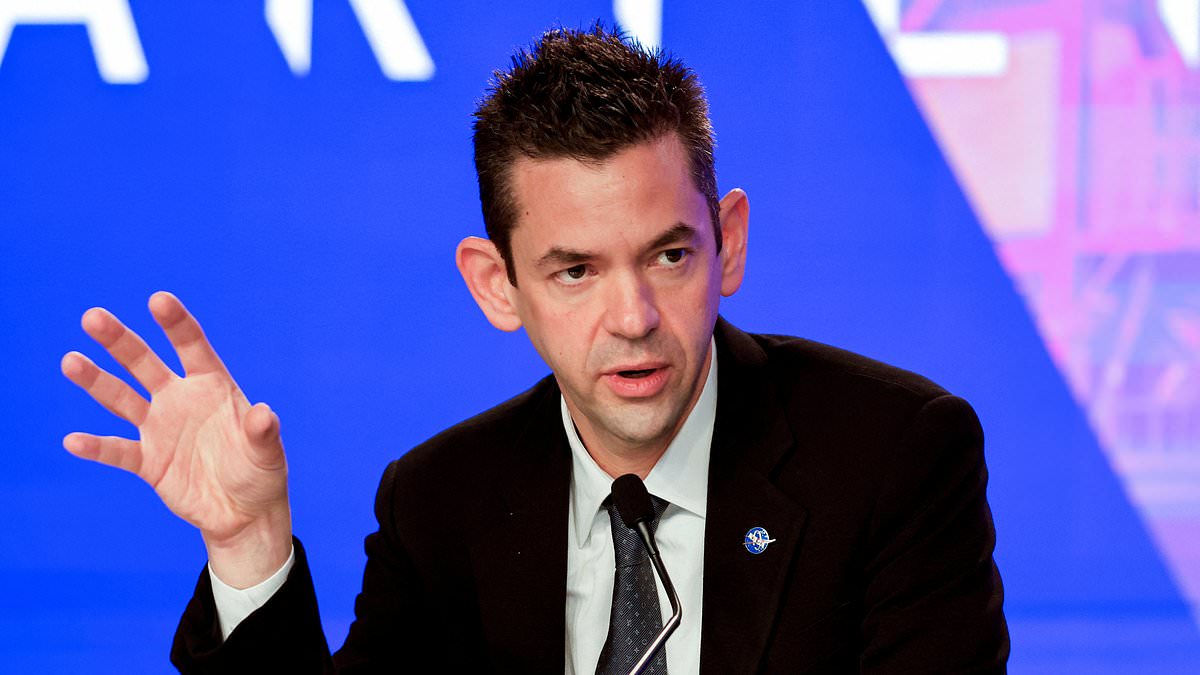
NASA Administrator Jared Isaacman speaks about the Artemis program

Mobile launcher 1 containing the massive Artemis II Space Launch System (SLS) rocket and Orion spacecraft
‘This is what America does, and it’s and we do it at our best when we’re up against a great competitor,’ he said.
Isaacman said that Trump was emphatic about pushing past the Apollo missions with the launch of the Artemis program that is scheduled to return humans to the moon by 2028.
‘Don’t just go back to the moon to plant the flag and bring back rocks,’ he said, detailing the mission to build a moon base and pursue ‘big, bold endeavors’ in space.
NASA’s Artemis II mission, scheduled to launch in April, will take four astronauts further into space than any other mission on a ten-day voyage around the moon and back to Earth.
arth.
‘It’s going to be the most demanding, most important human space flight mission in a half century,’ he said.
Isaacman said there was ‘no question’ that the United States was in a new space race with China.
China, he said, had a ‘very robust’ space program that should not be underestimated.
‘They don’t have what I would describe even, you know, a lot of the baggage right now,’ he said. ‘They are starting their program from scratch, and they’re resourcing it. They have the expertise and the will, and they are pursuing those goals.’
He acknowledged there had been setbacks with the Space Launch System (SLS) rocket powering the Artemis program as it was using a lot of heritage equipment that was ‘really old.’

NASA’s Artemis II Space Launch System (SLS) rocket with the Orion spacecraft is rolled back from pad 39B to the Vehicle Assembly Building

NASA Administrator Jared Isaacman stands with the Artemis II crew
The Artemis II mission has already been delayed for problems with the helium flow issues and hydrogen leaks, but Isaacman said it was no surprise that the equipment would need upgrading since it hadn’t been launched since 2022.
In February, Isaacman announced a major overhaul of the Artemis program, including an increase of launch cadence of the SLS. The result, he promised, would be two manned missions to the moon in 2028.
‘The challenges we’ve had up to now should absolutely have been expected. When you consider the history of the program, what matters most is that we’re going to do things differently,’ he said. ‘The status quo is unacceptable.’
NASA’s mission to return to the moon, he said, was the goal of the space program for over 30 years and the cost of the program had surpassed $100 billion.
‘You come up short. That sends a message to the world,’ he said.
Isaacman credited President Trump for lighting a fire under NASA’s mission, by passing significant funding for the program and getting everyone in Congress focused on the task at hand.
‘This is a president who appreciates space very much. He’s given us the mandate. He’s given us the funding … you combine that with the appropriations from Congress, we got all the ingredients to go out and change the world in air and space,’ he said.