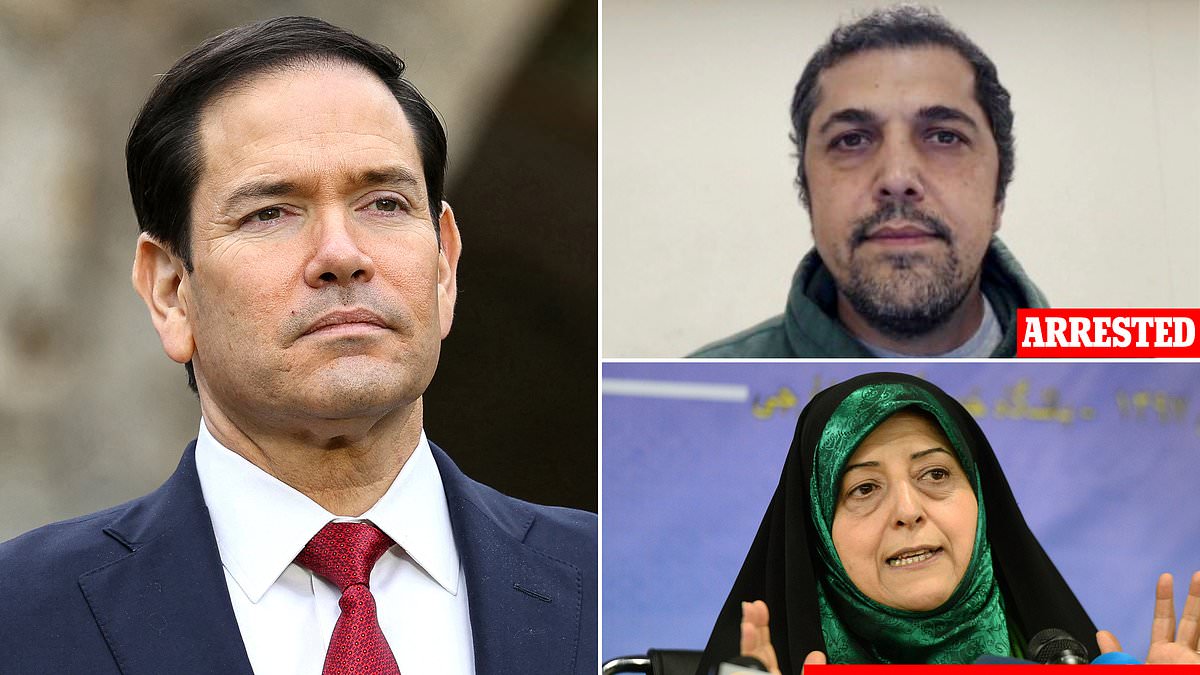

In a significant development, federal agents in Los Angeles have apprehended three Iranian nationals following an explicit directive from Secretary of State Marco Rubio. The order called for the termination of their legal residency in the United States.
Among those arrested was Seyed Eissa Hashemi, a notable figure due to his lineage as the son of one of Iran’s most infamous regime leaders. Hashemi had been residing in Southern California, leading a luxurious life that drew public ire and incited widespread demands for his expulsion from the country.
Hashemi, along with his wife Maryam Tahmasebi and their son, faced the revocation of their green cards. Currently, they are under the custody of U.S. Immigration and Customs Enforcement and await formal deportation proceedings.
The controversy surrounding Hashemi’s presence in the U.S. is underscored by the sentiments expressed by many Americans and Iranians alike. One petitioner poignantly remarked that while Hashemi’s mother, Masoumeh Ebtekar, remains unrepentant about her role in the 1979 U.S. Embassy takeover in Tehran, her son has benefited from the privileges of life in America.
The focus of this enforcement action, Eissa Hashemi, is deeply tied to a historical episode that left a lasting impact on U.S.-Iran relations. His mother, Masoumeh Ebtekar, also known as ‘Screaming Mary,’ became internationally notorious as the spokeswoman for the militants who seized the U.S. Embassy in Tehran, holding 52 Americans hostage for 444 days.
Ebtekar gained international notoriety as the ‘infamous spokeswoman for the Islamist militants who stormed the US Embassy in Tehran in 1979 and held 52 Americans hostage for 444 days.’
During the crisis, she served as the face of the regime’s propaganda machine, often arranging interviews that were staged with American hostages pushed to explain their treatment in a positive way, instead of telling the truth about their harsh treatment.
‘They were being held in solitary confinement, blindfolded and starved, and subjected to physical and psychological terror,’ the state department explains.
Eissa Seyed Hashemi is the son of Masoumeh Ebtekar, an Iranian regime politician who also acted as a spokesperson during the Iran hostage crisis of 1979
Iranian vice president for women’s and family affairs, Masoumeh Ebtekar, holds a media conference in Tehran, Iran on January 29, 2019. Ebtekar gained international notoriety as the ‘infamous spokeswoman for the Islamist militants who stormed the US Embassy in Tehran in 1979 and held 52 Americans hostage for 444 days’
Ebtekar later rose to the highest levels of the revolutionary government, serving as a vice president of Iran as recently as 2021.
Hashemi had reportedly been enjoying an affluent lifestyle in Southern California for years
The family’s presence in the US has become a point of intense political and public scrutiny, particularly regarding how they secured residency.
Records indicate that Hashemi and his family entered the country in 2014. By June 2016, they were granted green cards through the Diversity Immigrant Visa Program – a move that occurred just months after the IRGC sparked an international incident by seizing two US Navy vessels and capturing 10 American sailors.
Under the current administration, the issuance of these diversity visas has been suspended, and officials are now actively reversing prior approvals for those linked to hostile foreign entities.
This operation follows a string of similar high-profile removals targeting the relatives of Iran’s inner circle.
From chugging bottles of champagne and lounging in designer clothing to partying at luxury Las Vegas resorts, the niece of the late Iranian military commander Qassem Soleimani also lived a lavish lifestyle in the United States.
But Hamideh Soleimani Afshar, 47, and her daughter Sarinasadat Hosseiny, 25, are now facing deportation after Immigration and Customs Enforcement (ICE) officers detained them in Los Angeles.
Sarinasadat Hosseiny, 25, lounging by a pool in a black bikini
Afshar, 47, wearing a Louis Vuitton hoodie with a gold watch and jewelry
Afhsar’s home in Tujunga, Los Angeles. She bought the property for $505,000 in 2021 and it is now worth $740,000
Instagram posts show Hosseiny clubbing in Miami, vacationing in Alaska and partying in Las Vegas
Both women are related to Iranian general Qasem Soleimani, who was killed by a US drone strike at Baghdad Airport in January 2020
The women have also had their green cards revoked after US Secretary of State Marco Rubio accused Afshar of celebrating the deaths of American soldiers during President Donald Trump’s ongoing war with Iran.
The mother and daughter documented their glitzy lives on their now-deleted social media, posting enviable snaps of opulent holidays, expensive cars and stylish parties.
Afshar, who originally entered the US in June 2015 on a tourist visa, would often publish pictures of herself decked out in gold jewellery, dispatching from helicopters in the desert, and relaxing in Louis Vuitton clothes.
Her daughter, who came to the US with her mother on a student visa, appeared in snaps relaxing on a sun lounger by a pool in a black bikini, showing off her tattoos, and posing on a bed in a halter-neck party dress, next to a bottle of rosé.
Both enjoy donning outfits deemed illegal in Tehran, where women face arrest, beating, and even rape in custody for disobeying the strict dress code enforced by the Islamic regime, which includes the compulsory hijab.
Afshar is the niece of the slain Qasem Soleimani, one of Iran’s most powerful military figures who was the commander of the lethal Quds force and the architect of the regime’s terror activities throughout the Middle East.
Soleimani was killed by a US Reaper drone strike ordered by President Trump at Baghdad airport in January 2020.
Before his death, he was seen as the country’s most influential commander, second only to the late Supreme Leader Ayatollah Khamenei.
Afshar riding in a blue Hummer. She and her daughter lived in Los Angeles before their arrest
Afshar’s daughter, Hosseiny, was originally let into the country under a student visa in 2015

Hamideh Soleimani Afshar, above, and her daughter have both been arrested by Immigration and Customs Enforcement in LA and had their green cards revoked
After joining the Islamic Revolutionary Guards Corps in his early 20s, the hardliner eventually became responsible for hundreds of American deaths in Iraq and waves of militia attacks against Israel.
Earlier this month, Rubio terminated the legal status of Fatemeh Ardeshir-Larijani, the daughter of veteran Iranian politician Ali Larijani, and her husband, Seyed Kalantar Motamedi.
Ardeshir-Larijani and Motamedi are no longer in the United States and are barred from entry, according to the State Department.
Ali Larijani, an architect of Iran’s security policy, was killed in mid-March by a US-Israeli air attack.
In his second term in office, Trump’s administration has stepped up deportation efforts against immigrants, calling them threats.