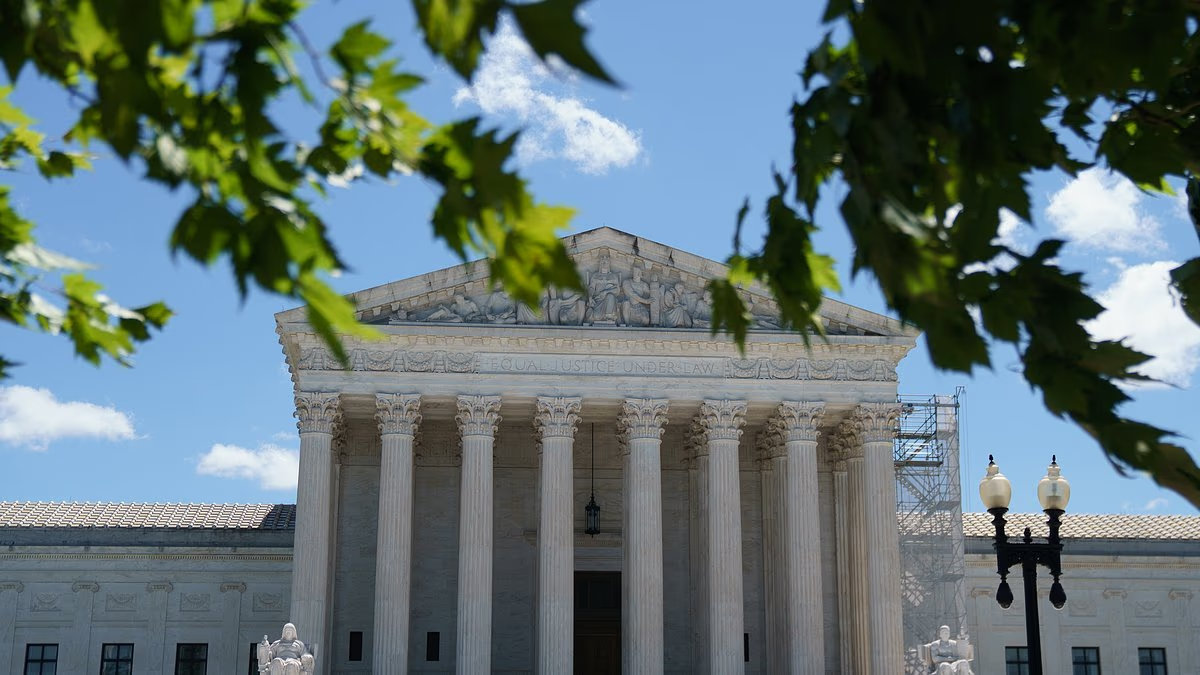

The Supreme Court ruled Monday that states may keep tallying mail-in ballots that are sent by Election Day and arrive within the following five days, handing President Donald Trump a major setback on an issue he has repeatedly targeted.
In a 5-4 decision, the justices left intact state election rules that allow those late-arriving absentee ballots to be counted. Republicans had contended the laws clashed with federal election statutes.
‘The federal election-day statutes do not prevent Mississippi from counting absentee ballots postmarked by election day but received up to five days thereafter; nothing in the federal election-day statutes requires ballots to be received by election day,’ Justice Amy Coney Barrett said in the majority opinion.
The decision quickly drew criticism from conservatives.
‘Yuck. Terrible decision,’ wrote Will Chamberlain, senior counsel for the Article 3 Project. ‘ACB and Roberts joining the libs.’
Chamberlain was referring to Barrett, a Trump appointee, and Chief Justice John Roberts.
The two conservative justices sided with the court’s three liberal members to protect rules permitting late-arriving mail ballots in states such as California.
Mail-in voting has remained a central grievance for Trump, who has repeatedly blamed absentee ballots for his 2020 loss to Joe Biden.

The Supreme Court on Monday ruled that states can continue counting mail-in ballots sent by, and received within, five days of Election Day

President Donald Trump previously pledged to lead a ‘movement to get rid of mail-in ballots’
He repeatedly harped on this claim despite studies showing minuscule amounts of fraud occur with mail-in voting.
Nonetheless, Trump pledged to lead a ‘movement to get rid of mail-in ballots’ and even signed a sweeping executive order earlier this year directing the government to create a list of ‘approved’ mail voters.
A federal judge struck down that order.
In her opinion, Barrett argued that the Constitution purposefully left election rules flexible, knowing the country would change over time. With an election day was written into law, the ‘election day statutes say nothing about ballot receipt,’ she wrote.
‘We cannot add to the words Congress chose,’ Barrett continued.
Justices in March heard roughly two hours of oral arguments in the case, Watson v Republican National Committee, centered on a 2024 lawsuit brought against Mississippi’s state law that allows for the counting of mail-in ballots received up to five days after the election, so long as they are postmarked by or before Election Day.

Justice Amy Coney Barrett, left, shares a private moment with Ketanji Brown Jackson

An election worker processes ballots during California’s primary election in June
Mississippi is one of 14 states, as well as the District of Columbia and three US territories, that currently allow for the counting of late-arriving mail-in ballots, so long as the ballots are postmarked by or before Election Day.
The issue had pitted the Republican National Committee against Democrats and the Democratic National Committee, which filed an amicus brief earlier this year supporting the late-arriving mail-in ballots.
In their brief, lawyers for the DNC emphasized the widespread use of mail-in ballots by many voters, including seniors, voters with disabilities and members of the military.
‘Throughout this Nation’s history, the term ‘election’ has been universally understood to refer to the voters’ act of choosing an officeholder – not to the later administrative acts of receiving or counting ballots,’ the DNC said in its amicus brief.
‘Today, democracy prevailed. The DNC is proud to have stood with the State of Mississippi to defeat the RNC’s latest attack on Americans’ voting rights.
‘The RNC’s lawsuit attempted to rip away democratically enacted safeguards for millions, including US service members,’ DNC chairman Ken Martin said.
Republican Party officials had argued the effort was aimed at better protecting election security and voter confidence — a view seemingly shared by at least some of the conservative justices on the Supreme Court.
Justice Samuel Alito cited concerns that ‘confidence in election outcomes can be seriously undermined’ when results of elections are delayed. Justice Brett Kavanaugh echoed this, noting that ‘if the apparent winner the morning after the election ends up losing due to late arriving ballots, charges of a rigged election could explode.’
‘Watson v. RNC is about a simple principle: ballots must be received by Election Day,’ Ally Triolo, the communications director for the RNC’s Election Integrity efforts, said before oral arguments kicked off in the case. ‘This prevents elections from dragging on for days and weeks after voters have cast their ballots, causing confusion and undermining our elections.’
The ruling comes amid a long-standing legal tug-of-war over how much control states should have over their voting regulations, including in elections involving both federal and local candidates.
Trump, for his part, took to social media to pressure lawmakers to support the the Safeguard American Voter Eligibility (SAVE) Act, or his signature election security bill, that would establish new voter identification requirements, has struggled to gain the support needed to clear the Senate.
“In light of the tremendous loss in the Supreme Court today concerning Voter’s Rights, and the fact that ‘people’s’ votes are allowed to be counted LONG AFTER an Election is over, it is more important than ever to pass THE SAVE AMERICA ACT,” Trump said on Truth Social.